
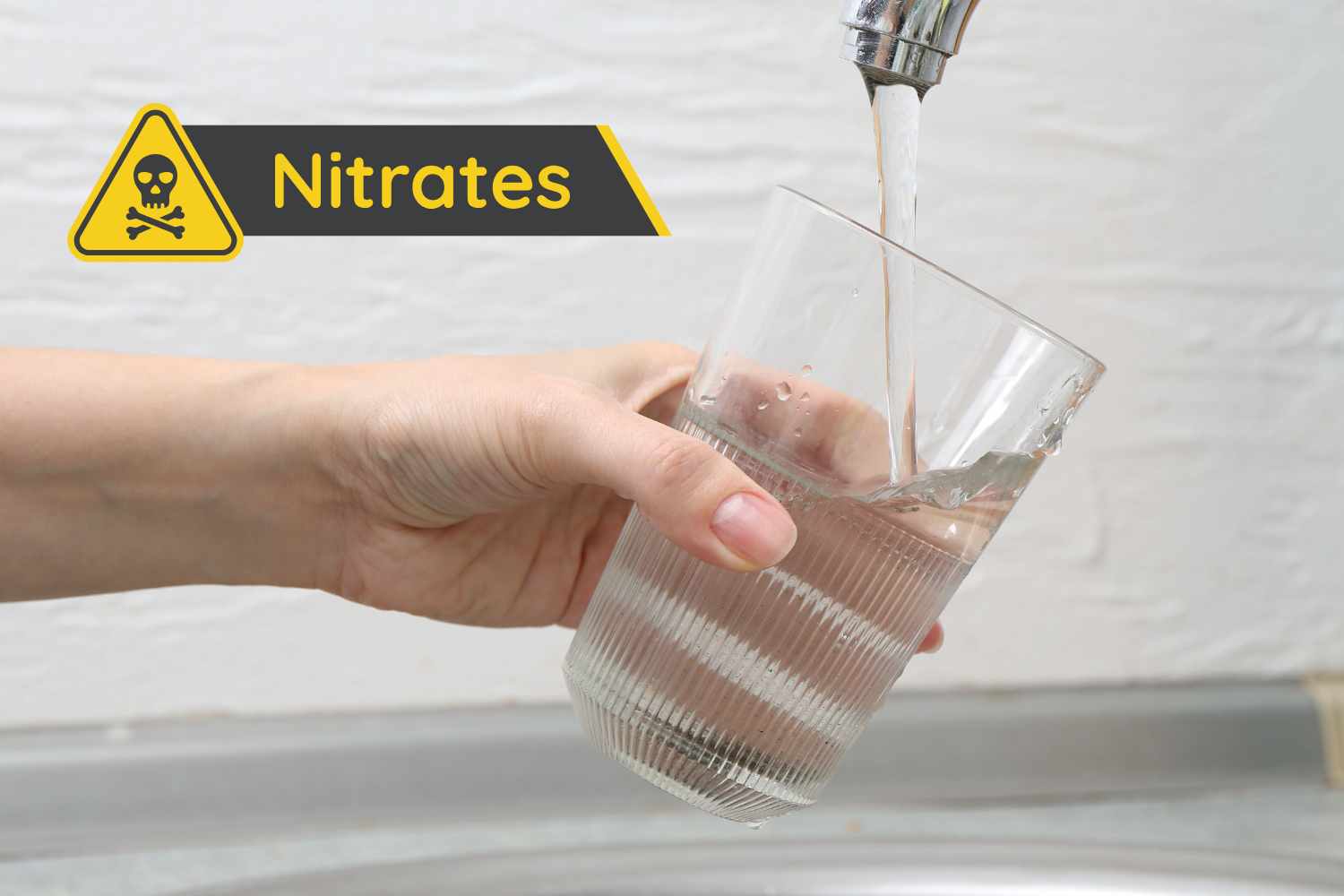
Is the current limit of 50 milligrams of nitrates per liter of water really enough to protect us? According to more than 80 international organizations involved in protecting health, the environment and food systems, the time has come to re-examine it.
On the occasion of World One Health Day today 3 November, Greenpeace International, the International Panel of Experts on Sustainable Food Systems (IPES-Food), the World Organization of Family Doctors (WONCA) and numerous other organizations have sent an open letter to the WHO calling for an urgent review of international guidelines on the quality of drinking water.
The reason? Studies published in recent years have identified associations between prolonged exposure to nitrates, even at concentrations lower than current limits, and a greater risk of colorectal cancer, adverse pregnancy outcomes and possible alterations in thyroid function.
Because nitrates in drinking water can be dangerous
Nitrates are nitrogen compounds naturally present in the environment. The problem arises when their concentrations increase due to human activities, especially due to the excessive use of nitrogen fertilizers and the management of effluents from intensive farming. Through the soil, these compounds can reach groundwater and contaminate resources used to produce drinking water.
The current WHO guideline value of 50 mg/L nitrate (NO₃⁻) is derived from a setting originally developed to prevent childhood methemoglobinemia, also known as blue baby syndrome. This is a potentially serious condition in which the blood loses some of its ability to carry oxygen, which is particularly dangerous in newborns.
That limit was maintained in subsequent international guidelines and is also provided for by European and Italian legislation on water intended for human consumption. But the question raised today by the organizations mainly concerns the effects of chronic exposure to lower concentrations: water compliant with 50 mg/L is not automatically free of any health risk related to nitrates, because the guideline value was not specifically developed to prevent all possible long-term effects currently being researched.
However, it should be noted that epidemiological studies identify statistical associations and do not demonstrate, in themselves, a direct cause-effect relationship for each of the pathologies considered.
The studies
One of the most significant research was conducted in Denmark and published in 2018 in the International Journal of Cancer.
The study, based on a large population cohort, found an association between exposure to nitrates in drinking water and an increased risk of colorectal cancer, even at levels well below the 50 mg/L limit.
Another systematic review with meta-analysis published in 2022 examined the available evidence on the relationship between nitrates, nitrites in drinking water and oncological risk. Concerns also concern reproductive health. A review published in Scientific Reports in 2023 analyzed studies on possible links between nitrate exposure and adverse pregnancy and birth outcomes.
These are results that require further investigation, but which, according to the international coalition, justify the adoption of a more precautionary approach.
Denmark wants to lower the limit
While calls are being made internationally for a revision of the guidelines, in Denmark, an international group of experts commissioned by the government has already recommended reducing the limit for nitrates in drinking water from 50 to 6 mg/L in 2025, a threshold more than eight times lower than the current one.
The Danish government has thus committed to proceeding towards a revision of the limit, but the new threshold has not yet entered into force. It therefore does not mean that water with concentrations higher than 6 mg/L is automatically dangerous or to be considered undrinkable according to current legislation.
The Danish Ministry of the Environment itself has specified that exceeding the recommended value does not in itself entail an acute health risk. However, the Danish choice represents an important precedent: it could push other European countries to reevaluate their safety standards.
How we are in Italy
The issue also closely concerns Italy, especially the areas characterized by a high concentration of agricultural and livestock activities. This is the case of the Po Valley, where the presence of intensive farming and the use of nitrogen fertilizers exert significant pressure on water resources.
Water must give life, not threaten it. We cannot protect human health without protecting rivers and aquifers, declares Simona Savini, head of Greenpeace Italia’s Agriculture campaign.
The association reports that in recent months it has collected testimonies from residents and conducted pilot tests on drinking water in some communities in the Po Valley.
For Greenpeace, the problem cannot be addressed only through controls on distributed water, but requires interventions on the main sources of contamination.
A particularly delicate aspect concerns the timing of pollution: nitrates from fertilizers and livestock waste can take years and, in certain conditions, even decades, before reaching the groundwater. This means that the effects of today’s agricultural activities may continue to manifest themselves long after measures to reduce pollution are introduced.
The climate crisis contributes to making the situation even more complex: prolonged droughts and water shortages can favor the concentration of pollutants in water resources, increasing difficulties especially for rural communities that depend on groundwater.
Therefore, the question is not only to establish how many nitrates may be present in the water we drink, but to prevent them from continuing to accumulate in the aquifers. Ensuring safe drinking water also means intervening on what happens long before that water reaches our taps: in the fields, on the farms and in the territories from which it comes.
