
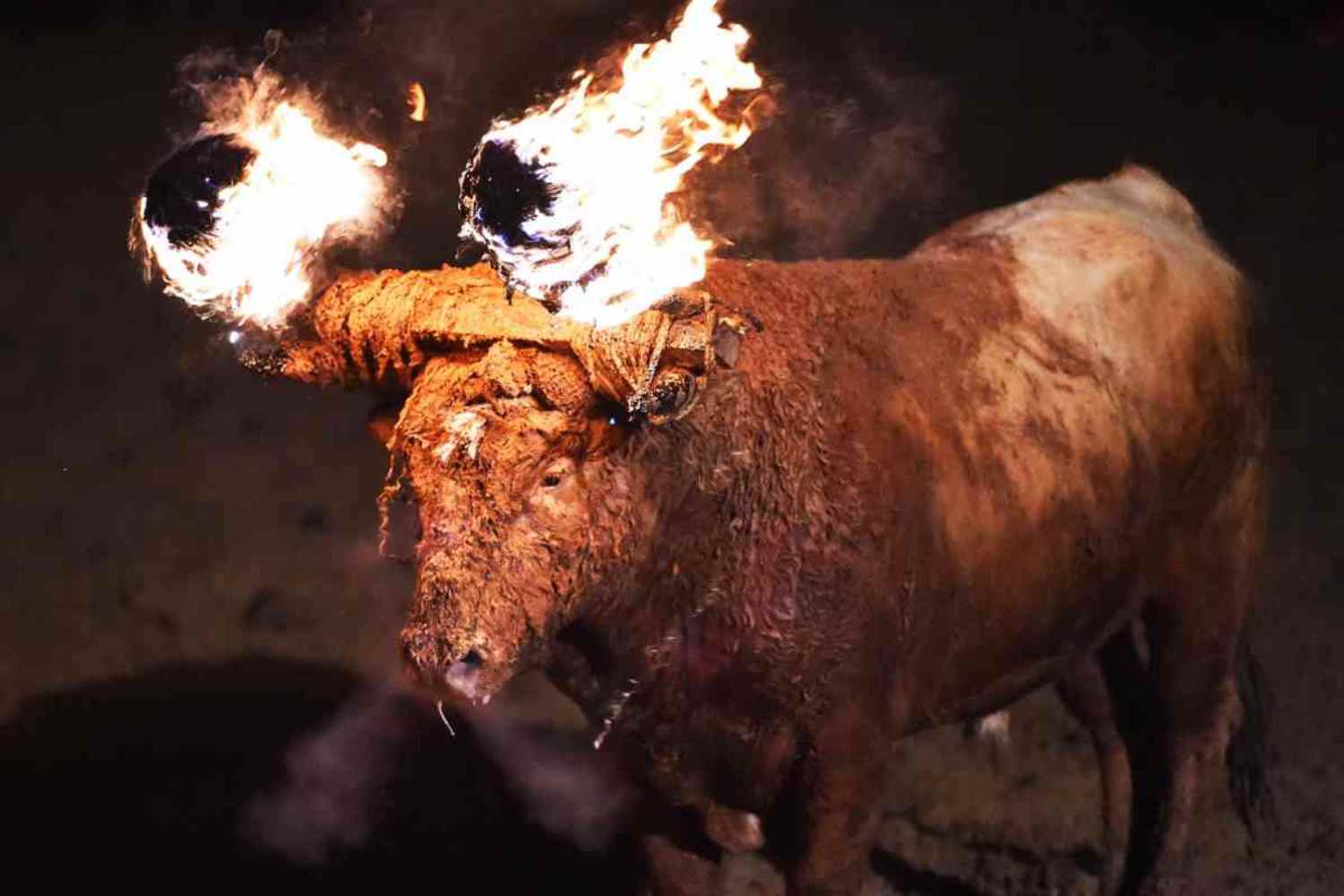
In a square lit by torches and surrounded by hundreds of spectators, a terrified bull runs with no escape route. On his horns he carries a wooden structure with lit flammable materials, while the crowd watches and cheers. It is the Toro Jubilo, one of Spain’s most controversial traditions.
The ritual takes place every year in Medinaceli, a small municipality in the Castile and León region. Here the bull is led to the center of an improvised arena set up in the town square. A circle of people forms around the animal, while the preparations slowly transform the scene into a spectacle that deeply divides public opinion. For some it is a centuries-old tradition, but in reality it is an event that today appears increasingly difficult to justify.
If the beginning of this video is expansive, the ending (you can watch it…) is desolating. And a separate mention about the audio, which is basically interesting. #ToroJubilo #Medinaceli #LaBarbarie #LaInvolución #LaCobardia #LaVergüenza #ElHorror https://t.co/NMVMnun68W pic.twitter.com/Nx2CsaqLny
— Patri Sparrow (@PatriSparrow) November 13, 2022
The fire ritual
The central moment of the celebration comes when a wooden support tied to the horns is fixed on the bull’s head. At the ends are applied materials impregnated with pitch and cotton, intended to burn for a long time. When the torches are lit, the flames envelop the animal’s horns. At that point the bull, frightened and disoriented, begins to move frantically in the arena, surrounded by the public.
According to the organizers, the animal’s body is covered in mud to protect it from the heat. However, for many animal rights associations this explanation is not enough to erase the evident suffering of the bull. The ritual lasts several minutes and takes place amidst applause, shouts and fireworks, as the animal repeatedly tries to free itself from the flames burning above its head.
The battle of animal rights activists
In recent years the Jubilo Bull has become the symbol of an increasingly intense battle between defenders of bullfighting traditions and animal rights movements. The PACMA Animal Rights Party has presented a dossier of over 50 pages to contest the plan to declare the festival an asset of cultural interest.
According to animal rights activists, recognition would be a political and electoral choice, rather than a cultural one. The document also claims that there is no concrete historical evidence that demonstrates with certainty the ancient origin of the celebration, often described as a tradition of over two centuries. PACMA also claims that the event does not have a solid legal basis and continues to take the matter to the Spanish courts.
PACMA @PartidoPACMA has classified as “disproportionate” the information in which “it is necessary to confirm that the #bull no sufre because it #sufrimiento it is exclusive to human beings”
Toro Jubilo de Medinaceli como Bien de Interés Cultural #BIC https://t.co/Gqk1awhnYM
— EcoAvant.com (@EcoAvant) March 6, 2026
An immense cruelty disguised as tradition
The debate around the Jubilo Bull reflects a broader fracture that runs through Spanish society. On the one hand there are those who defend the value of popular traditions, considered part of the cultural identity of the area. On the other hand, an increasingly broad movement is growing that denounces the animal suffering linked to many bullfighting events.
In the meantime, the celebration continues to take place every year, attracting onlookers, tourists and protesters. And while the flames flare up again in the Medinaceli square, the question remains suspended in the air: how long can we justify cruelty of this type towards animals as a simple tradition?
You might also be interested in:
