
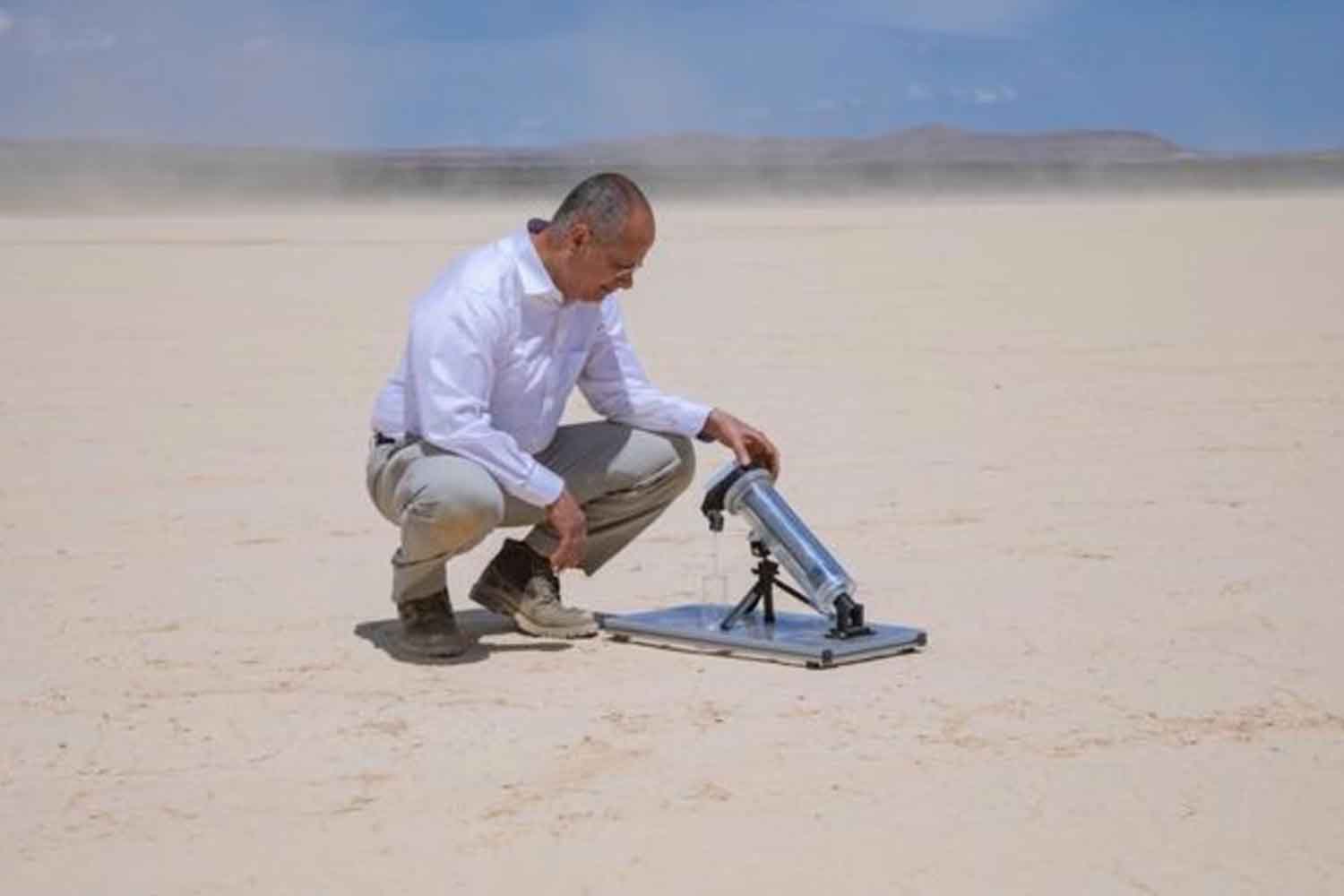
The water crisis is no longer a distant threat relegated to the reports of international organizations. It is a concrete reality that already affects billions of people and which, according to many scientists, risks becoming one of the great global emergencies of the coming decades. In a planet where temperatures are rising and droughts are intensifying, scientific research is trying to change perspective: instead of looking for water further and further away, we are learning to produce it directly from the air we breathe.
One of the most surprising innovations comes from a technology capable of extracting water from the desert air thanks to solar energy and ultra-porous materials. A system which, in the most advanced versions, could produce up to 1,000 liters of water per day, opening up completely new scenarios for the driest regions of the planet.
How the technology that captures water from desert air works
To understand this innovation we need to start from a detail that we often forget: even in the driest places on Earth the air always contains a certain quantity of water vapour. The difficulty lies in being able to capture it and transform it into liquid water.
This is where Metal-Organic Frameworks (MOFs) come into play, advanced materials designed to trap molecules like real microscopic sponges. Their structure is made up of a three-dimensional network of tiny cavities, so dense as to create an enormous internal surface. Just one gram of MOF can provide an area equivalent to several football pitches.
This feature makes MOFs incredibly effective at retaining moisture in the atmosphere, even when humidity levels are very low. In fact, some prototypes even work with humidity around 20% or even lower, conditions typical of desert regions.
The process is surprisingly simple. During the cooler hours the material absorbs water vapor from the air. When the sun heats the device, the heat causes the water trapped in the pores of the material to be released. The released vapor is then cooled and condensed, turning into liquid water ready to be collected.
This technology belongs to the family of Atmospheric Water Harvesting systems, solutions designed to recover water directly from the atmosphere without resorting to rivers, aquifers or traditional water infrastructures.
Solar energy and drinkable water even in the most isolated places
One of the most fascinating elements of this technology concerns how it is powered. Many existing atmospheric water generators operate through cooling systems that consume large amounts of electricity. The MOF-based device, however, uses solar energy to activate the water release cycle. This means that it can also work completely off-grid, without the need for energy infrastructure.
In practice, a system of this type could be installed in desert villages, rural communities or isolated areas where access to drinking water still represents one of the main daily difficulties. The combination of renewable energy and harvesting water from the air makes this solution particularly interesting to address the growing global water crisis.
Before imagining large-scale applications, the technology was tested in extreme environments. Some experiments were conducted in Death Valley in the United States, one of the driest and hottest places in North America.
The first devices developed in laboratories were relatively small and produced limited quantities of water. Some experimental systems managed to generate around 285 grams of water per day, while more advanced setups achieved around 2.8 liters per kilogram of MOF material used.
Numbers that may seem modest, but which have demonstrated a fundamental principle: water can really be extracted from the air even in deserts.
The research did not stop at laboratory prototypes. More recent projects are working on much larger devices, designed to serve entire communities. Some experimental versions, about the size of a shipping container, could produce up to 1,000 liters of water a day. A quantity sufficient to guarantee water supply to small villages or isolated structures in desert areas.
The goal is to develop modular systems that can be easily installed and that work autonomously using only the sun’s energy. The real challenge now concerns the industrial production of MOF materials and cost reduction, fundamental steps to make this technology accessible on a large scale.
The research behind the materials that “capture” water
Among the protagonists of this innovation is the chemist Omar Yaghi, professor at the University of California at Berkeley and one of the pioneers of the so-called reticular chemistry, a discipline that earned him international scientific recognition and the Nobel Prize for Chemistry for his studies on reticular molecular structures.
His research has focused for years on the design of materials capable of capturing specific molecules from the air, such as water or carbon dioxide. The idea of applying MOFs to the production of drinking water also came from a personal experience: during his childhood in Jordan, Yaghi lived in a context where water was a rare and precious resource.
To bring this technology out of the laboratories and towards real applications, a startup called Atoco was also created, which works on the industrial production of MOFs and on the development of systems for the collection of atmospheric water.
A possible response to the global water crisis
Today, more than two billion people around the world live in regions where access to drinking water is limited or uncertain. Climate change, with increasingly frequent and intense droughts, risks further worsening this situation. Technologies such as the one based on MOFs show how scientific research can open up completely new avenues. Instead of transporting water hundreds of kilometers or building huge infrastructures, it becomes possible to produce water directly where it is needed.
The idea of transforming air humidity into drinkable water may seem almost like science fiction. Yet, thanks to advances in materials science and renewable energy, this perspective is slowly taking shape. If technology can overcome the challenges of cost and large-scale production, one day we may truly see a small revolution: desert villages capable of producing their own water simply from the sun and air.
You might also be interested in:
