
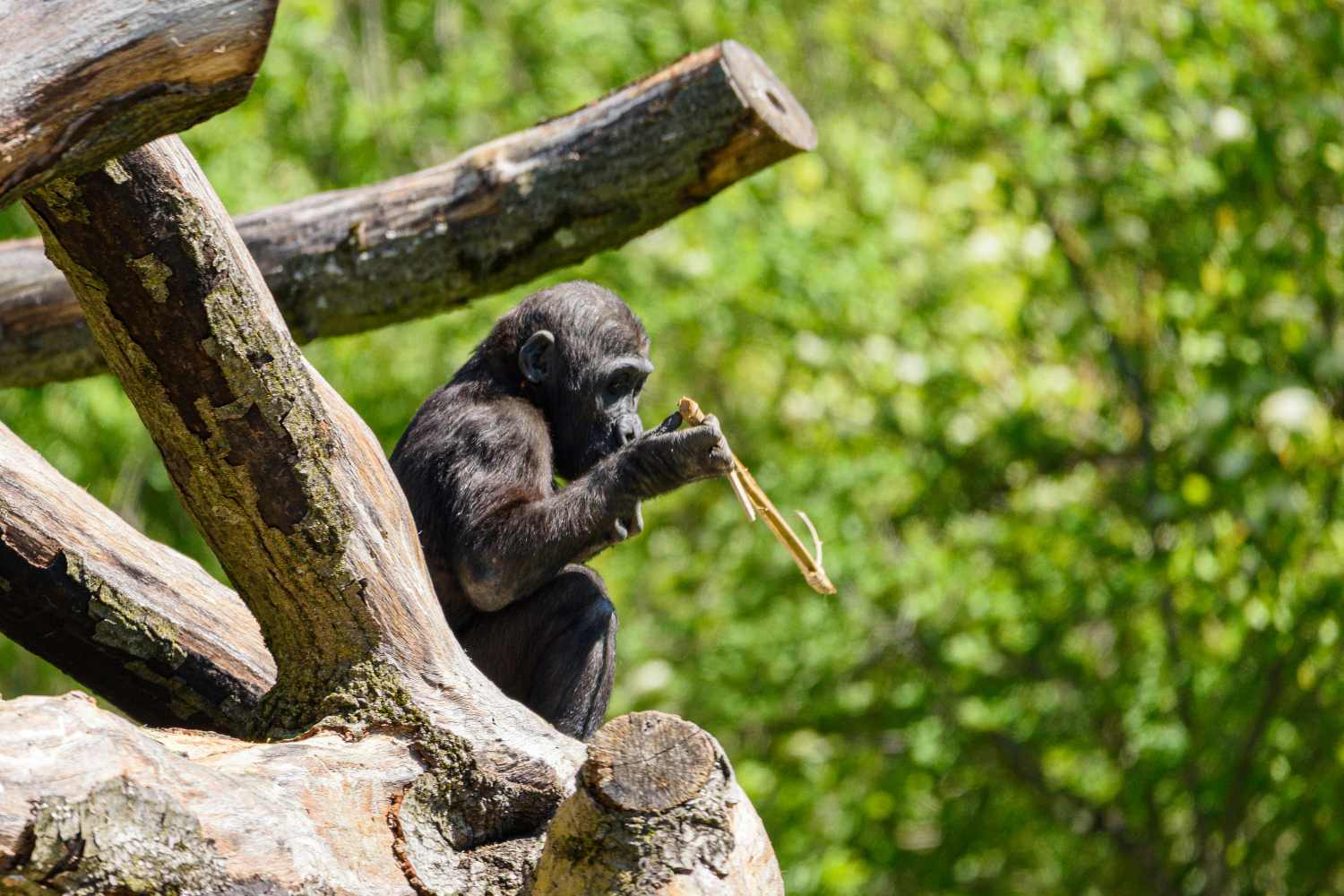
Adolescence is a time of experimentation and risk, not only for humans but also for chimpanzees. A study published in iScience by the University of Michigan team shows how young primates, once they reach puberty, begin to perform increasingly risky movements in trees, from controlled falls to jumps between branches at great heights.
The research focused on more than 100 chimpanzees in Kibale National Park, Uganda. The animals observed ranged in age from 2 to 65 years and the researchers recorded falls, jumps and risky steps. The results indicate that dangerous behavior is more frequent between late childhood and adolescence, while adults tend to avoid risks, showing a clear link between age and prudence.
It’s not the hormones’ fault
Contrary to what you might think, the increased risk is not linked to hormonal changes. The authors explain that it is the end of parental control that stimulates young chimpanzees: from two years onwards, when they are no longer constantly close to their mother, adolescents begin to explore the world with greater autonomy, facing calculated risks and, sometimes, accidents.
Locomotion in trees is essential for chimpanzee survival, but comes with dangers: jumping between branches or falling to the ground can cause serious injury or death. The researchers observed that young chimpanzees are more likely to attempt risky jumps, while with age the behavior becomes more cautious. This model reflects a kind of experiential learning, similar to that observed in humans, where risks decrease with increasing maturity.
The implications for the human species
The study offers interesting insights into understanding the relationship between parental supervision and risk in humans. In primates, reduced surveillance promotes risky behavior. In humans, the presence of parents and caregivers physically limits dangers and allows gradual independence. The analogy between chimpanzees and human adolescents suggests that risk-taking is a natural part of emancipation, useful for developing motor skills, strength and autonomy. The risk phase is not a flaw, but a moment of essential development: from the urban jungle to the tree branches, adolescents learn to evaluate challenges, balancing prudence and courage.
You might also be interested in:
