
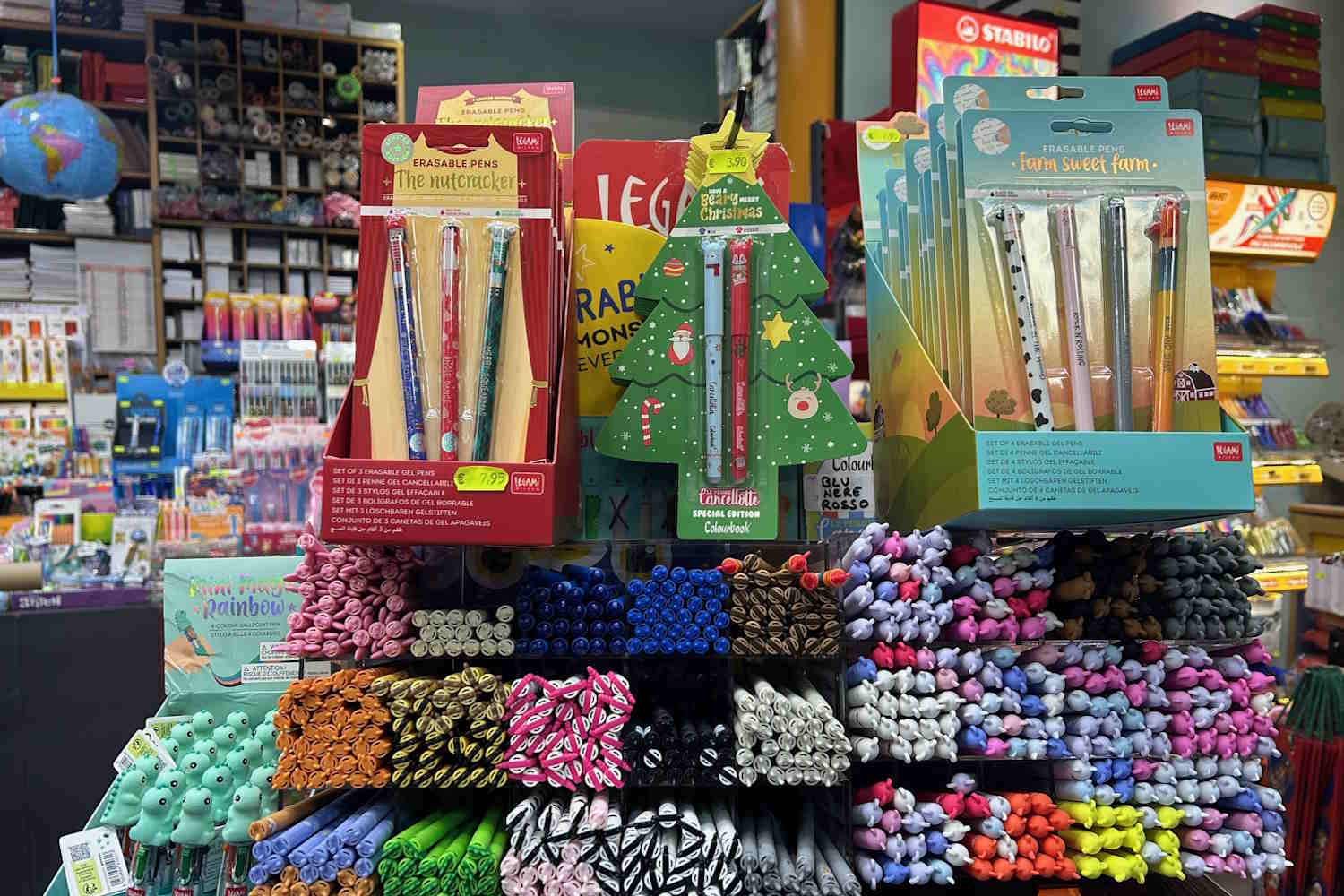
Avocado-shaped pens, cat-shaped erasers, stackable pencils with panda faces. Everything in the stationery shop has a face. And not a “face” thrown there at random, but well studied at a marketing level so that we can have the feeling that we – that super colorful stuff – cannot do without.
It is anthropomorphism that deceives us: we tend to feel empathy for objects with human or animal features, between sweet, half-closed eyes and smurfy crayon holders. This pushes us to buy them to “adopt” them, but also makes it psychologically more difficult to dispose of them correctly, leading to accumulation at home.
If on the one hand that cute aesthetic is dictated by a real commercial strategy, in fact, on the other for us and for the environment it is a double-edged sword: a pile of useless stuff and plastic that is difficult to dispose of.
Kawaii effect
Starting from unsuspecting times, with the mythical Hello Kittyup until the global success of Labubu, everything, every pink, furry, round or small-eyed object, refers to the Japanese concept of “kawaii”. And not only that, even in clothing and furniture, it’s all about Kawaiiwhich is not reduced to our simple “cute”, but is much much more.
The word kawaii it occupies a central place in Japanese culture and does not have a perfectly comparable translation in other languages. In English it is approached to skinbut its meaning is much broader: it applies to clothing, food, entertainment, physical traits, and describes something tender, fragile, childlike, or simply adorable. In short, kawaii is that positive sensation that arises from emotion and which in turn translates into an aesthetic made of tenderness and calm.
It is no coincidence that in Japan this visual language is also used in unexpected contexts: on construction sites to reduce tension, by airlines and even by police forces, with the aim of making their image more reassuring and accessible.
But what do we do with the pen that “speaks to us” and with the compulsive purchases that we are led to make?
When cute design makes us forget the environmental impact
The truth is that aesthetics kawaii — made extremely popular by brands such as Legami and Tiger — is changing our way of perceiving consumer objects, attenuating (if not completely erasing) the awareness of their environmental impact. If it’s “cute”, it also seems harmless. But is it really?
Avocado-shaped pens, panda highlighters, kitty erasers, notebooks with smiling faces. Everything has a face, an expression, a “personality”. The implicit message is powerful: you are not buying a disposable object, but something to keep, collect, almost look after.
The result? We consumers are led to lower our critical defenses, so much so that plastic, mixed materials, superfluous packaging fade into the background because the object appears playful, light, even “affectionate”. This is where a real green cognitive bias comes into play: what is aesthetically tender automatically seems less harmful to us.
The design kawaii it is not neutral. Adding eyes, smiles or animal shapes to an object activates a precise emotional mechanism: anthropomorphism. We tend to attribute human or animal characteristics to what visually recalls them, developing a form of empathy. So a pen is no longer just a pen, but “the one shaped like a cactus”. A tire is not waste, but “the kitten”. This pushes us to buy on impulse, because “it’s too pretty to leave there”, but it also makes it harder to part with it when it stops working.
From a psychological point of view, these objects are not purchased only for their function, but for the “emotional bond” they promise. It is a dynamic similar to that of collecting: we accumulate, we conserve, we postpone disposal. The paradox is evident: products that are often cheap, made of plastic and difficult to recycle end up staying in drawers for years or, worse, are thrown into the unsorted waste. The cute aesthetic, in short, hides waste under an emotional veneer.
The effect kawaii It’s not negative in itself, be careful! What remains certain is that design has always communicated emotions, and interior architects, for example, know this very well. The problem arises when tenderness becomes a strategy that anesthetizes in the true sense of the word critical thinking, pushing us to buy more and reflect less on materials, durability and end-of-life of the product.
If we really want to talk about sustainable consumption, we must learn to look beyond the eyes and ask ourselves: what is it made of? How long does it last? And where will it go when I no longer use it? Because an object can be adorable. But it still remains a potential refusal.
