
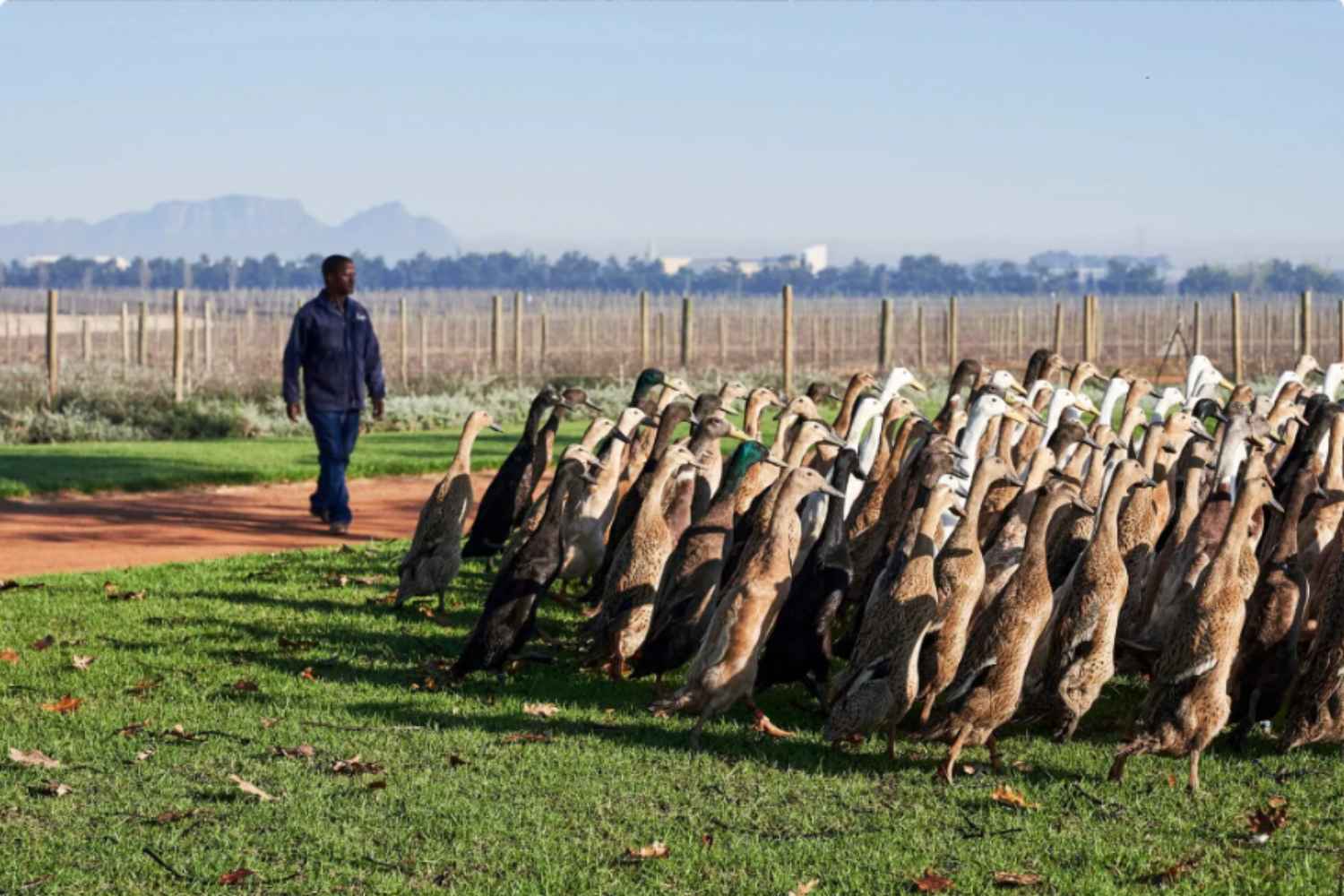
In the South African wine lands of the Stellenbosch region, near Cape Town, the defense of vines relies not on machinery or chemicals, but on the work of a most unusual regiment. Every morning and mid-day, the Vergenoegd Löw Wine Estate is crossed by a compact column of over a thousand Indian Runners, the famous Indian running ducks.
Characterized by an upright posture and an unmistakable gait, these birds advance in perfect order along the lawn of the property to reach the rows. What at first glance might seem like a simple setup for the use and consumption of social networks is actually a regenerative agriculture practice designed for the biological control of parasites.
A tradition born in the 1980s with John Faure
The use of ducks within the Vergenoegd Löw Wine Estate has deep historical roots. It was then-owner John Faure who introduced the first specimens in the 1980s, with company sources placing the turning point in 1989. Since then, the colony has grown to hundreds of individuals and has become the mainstay of the farm’s integrated pest management programme. Indian runner ducks scour the soil feeding on snails, insects and weeds, eliminating the need to spread chemical pesticides that are harmful to the environment and the quality of the grapes.
Sustainability, natural fertilization and tourist attraction
The ecological contribution of Indian Runners extends far beyond the elimination of parasites. Grazing between the rows, the ducks release excrement which enriches the soil with organic substance, increasing the fertility of the soil. The estate also supports Dexter cattle, which are also used for grazing and natural fertilization, combining everything with photovoltaic systems, drip irrigation systems and water recovery techniques. This virtuous combination has earned the company, founded in 1696, the title of WWF Conservation Champion. The model proved to be so successful that the property began raising ducklings to sell to other wineries in the area eager to replicate the project.
How to watch the spectacular daily parade live
In addition to its agronomic value, the duck parade has become an attraction of international importance. Anyone passing through Stellenbosch can watch the movement of the animals for free, which parades twice a day, seven days a week, exactly at 09:00 and 12:00. The walk lasts between 15 and 30 minutes and winds between the Casa Agricola (the historic Manor House) and the vineyards, passing by the Geuwels Restaurant and Clara’s Barn. To protect the well-being of this precious feathered workforce, pets are strictly prohibited from entering the facility.
View this post on Instagram
