
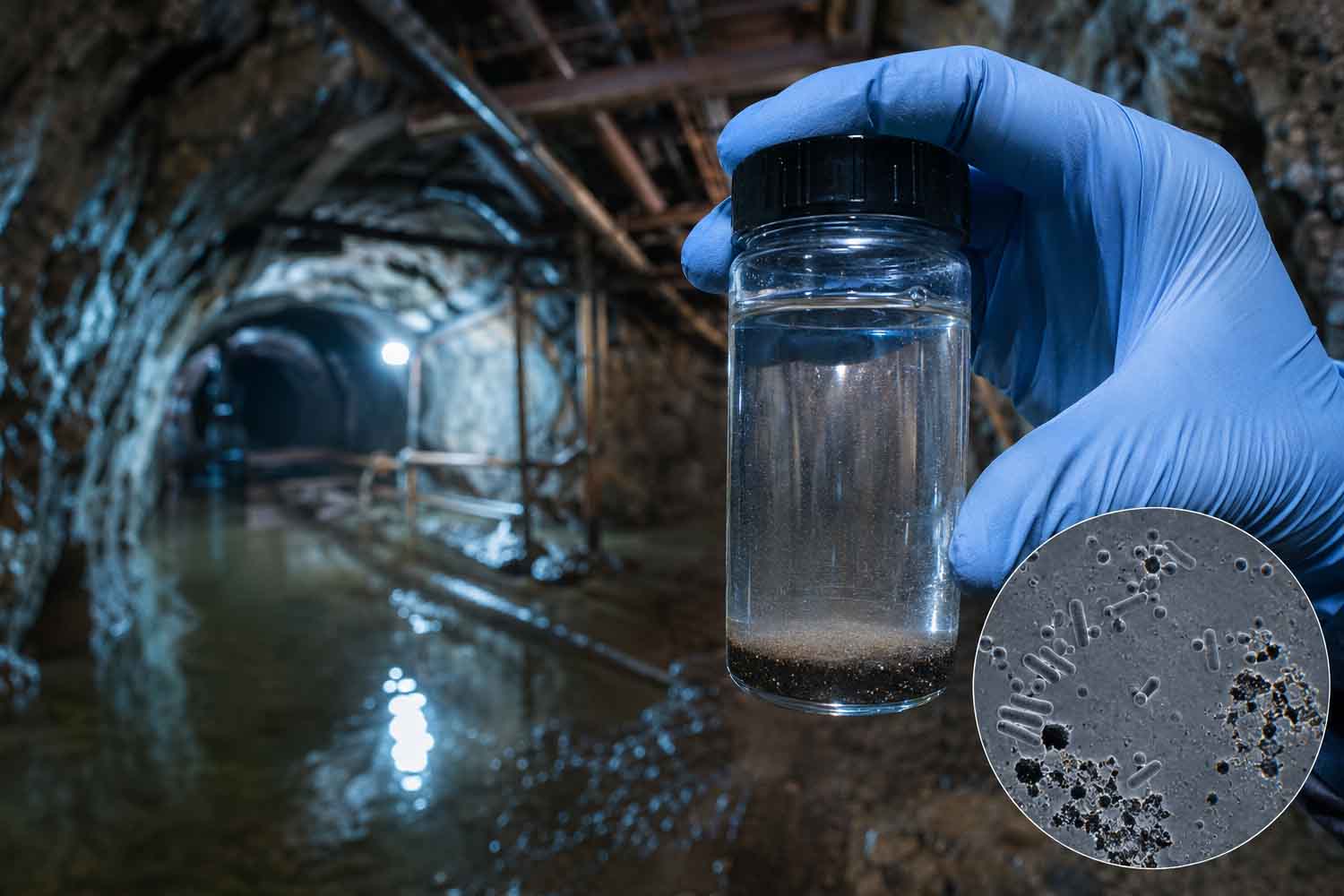
Uranium remains uranium, including radioactivity. In the laboratory, however, the bacterial community already present in the water of an old German mine contributed to moving much of it from the water to solid precipitates, which are much less inclined to move in the aquifer. After 130 days, the concentration of dissolved hexavalent uranium had dropped from 1 to 0.04 milligrams per liter: 96% less.
That 96% measures how much hexavalent uranium remained in the water. The atoms have not disappeared and the bacteria, however willing, have not eaten them. The result is described in a study published in Nature Communications by researchers from the Helmholtz-Zentrum Dresden-Rossendorf, the University of Granada, the public company Wismut and the European Synchrotron Radiation Facility in Grenoble.
The water came from the Schlema-Alberoda uranium mine in Saxony. It is therefore contamination left by mining activity, not liquids from a nuclear power plant. The mine closed in 1990 and was flooded, while water treatment continues today.
Two liters of water, glycerol and 130 days
The researchers filled two-liter containers with water taken at the entrance to the treatment plant. They then added 10 millimoles per liter of glycerol and left the samples in the dark, without oxygen and at 28 degrees, for 130 days. Each condition was repeated three times. The microorganisms were those already present in the mine water. The protagonist of the experiment is therefore an entire microbial community, with different species and functions, rather than the usual bacterium with a superhero cape.
The controls help sizing the title easy. In samples without glycerol, dissolved uranium decreased by about 25%; in sterilized water to which glycerol had been added, by 36%. A part of the metal can in fact adhere to the walls of the containers, to the biomass or to the mineral particles.
With live microorganisms and glycerol, the reduction reached 96%. In the first twenty days it proceeded slowly, between 5 and 20%, and then accelerated. The final value of 0.04 milligrams per liter would be lower than the discharge limits cited by researchers for Saxony, of between 0.20 and 0.50 milligrams per litre. It remains the result of a closed and controlled system, much more polite than a flooded mine.
The glycerol favored fermentative bacteria, which transformed it into organic acids and hydrogen. These compounds then fed microorganisms capable of reducing sulphates and metals, including genus bacteria Desulfobulbus And Desulfovibrio.
The process could have occurred either directly, through microbial enzymes, or indirectly through hydrogen sulfide and reduced iron. The data collected does not allow us to assign a precise percentage to the different mechanisms. It’s a chain of biological and chemical reactions, not a single morsel of uranium.
Uranium remains radioactive: its shape and mobility change
Under oxidizing conditions, hexavalent uranium, referred to as U(VI), forms soluble complexes capable of moving with water. By receiving electrons it can transition to lower oxidation states and precipitate into solid forms.
Microscopic analyzes have identified uranium-rich aggregates on the surface of bacterial cells and nanoparticles especially between two and three nanometers in size. Among 231 particles examined on five cells, 55.4% were identified as FeU(V)O4a compound containing pentavalent uranium; 40.3% was uraninite, formed from tetravalent uranium. The small remainder was pyrite.
The presence of pentavalent uranium, U(V), is the most interesting result. This chemical state is usually considered transitory: a sort of passage between the mobile hexavalent uranium and the less soluble tetravalent uranium.
In the experiment, however, a part of the U(V) remained stable during the entire 130 days without oxygen. A sample of the precipitate was then exposed to air for four weeks. At the end, pentavalent uranium still represented 53% of the total analyzed, while 40% had returned to the hexavalent form and 7% remained tetravalent.
The test shows both the promise and the problem. The compound FeU(V)O4 resisted oxygen better than expected; however, a substantial part of the uranium has reoxidized, returning to its more mobile form. Four weeks also says little about what might happen after years underground.
From bottles to flooded tunnels
Schlema-Alberoda’s water is already treated by aeration, removal of carbon dioxide and addition of alkaline substances, which precipitate uranium and other contaminants. The solids are separated and become sludge to be managed.
In its 2024 environmental report, Wismut indicates an abatement efficiency of around 90% for uranium and 95% for arsenic for the plant. The treatment works, but requires continuous activity, produces secondary waste and does not have a particularly reassuring expiry date.
Stimulating bacteria directly in groundwater could reduce the load going to the plant. Glycerol, also available as a by-product of biodiesel production, would also have low costs. The concentrations of iron, sulphates and arsenic also decreased during the experiment, by 98%, 68% and 44% respectively. Each intervention therefore modifies a much more crowded chemistry of uranium, with effects to be studied before distributing glycerol in the tunnels.
For now the result is inside two-liter bottles. In the mine it will be necessary to demonstrate that the uranium remains stationary for years, even when oxygen, pH, water flows and nutrient availability change. Immobilizing him for 130 days is a good start. A cleanup, understandably, takes a little longer.
