
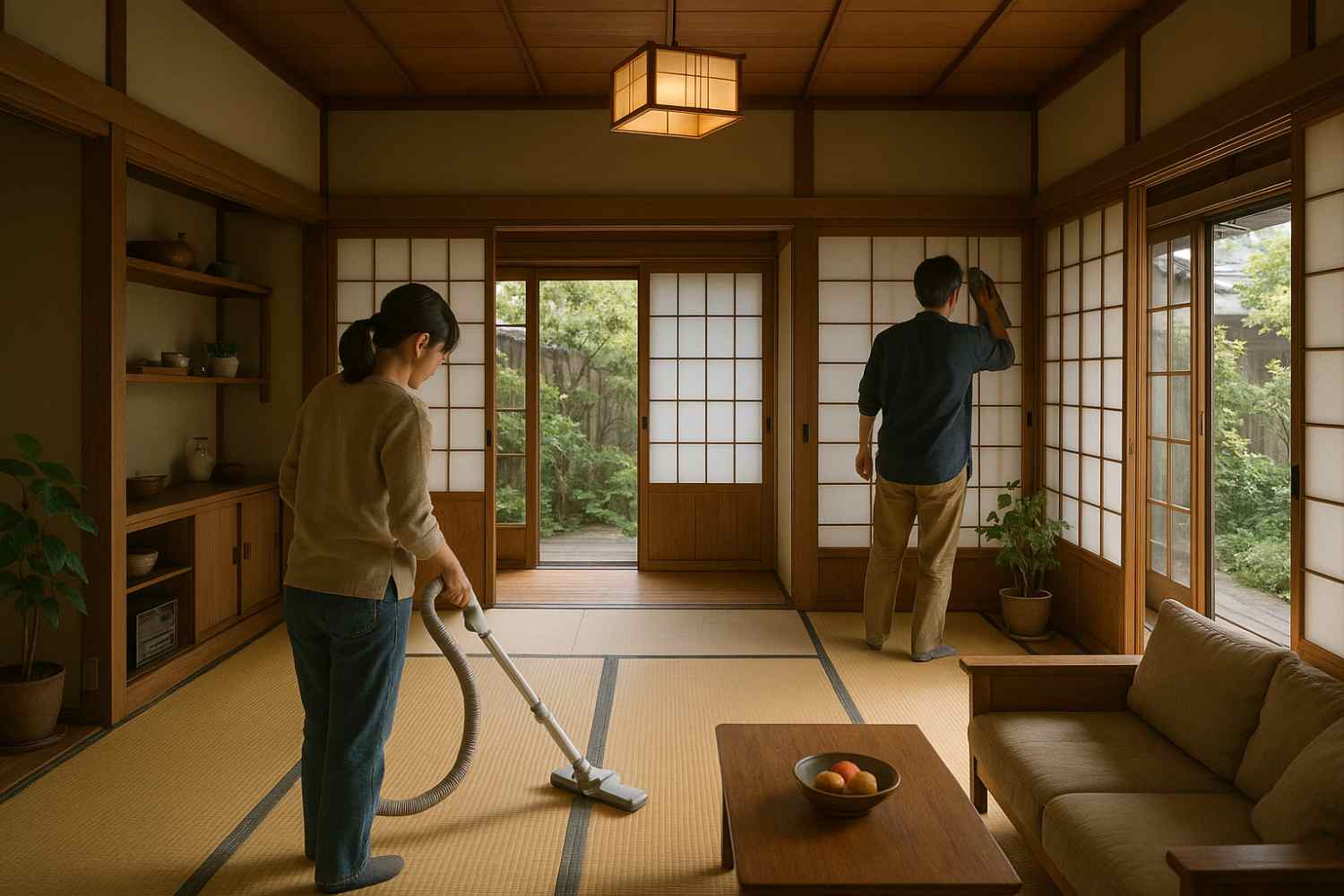
Before starting, we need to understand that Ōsōji was not created to make a floor shiny, but to prepare the house – and those who live there – for a new beginning. Japanese culture attributes an almost spiritual role to environments: they influence mood, thought, even luck. For this reason, the end-of-year ritual is considered an act of purification, not a simple domestic chore. If this logic were accepted, cleaning would no longer be perceived as an obligation, but rather as a conscious choice to “make space”, not only physical but emotional.
According to Japanese editorial sources, Ōsōji represents the closing of the year, the moment in which dust, useless objects and above all stagnation are eliminated. Clean means Don’t bring with you what you don’t need in the new cycle. An attitude which, if adopted, would transform the perception of the home environment, making it a daily ally instead of a source of stress.
Where it comes from: the historical and spiritual sense
The term “Ōsōji” means “great cleanliness” and is not accidental. Its roots go back to the ancient ritual called Susuharailiterally the “removal of soot”, dating back to imperial times. Originally altars and royal residences were cleaned to welcome the new year’s deity. During the Edo period the tradition became popular: palaces, temples and private homes were cleaned. Dirt and clutter were believed to hold negative energies. If the house was left dusty, luck would have no place there.
This vision is inherited from the Shinto doctrine, which associates purity and harmony with the benign presence of the kami, the spiritual entities. Cleaning was not “done” but offeralmost as a ritual gift. It is this mentality that should be rediscovered to transform the practical act into a gesture of renewal.
Preparing for Ōsōji: why choose a date and what attitude to adopt
Japanese tradition has it that Ōsōji is performed at the end of December, often on the 28th or 30th, avoiding the 29th because the number brings bad luck. But more important than numerical detail is that a precise moment is chosen. If the cleaning were improvised, it would lose intensity. The Ōsōji requires decision: when a date is established, one must also mentally accept that from that day “it ends”.
Starting this ritual with a relaxed attitude, focused on purpose and not urgency, would allow you to experience the day not as a physical massacre but as a symbolic transition. In Japan, a window sometimes opens, inviting the winter air to “bring out the old year.” A tradition that deserves to be adopted: if the house were truly opened to new air, perhaps the difference would be perceived more clearly.
How to proceed without turning the day into a stress
Many abandon Ōsōji because they consider it too tiring. The point is that it should not be experienced as an intensive cleaning done at speed, but rather as a journey. The Japanese begin by eliminating what is not needed, not by cleaning what remains. If we started from free surfaces and not from the vacuum cleaner, the effort would decrease.
The most effective thing would be to start from a central area of the house, the one we live in the most. In Japan we often start from genkanthe entrance area, because it represents the gap between the house and the outside world. From there you move towards the rooms, proceeding calmly, thinking about each object. In the West, the same principle could be applied starting from the living room or kitchen: choose the area where the most energy flows, where “life passes”.
Deep cleansing as a mental practice: remove to regain clarity
When you faced the Ōsōji with awareness, you would notice that the most intense part is removing, not cleaning. Eliminating superfluous objects forces you to ask yourself: “Is it useful? Do I use it? Does it still represent me?”. These are questions we rarely ask. The concept of mottainaivery rooted in Japanese culture, expresses regret for waste: it is not thrown away to get rid of it, it is eliminated out of respect, making sure that what remains is truly useful, or at least significant.
Modern application: if you kept something only “because it cost money” or “because you never know”, you would be maintaining stagnation. If instead you decided to let it go, the flow would be promoted. And it is precisely at this moment that Ōsōji becomes transformative.
Clean every corner: what does “leave no room for shadows” mean
Japanese deep cleaning does not ignore any part of the house. The spaces where we don’t look – behind appliances, under furniture, above wardrobes – are tackled first. The reason is simple: where dust hides, unresolved thoughts hide. Anyone who decides to tackle those areas will realize that a few centimeters of neglected dirt are enough to alter the perception of the place.
Following the original approach, any areas of shadow should be illuminated, even if only symbolically. This doesn’t mean wanting to become obsessive, but recognizing that if something remains constantly hidden, the house is not completely “new”.
Involving those who experience the space: because doing it together has more impact
In traditional Japan, the whole family participates in Ōsōji. Not out of operational necessity, but to share the act. It is the way in which collective spirit is created and responsibility in the care of common space is defined. However, imbalances emerge in modern families: recent surveys show that many men tend to declare themselves satisfied with female participation, while a smaller number of women evaluate their partners’ commitment as sufficient. This imbalance highlights that the Ōsōji also reveals the perception of the home as a shared or delegated environment.
If the practice were integrated as a common choice and not as “someone’s task”, it could also become an opportunity for rebalancing. Cleaning together, accepting that everyone grasps what they perceive as needing resolution, would give the ritual a truly regenerative value.
The decline of tradition: what is changing and why
Despite its cultural importance, the percentage of Japanese families performing complete Ōsōji has been declining in recent years. The accelerated pace of life and smaller domestic spaces often make it impractical to dedicate a day to surgery. Furthermore, the use of professional cleaning services is increasing. However, part of the spiritual value is lost: by delegating, one gets rid of the effort, but the conscious gesture is not carried out.
However, the ritual is not disappearing: it is transforming. In some work contexts, a collective day of tidying up the offices is organized before the holidays. We thus try to maintain the symbolic value. The essential thing, as always, lies in the spirit with which one acts: if it were applied with awareness, even a cleaning organized by third parties could reflect the profound meaning of the Ōsōji.
How to reinterpret Ōsōji in a Western context
Anyone wishing to be inspired by this practice could do so without forced imitation. It would be enough to choose a moment of the year – not necessarily December – when you feel the need to close a chapter. A day should be decided in which to stop, give yourself time, face the house with intention. More than cleaning, it should refounded the space.
You could start by opening a window, letting in fresh air, and proceed slowly. You don’t need to talk, but feel. The gesture of moving a piece of furniture, of lifting a carpet, of eliminating a box full of small objects accumulated and never used, would become a symbolic act. It would be the exact moment in which you say: “I’ll start again from here”.
After the Ōsōji: how to maintain the state of renewal
Once the ritual is over, the house looks different. The rooms seem larger, the air lighter. The Japanese advice is not to immediately rebuild the previous order, but to let the spaces breathe. Don’t fill the shelves again, don’t replace what has been eliminated just to replenish a quantity. It is important that the Ōsōji has a consequence: the house must speak of what you are now, not what you were yesterday.
If you wanted to maintain that sense of clarity, you could integrate some daily micro-cleansing practices, Kaji style. But this is another philosophy, which acts day by day. The Ōsōji on the other hand is an event, a cut, a jump.
If performed with intention, Ōsōji could become one of the most significant moments of the year. It doesn’t require perfection, but clarity. It doesn’t aim for the aesthetic result, but for rebalancing. A house that is clean down to the last corner is an achievement; a purified home, a new starting point.
If you choose to apply it, do it not so much to “fix”, but to start from scratch with a clarity that few domestic gestures offer. If the house became lighter, perhaps thoughts would also become lighter.
