
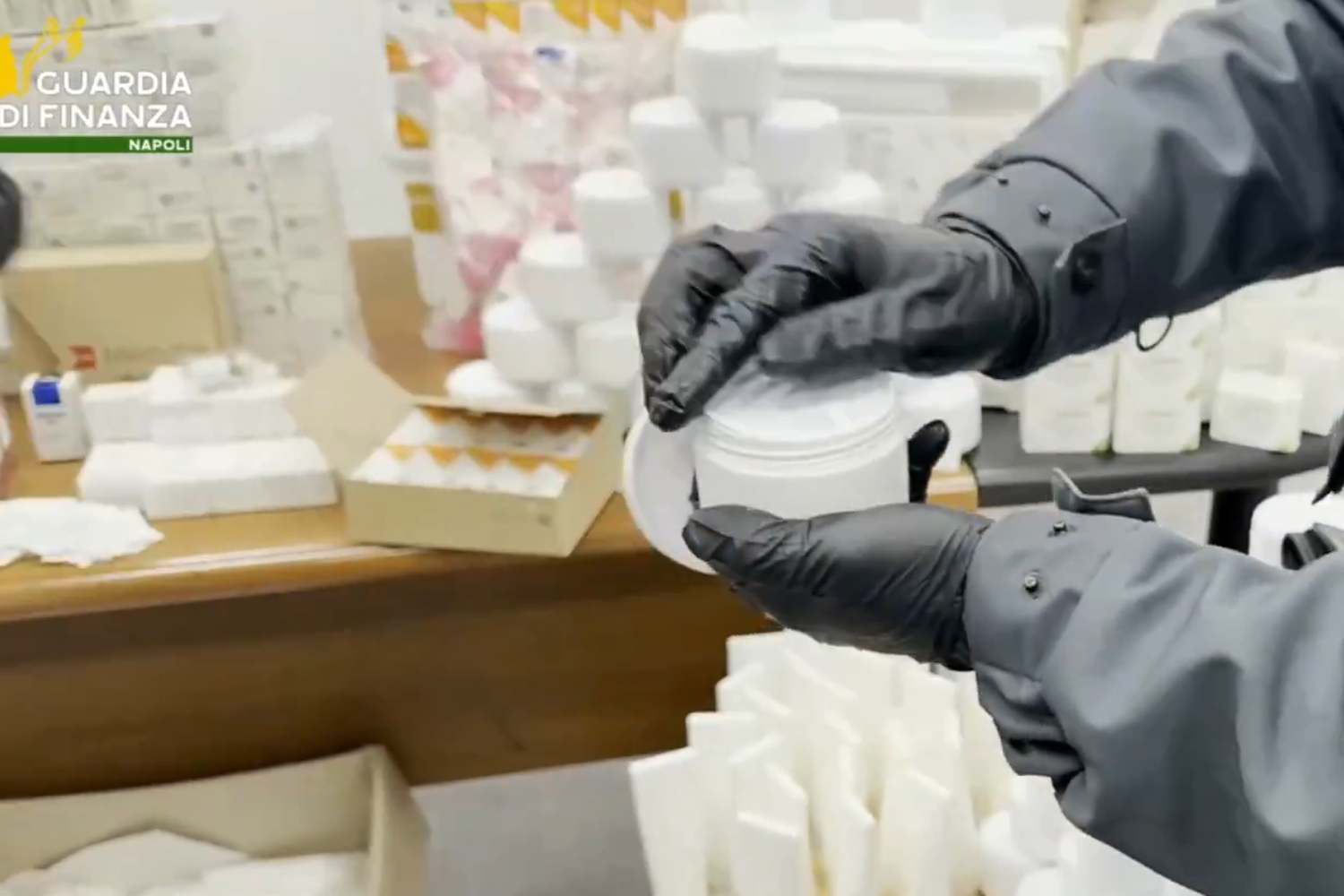
In the Soccavo district of Naples, inside a multi-storey garage, without any commercial or health authorisation, the soldiers of the Provincial Command of the Guardia di Finanza found what was in fact an illegal pharmaceutical warehouse with improvised shelves, kitchen refrigerators overflowing with vials, and over 191,000 doses of botulinum toxin ready to enter the parallel beauty market.
Everything was designed to leave no traces. The medicines, imported illegally from non-EU countries through private couriers, were formally registered in the name of non-existent subjects, a ploy to bypass the customs and health checks required by law. The packages were devoid of any therapeutic indication in Italian – among the material seized were also labels with pharmaceutical wording in Greek and rolls of adhesive tape with counterfeit seals, used to reconfigure the packaging of the products.
Together with the Botox vials, the financiers found 73,000 ml of equally undocumented anesthetic creams, as well as computer equipment and mobile phones: the tools of online commerce, through which the flow of drugs was managed and distributed. A proven, profitable, and highly dangerous system.
The hidden price of low-cost Botox
The estimated commercial value of the seized items exceeds 500 thousand euros. A figure that is not surprising, if we consider the growing demand for accessible beauty treatments also fueled by social media, where botulinum injections are shown as a daily routine, almost as banal as a haircut.
But behind that convenient price lies a chain of risks that the final consumer almost never knows about. Botulinum toxin-based medicines are classified as medicines for hospital use only, which can only be distributed through authorized and traceable channels. Each vial must comply with very strict production, transport and storage protocols.
When these protocols fail — as in the case of drugs crammed into a home refrigerator, in a garage without temperature control systems — the molecule can degrade, become contaminated, or simply not be what it claims to be.
#GdiF #Naples illegal storage of illegal medicines imported from abroad discovered. A shipment of Botulinum containing over 191,000 doses has been seized. If the medicines were placed on the market they would have yielded an illicit profit of over 500,000 euros. The person responsible was reported.#NoiconVoi pic.twitter.com/6tKLh2Vl9i
— Financial Police (@GDF) February 12, 2026
What risks those who rely on these products
Botulinum toxin is, for all intents and purposes, one of the most powerful biological substances known in nature. Its use in aesthetic medicine is considered safe only when the product is authorized by the regulatory authorities, stored correctly according to the manufacturer’s instructions and administered by a doctor with specific training. Outside these conditions, the risks increase significantly.
A drug that has suffered breaks in the cold chain may lose stability and effectiveness, since botulinum toxin is a protein sensitive to temperature changes. The degradation of the active ingredient can alter the clinical response and make the effect of the treatment unpredictable.
In the most serious cases, incorrect administration – due to dosage, technique or quality of the product – can lead to systemic diffusion of the toxin, with generalized muscle weakness, difficulty swallowing or breathing. These are rare events in the regular medical circuit, but described in the literature especially in the presence of non-compliant products or improper uses. In extreme cases, the clinical picture can resemble systemic botulism, a potentially lethal condition.
The seized anesthetic creams are no less insidious. If they contain active ingredients such as lidocaine or prilocaine at undeclared concentrations or above the permitted limits, skin absorption can cause systemic toxicity from the local anesthetic: cardiac arrhythmias, convulsions, neurological alterations and, in the most serious cases, respiratory depression.
The most alarming fact, underlined by the military themselves, is that the final recipients of these drugs were “unaware of the dangers caused by the use of non-compliant medicines“: people who turned to apparently regular centres, attracted by curated social profiles and competitive prices, without knowing what they were being injected with.
The organizer of the trafficking discovered in Naples was reported to the Public Prosecutor’s Office with charges that reflect the seriousness of the matter: receiving stolen goods, abusive practice of the profession, trade in substances dangerous to public health and illicit importation of medicines.
But the crimes alleged against the suspect must be definitively ascertained during the judicial proceedings, in compliance with the principle of presumption of innocence.
How to protect yourself
Some practical tips to protect yourself:
