
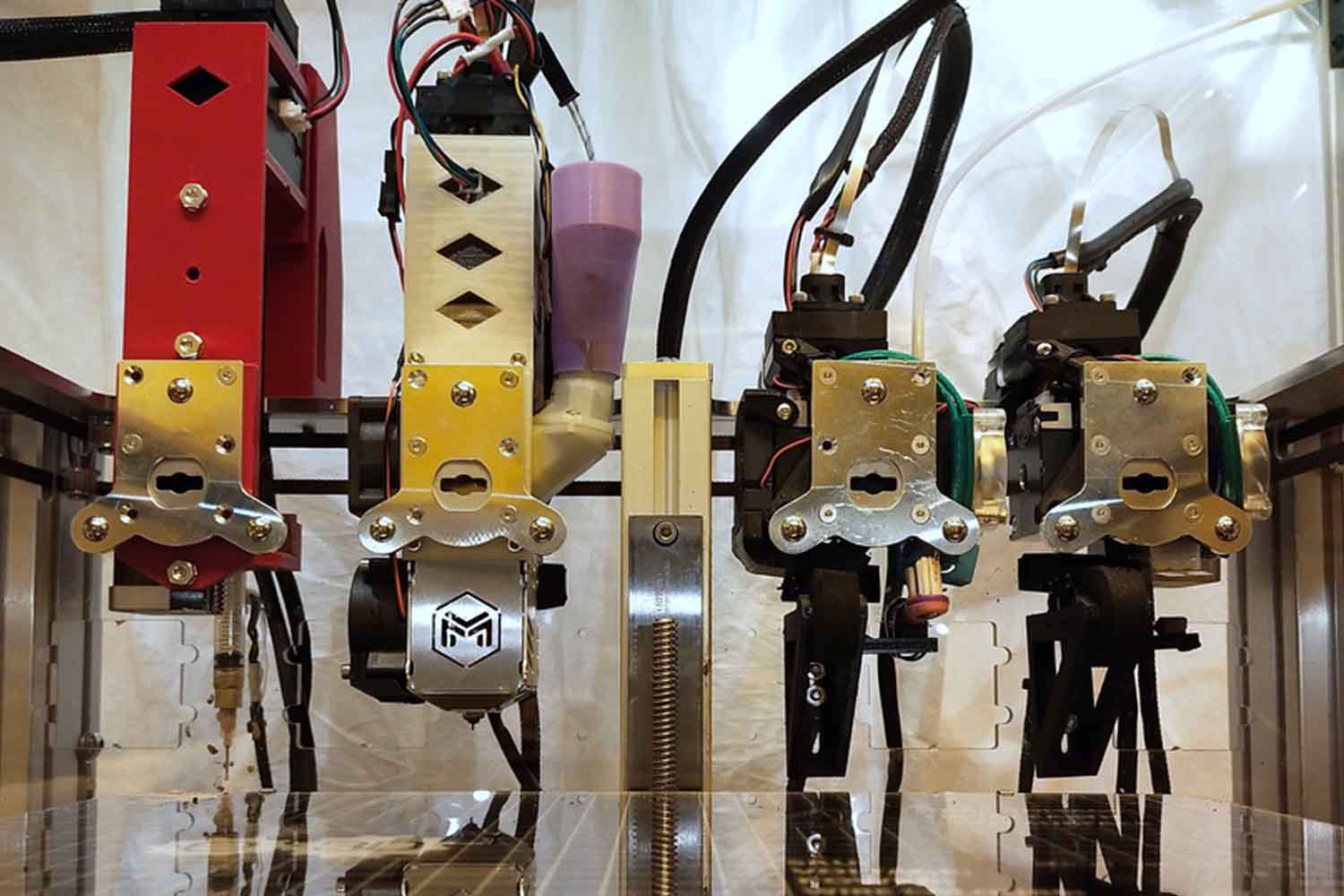
Manufacturing is going through a silent transformation that affects the way we think about objects, spare parts, repairs. The idea of waiting weeks for a faulty component belongs to a production model that today shows all its fragility. In the laboratories of Massachusetts Institute of Technology a concrete alternative is taking shape: printing an electric motor that works in just three hours, using materials with a total cost of around 50 cents.
The research, published in the scientific journal Virtual and Physical Prototypingtells a story about autonomy, waste reduction and local production. Themes that have always been part of the debate on industrial sustainability and which today find a surprisingly concrete technological application.
Print an electric motor in 3 hours
Anyone who has dealt with industrial machinery knows that a broken motor can block everything, generating days of waiting, international shipments, high costs and an environmental impact that is rarely fully calculated. The research coordinated by Luis started precisely from this critical issue Fernando Velásquez-Garcíawho together with his team developed a platform of Multi-material 3D printing capable of creating complete electric machines in a single process.
The real innovation lies in the ability to integrate multiple functional materials at the same time. To build an electric motor you need elements with very different characteristics: electrically conductive materials to transport the current, rigid magnetic materials to generate the magnetic field necessary for energy conversion and insulating components that guarantee safety and stability. The traditional systems of Multi-material 3D printing they can handle a maximum of two materials of the same type, such as filaments or pellets; the MIT team decided to go further.
They modified an existing printer by integrating four distinct extruders, each designed to process a different form of material. Some high-performance conductive components, for example, come in the form of inks that must be extruded under pressure, while other materials require heated nozzles to melt filaments or pellets. Coordinating these technologies into a single platform has presented complex engineering challenges, because each material has specific temperature, solidification and stability needs.
The conductive material, for example, had to harden without the use of excessive heat or UV light, so as to avoid deterioration of the surrounding dielectric material. A delicate balance, achieved thanks to strategically placed sensors and a control system that allows robotic arms to engage and release each extruder with extreme precision. Each layer is deposited millimetrically, because a slight misalignment is enough to compromise the final performance of the device.
The result is a fully 3D printed linear electric motor in approximately three hours, using five different materials and requiring only one post-process step: the magnetization of rigid magnetic materials to make it fully operational.
A 50 cent engine that challenges traditional systems
The motor created by the MIT team belongs to the category of linear motors, used in areas such as pick-and-place robotics, optical systems and airport conveyor belts. The biggest surprise concerns the performance: The 3D printed device was able to generate motion many times greater than a common linear motor that relies on complex hydraulic amplifiers.
All this with a material cost of around 50 cents and with a much more streamlined production process compared to conventional methods, which require multiple assemblies and several subsequent processing phases.
The potential is evident. If today a factory has to order a spare part from the other side of the world, with delivery times that can last weeks, tomorrow it could simply print the component on site, reducing costs, transport and waste. There on-site production it would become a strategic lever not only for industrial efficiency, but also for environmental sustainability.
In the long term, this platform could be used to rapidly fabricate customized components for robots, electric vehicles or medical equipment, paving the way for more flexible manufacturing that is less dependent on global supply chain dynamics.
Researchers are already working to integrate the magnetization phase directly into the printing processdemonstrate the fabrication of fully 3D printed rotary electric motors, and further expand the number of tools compatible with the platform, thus enabling the monolithic fabrication of increasingly complex electronic devices.
Printing an electric motor in three hours doesn’t just mean speed, it means reducing dependencies, cutting waste and imagining a production system closer to the territories and less fragile in the face of global crises. Perhaps the true revolution of industrial 3D printing begins right here, in that apparently simple gesture of “manufacturing where needed”, transforming an emergency into an opportunity and a failure into autonomy.
