
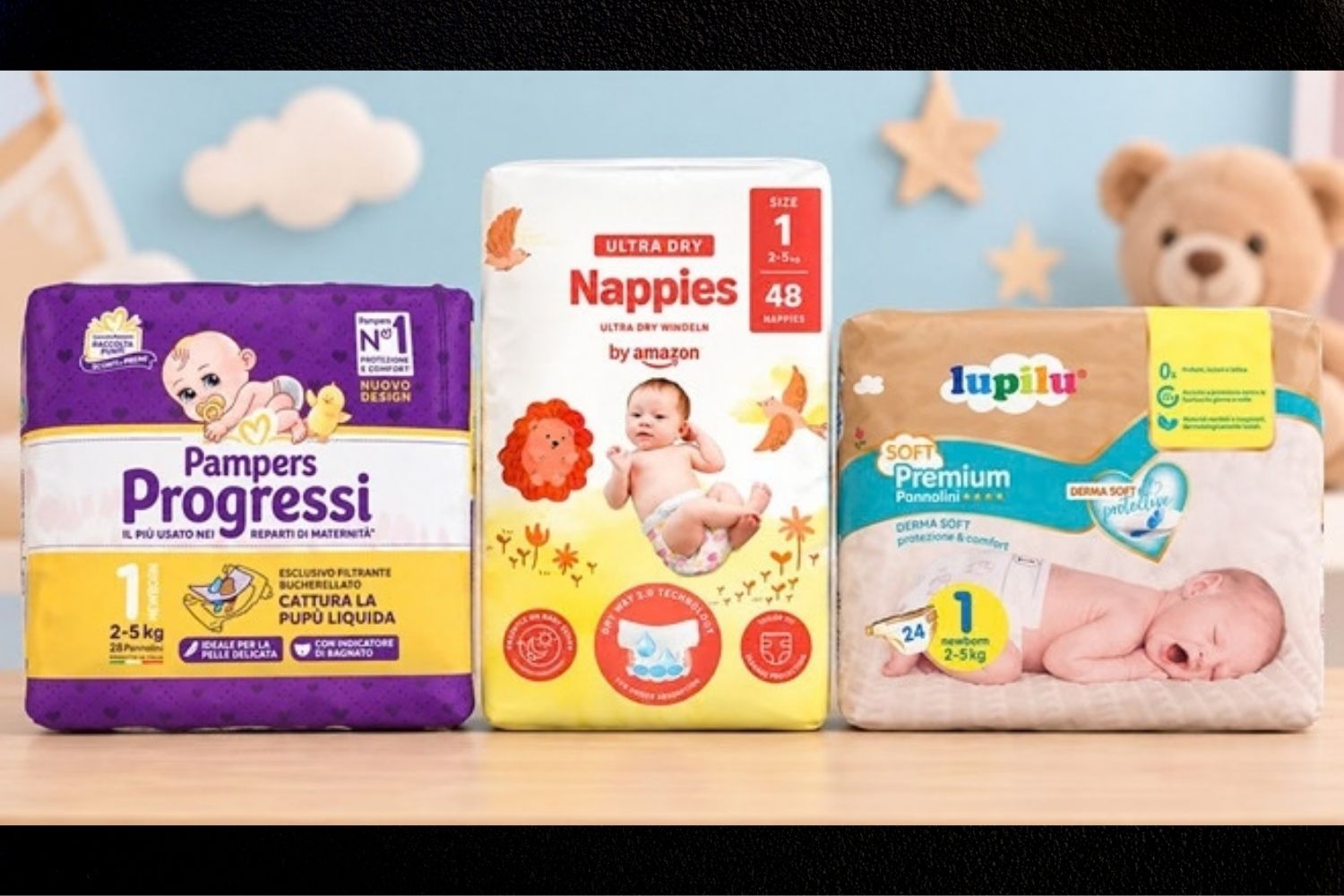
With a newborn at home, diapers run out at an impressive rate and what seems like a small daily expense, at the end of the month, can turn into a sum that is anything but negligible. Between constant changes, packages to repurchase and offers to chase, it is natural to ask whether it is really worth always choosing the most expensive brands or whether there are equally valid, but decidedly more convenient alternatives. The answer is given by Altroconsumo, which compared eight size 1 disposable diapers, suitable for newborns between 2 and 5 kg, subjecting them to laboratory tests and practical tests with families. The result reserves some surprises: Pampers Progressi confirms itself as the best, while Lidl’s Lupilu Premium reaches practically the same level, with a price almost three times lower. A difference which, considering the number of diapers used every day, can translate into significant savings for new parents.
What are the best diapers for newborns according to Altroconsumo?
First place goes to the Pampers Progressi Newborn, which obtained 75 points out of 100 and won the title of Best of the Test. In addition to the good performance recorded in the laboratory, they are the ones that most convinced the parents involved in the practical test, especially for softness, absorption capacity, wearability and protection from spills.
The real surprise, however, comes from the second place: Lupilu Premium by Lidl reaches 73 points out of 100, just two less than Pampers, obtaining particularly positive results in the absorption of liquids and the prevention of losses. The much lower price also allows it to win the Best Buy award, awarded to the product that offers the most advantageous relationship between quality and cost. On the third step of the podium we find By Amazon Ultra Dry Nappies, previously sold under the Mama Bear brand, which score 70 points and stand out above all for their absorbent capacity and moisture control on the surface in contact with the skin.
The complete ranking of the 8 diapers
Here is how all the analyzed products positioned themselves, in order of score:
- Pampers Progressi Newborn – 75/100, Best of Test
- Lupilu Lidl Premium – 73/100, Best Buy
- By Amazon Ultra Dry Nappies – 70/100
- Coop Crescendo Advance first days – 68/100
- Esselunga Newborn Diapers – 64/100
- Conad Newborn Diapers – 52/100
- Pee&Poo Ultra Comfort Newborn – 51/100
- Huggies Extra Care – 50/100
The ranking highlights an interesting aspect, namely that the price of a diaper does not necessarily reflect the quality. In fact, some economical products manage to outperform better-known brands, while between the first two classified the difference in performance is decidedly smaller than that in cost.
How much do diapers cost? With Lidl you save almost 80 euros a month
To understand how much the choice of brand can impact the family budget, Altroconsumo estimated the expense necessary to purchase approximately 300 diapers per month, assuming an average of ten changes per day. With Pampers Progressi, the most expensive product among those examined, it costs around 119 euros per month; by choosing Lupilu Premium by Lidl instead, the expense drops to 41 euros, with a saving of 78 euros in thirty days. A notable difference, especially considering that the two products are separated by just two points in the final evaluation. The other brands also show very variable prices: for Coop Crescendo Advance you spend approximately 55 euros per month, for Esselunga Newborn 44 euros, while Huggies Extra Care reaches around 92 euros, despite being in last place in the ranking. Naturally these are estimates based on prices recorded in March 2026, which may vary depending on promotions and retailers, but the comparison remains significant: to have a good quality diaper it is not essential to choose the most expensive one.
How were the tests carried out?
The survey took into consideration both the technical characteristics of diapers and the daily experience of those who use them. Laboratory analyzes represented 55% of the final score, while the remaining 45% was determined by the evaluations of the parents, involved in a blind test during which they did not know the brand of the products.
Various parameters were examined in the laboratory: the speed with which the diaper absorbs liquids, the moisture that remains on the surface after absorption, breathability and resistance to lateral leakage. Families instead evaluated aspects such as comfort, softness, ease of changing and the possible appearance of redness. Before the practical test, all products were also subjected to checks to verify the presence of some unwanted chemical substances, with the exclusion of those that had not passed these checks.
Size 1 diapers: why it is not worth keeping large stocks
Finding a particularly advantageous offer can push you to buy several packs all together, especially when preparing what you need for the arrival of a baby, but in the case of baby diapers this choice risks proving to be less than convenient. Size 1 is in fact intended for children who weigh between 2 and 5 kg and can be used for a rather short period: some newborns are born already close to the upper weight limit, while others grow rapidly and need to move to the next size sooner than expected. Therefore, it is better to avoid excessive purchases, at least at the beginning, and try the product to understand if it adapts well to the child’s body, if it contains spills and if it is comfortable on the skin. Even during the change, it is not necessary to continuously use wipes and creams: for daily cleaning, generally, warm water, possibly a delicate detergent and careful drying are sufficient, while barrier creams can be useful in the presence of irritation.
Ultimately, Altroconsumo’s comparison shows that Pampers Progressi remains the best diaper among the eight examined, but Lidl Lupilu Premium represents the more convenient choice, thanks to performances very close to those of the winner and at a decidedly lower cost. A result to keep in mind when dealing with the expenses of the first months of a child’s life.
