
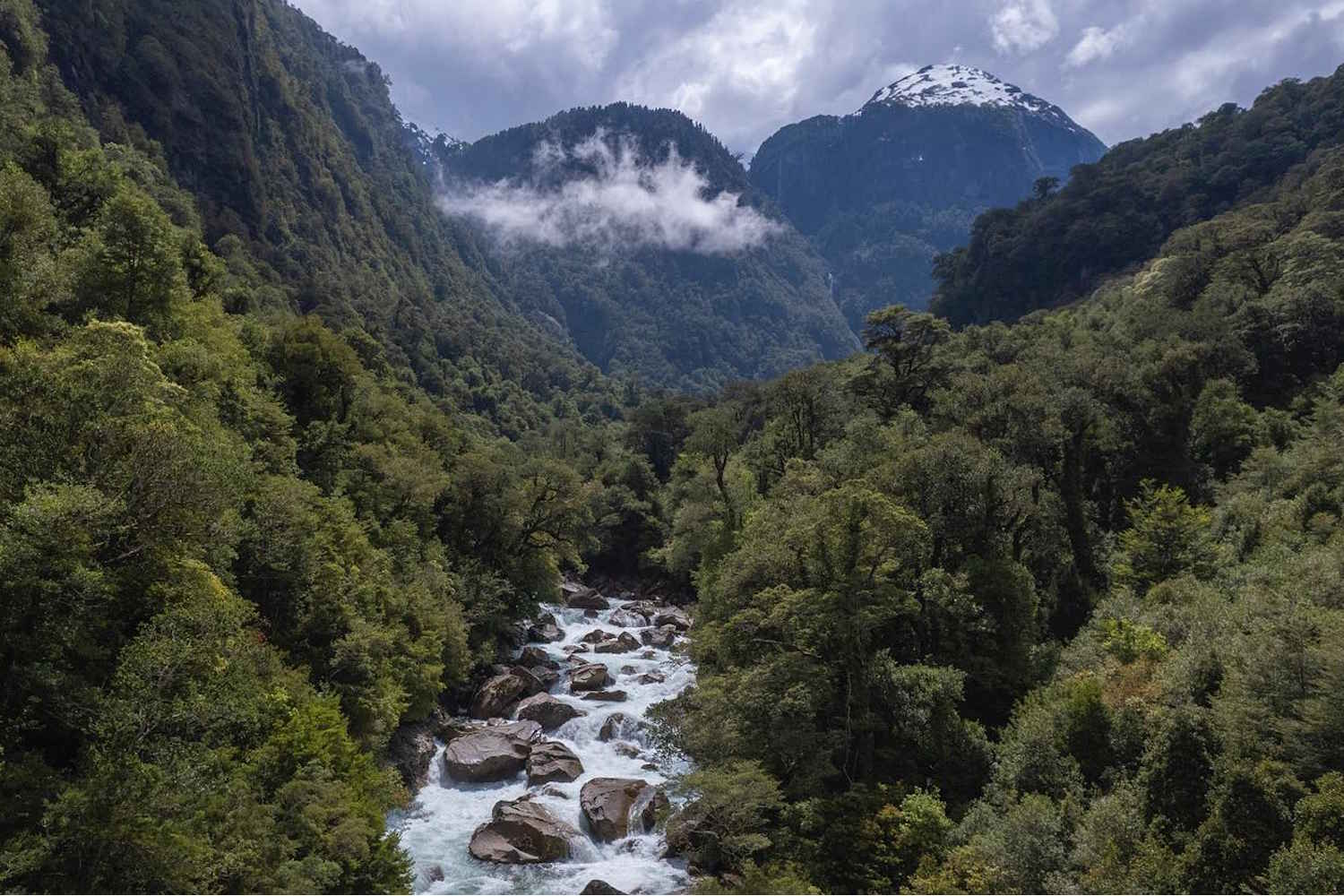
The Cochamó Valley, in the heart of Chilean Patagonia, is one of the last truly uncontaminated places on the planet, a natural sanctuary where biodiversity is expressed in its purest and most intact form. Here nature still dominates without compromise, among thousand-year-old forests, turquoise rivers and mountains that seem to have remained out of time. And today that natural wonder is safe.
Thanks to extraordinary grassroots fundraising, 133,000 hectares of wilderness – the equivalent of 383 times the size of New York’s Central Park – have been purchased and placed under permanent protection. An enormous, fragile, precious area, which risked being overturned by deforestation, dams and aggressive real estate development.
The territory was purchased for 63 million dollars by a coalition led by the NGO Puelo Patagonia and officially entrusted, last December 9, to the Chilean foundation Conserva Puchegüín. A historic victory for environmental conservation and local communities.
The Cochamó Valley is a primordial paradise: ancient forests, turquoise rivers, waterfalls, hummingbirds, condors and thousand-year-old alerce trees, some of which sprouted around 1000 BC, when the Roman Empire did not yet exist. 11% of the alerce remaining on the planet are concentrated here, a species exploited in the past for its resistance to water, used for ship masts and telephone poles.
View this post on Instagram
It is a biodiversity that has almost never known human intervention: no roads, very few settlements, energy produced with solar panels or domestic wind turbines, supplies still transported on horseback. A model of life that seems to belong to another century, but which today represents a very powerful example of balance with the environment.
Yet this corner of Patagonia has been on the brink of devastation several times: in 2012 a $400 million hydroelectric project threatened the construction of 150-meter-high towers, access roads and the irreversible alteration of the Manso River. Then came plans for luxury resorts and paving roads.
The response was collective. Ranching families, cowboys, tour guides, climbers, environmentalists, NGOs and residents have come together to say no and imagine a different one.
We wanted to turn threats into opportunities, explained José Claro, president of Puelo Patagonia. And so it was.
The fundraising involved Chilean and international donors.
The project does not limit itself to “buying” land, but builds a long-term vision. The goal is to protect at least 80% of the territory as a total conservation area, while the remaining 20% will be allocated to sustainable use: low-impact tourism, family farms, small local businesses.
Furthermore, a maximum limit of 15,000 visitors per year has already been established. Reservations will be needed, official paths will be traced, base camps and essential structures will be created, all with the direct participation of local communities.
Not a showcase park, but a living ecosystem. Meanwhile, wildlife monitoring has begun with camera traps and the collaboration of the inhabitants. A recent discovery has excited everyone: a small population of huemulthe deer national symbol of Chile, today in serious danger of extinction.
The project is inspired by the vision of legendary conservationists Doug and Kris Tompkins, who helped protect more than 5.7 million hectares across Chile and Argentina. But Cochamó follows a new path: that of “hybrid” parks, where environmental protection coexists with sustainable economic activities. Because conservation also needs a future, not just protection.
