
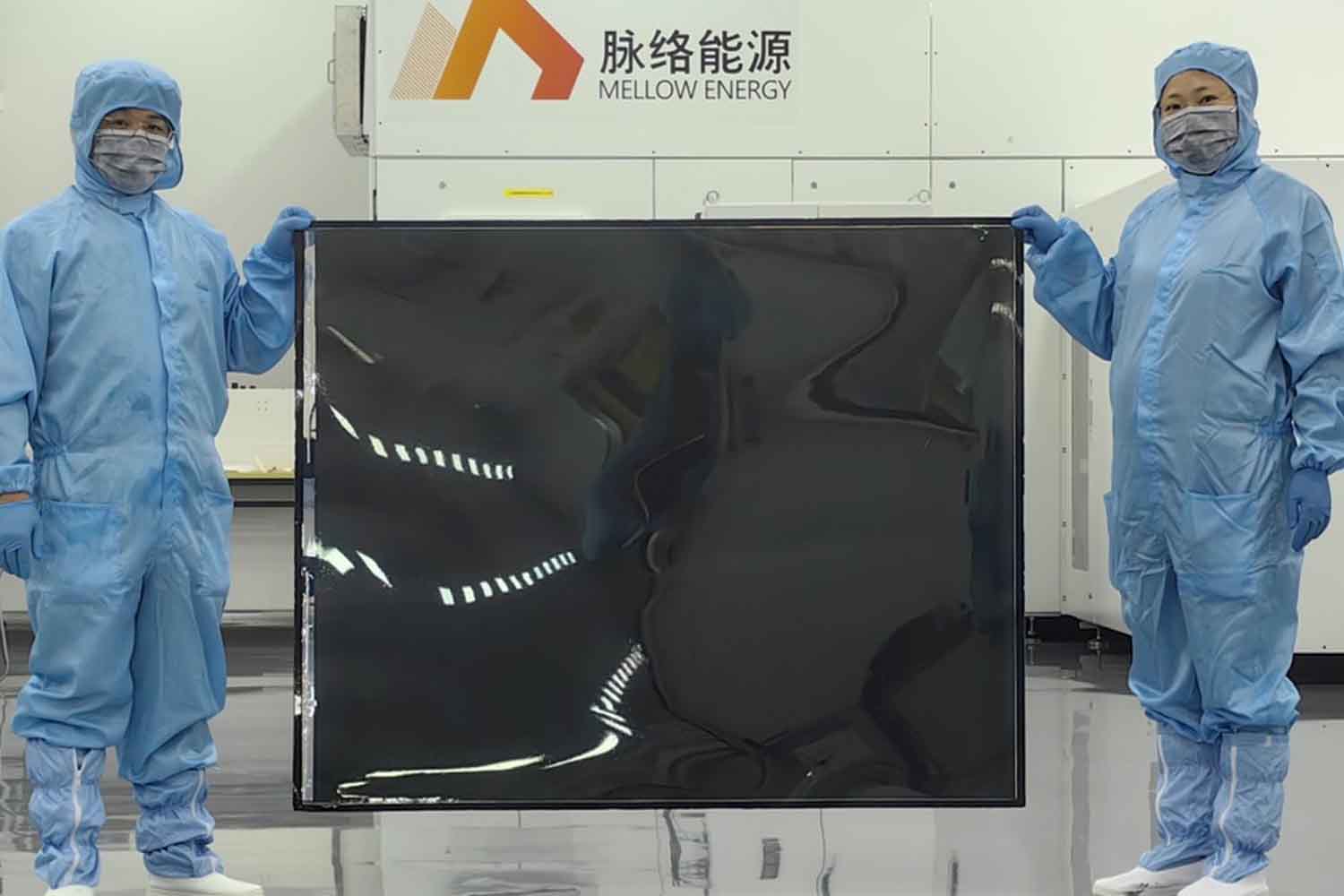
Photovoltaic technology takes another important step forward thanks to Mellow Energya Chinese company founded as a spin-off of the Institute of New Energy Technology of Jinan University. The company announced the creation of the largest flexible photovoltaic module in the worldnamed ML-Flex.
According to what was reported by the managers, the new module would measure 1,200mm x 1,600mm x 1mm and it would have a weight of only 2.04kgcharacteristics that would highlight its lightness and scalability. This would be a further demonstration of the potential of the perovskitea material that is attracting more and more attention for its high efficiency, ease of production and low costs.
The promises of perovskite
The company highlighted how the ML-Flex module can pave the way for a wide range of applications. Among the possibilities mentioned would be: wearable devices, portable solar products, electric vehicles (EVs), drones (UAVs) and even the building-integrated photovoltaics (BIPV). According to Mellow Energy, the versatility of perovskites it would represent an opportunity to revolutionize multiple industrial sectors.
The technical characteristics of the module are particularly promising: the power generated would range between 260W and 300Wwith a conversion efficiency that would vary from 13.5% to 15.1%. Open circuit voltage values between would also be reported 200V and 205Vwhile the short-circuit current would oscillate between 2.16A and 2.26A. As for operating temperatures, the panels would be designed to withstand a range between -40°C and 85°Cmaintaining a temperature coefficient of -0.30%/°C. The presence of a junction box with certification IP68 finally, it would guarantee optimal protection against water and dust.
Mellow Energy stated that its production line, designed for a capacity of 100MWwould be compatible with the fabrication of both rigid and flexible modules. At the moment, the production process would be in a phase of performance and capacity enhancementa fundamental step to achieve large-scale production.
The company would also communicate that i flexible modules they are currently undergoing stability tests, while for the rigid ones we are working to obtain certification IEC 61215 by June. Efficiency checks by third-party bodies would also be underway, the results of which are expected soon.
Ultra-thin coatings
In addition to the progress of Mellow Energyfurther developments in the field of perovskite they would come from a research team fromUniversity of Oxford. Scientists would develop a ultra-thin photovoltaic coatingoften just a micronequivalent to 100 times less than the thickness of a human hair. This material could be applied to surfaces such as backpacks, smartphones or car roofs through printing techniques a inkjetallowing solar energy to be captured more widely and efficiently.
According to the researchers, the coating would be designed to absorb a greater amount of sunlight than traditional silicon panels, guaranteeing an efficiency that would reach the 27%against the 22% of the photovoltaic modules currently on the market. It would also be hypothesized that, with further improvements, the efficiency could exceed 45%opening completely new scenarios for the sector.
The scientists explained that this technology could reduce the need to build large solar plants that occupy large areas of land, solving one of the main problems associated with traditional photovoltaics. However, they would have clarified that the intent would not be to replace existing solar parks, but to offer a capable alternative integrate solar energy production in a more sustainable way.
Challenges and future prospects for perovskites
Despite significant progress, researchers have highlighted that one of the main challenges remains stability of perovskitesa problem that until now would have hindered their large-scale commercialization. In fact, some coatings would deteriorate rapidly in uncontrolled conditions, making them less durable than traditional silicon solar panels.
Despite this limitation, the perovskites they would represent one of the most promising innovations in the panorama of renewable energy. The ability to apply these materials to a wide range of surfaces, from building facades to vehicles, could significantly reduce production costs and accelerate the global transition to clean energy sources.
Second Henry Snaithlead researcher of the Oxford team, innovations in the field of perovskites could lay the foundations for a new industry, capable of generating solar energy in a more sustainable and economical way. Snaith would also point out that the company Oxford PVborn from the University of Oxford, has already started the large-scale production of perovskite panels in its factory in Germany, a concrete sign of the commercial potential of this technology.
