
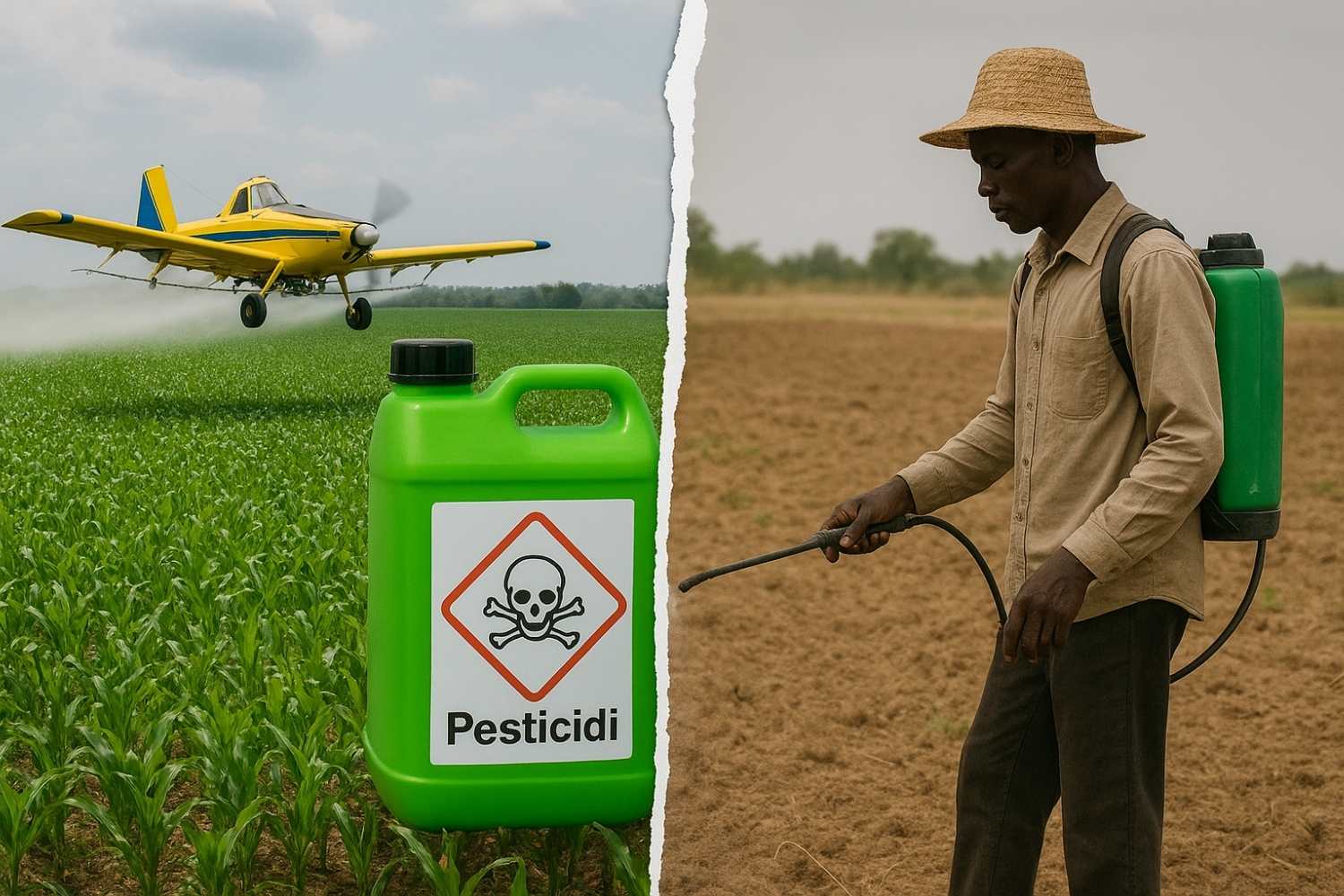
In recent years Europe has become increasingly restrictive on the use of pesticides – and reason, given the scientific evidence on their harmful effects – but not the whole world is a country: what is prohibited here continues to be produced and exported elsewhere, with heavy consequences.
Do you think that the export of pesticides prohibited by the European Union is more than doubled in just seven years. This was reported by a new investigation conducted by Unearthed, the Greenpeace investigative unit, together with Public Eye.
The investigation
What emerged is very serious: in 2024 the EU authorized the export of pesticides containing 75 chemicals banned in the cultivated fields for their danger to health and the environment. There were 41 in 2018, almost half.
It is not just an increase in variety, even the volumes have grown impressively. Last year, the EU notified the intention to export 122 thousand tons of prohibited pesticides, over twice the 2018. Among the substances there are suspicious carcinogenic herbicides, lethal insecticides for bees and products that cause brain damage in children, infertility and serious endocrine interference.
To pay the price of all this are, guessing the most vulnerable countries.
In 2024 these pesticides were exported to 93 countries, of which 71 in the medium or low income, which absorbed 58% of the total. The main importers appear Brazil, Ukraine, Morocco, Malaysia, China, Argentina, Mexico, Philippines, Vietnam and South Africa. As many as 25 African countries are habitual recipients of these substances, while among the rich countries to guide imports there are the United States, which are placed in the first absolute place in the world.
A evident and very serious double standard: what is considered too dangerous for European citizens continues to be produced and sent elsewhere, in contexts where environmental and health regulations are more weak and the protection systems for less developed agricultural workers. As if the citizens were not all the same and exposed to the same risks.
The pesticides that exports the EU
The document highlights different types of pesticides prohibited in Europe but still exported to other countries:
Herbicides
Fungicides
Insecticides / neonicotinoids
Smokers / growth regulators
The protagonists of this toxic export
According to the survey, 13 EU Member States are involved in the export of prohibited pesticides. Germany leads the ranking with over 50 thousand tons, followed by Belgium, Spain, the Netherlands and Bulgaria. Italy is in sixth place, with almost 7 thousand tons of products exported in 2024, containing 11 prohibited chemicals.
At the corporate level, over 40 European companies include among exporters, with the German giant Basf at the top of the list. Six companies operate from Italy, including Finchimica, Tris International, Corteva and Sipcam Oxon.
What exports our country? The most exported pesticide is the Tripluralin, a herbicide forbidden in the EU for almost 20 years because they are highly toxic to fish and other aquatic animals, carcinogenic suspicion and persistent in the soil. Only the Finchimica has notified the export of about 4 thousand tons of Triplurain to Australia, the United States, Canada, Japan and Chile, as well as 1,300 tons of its chemical analogue, the Ethalfluralin.
There is no shortage of even more controversial cases such as that of the Tris International which has notified shipments to Morocco di smokers of the soil based on 1.3-Myanloropropen, prohibited since 2007, in some cases mixed with chloropicrin, a substance once used as a chemical weapon during the First World War. Other companies, such as Sipcam Oxon and Corteva, have notified exports of fungicides containing substances prohibited for reproductive toxicity and risk of contamination of the slopes.
Greenpeace’s complaint: “European hypocrisy”
Simona Savini, of the agriculture campaign of Greenpeace Italia said:
It is shameful and at the same time deeply hypocritical that the European export of pesticides prohibited in EU farms has grown so much in the last seven years. These pesticides are known to be dangerous for humans, pollinating insects and other wild species, yet companies in the center of the investigation – including Italian ones – continue to profit by selling prohibited products above all to the poorest countries and with weaker regulations, jeopardizing the health of the workers of the agricultural sector, local communities and nature.
The paradox, Greenpeace underlines, is that agricultural products treated with these substances could return to Europe as imports, actually circumventing the European ban and putting the same poisons into circulation that the EU has considered too dangerous for its fields.
Already in 2018, after the first Investigation UneArthed-Public Eye, the European Commission had announced the desire to prohibit the export of prohibited substances at the community level. Some countries were the forerunner: France and Belgium in 2025 introduced national laws against these exports in 2022. But at European level the promises remained dead letter.
The Commission has started consultations and preliminary studies, but has not yet presented any concrete proposal. In the meantime, toxic trade grows.
It is scandalous that the profits of the European chemical industry have precedence over the health and environment of people – concludes Savini.
A double standard that can no longer be ignored: the ban must become European and binding, otherwise the EU’s commitment to health and sustainability will remain only a facade exercise.
