
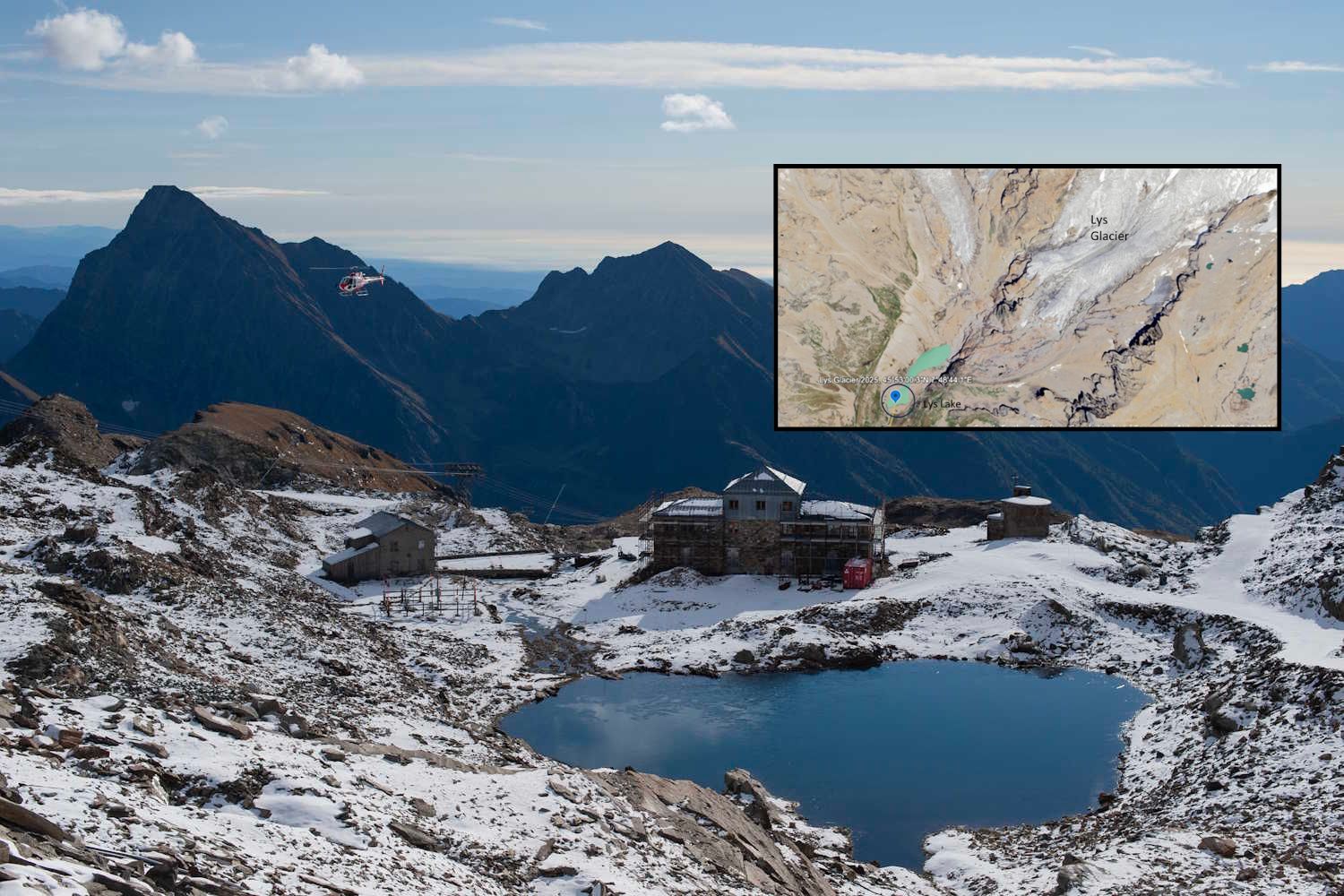
Up to 3.08 nanograms per liter of PFAS in the meltwater of the Lys glacier, on the southern slope of Monte Rosa. This is the most alarming data that emerges from two sampling campaigns carried out by Greenpeace Italia, which document significant contamination even in one of the most remote environments in the Alps, in Valle d’Aosta.
The analyses, carried out in October 2024 and July 2025, concerned both the waters of the Lys river, at approximately 2,000 meters above sea level and 1.5 kilometers downstream of the glacial lake, and the waters of Lake Lys, located at approximately 2,340 metres.
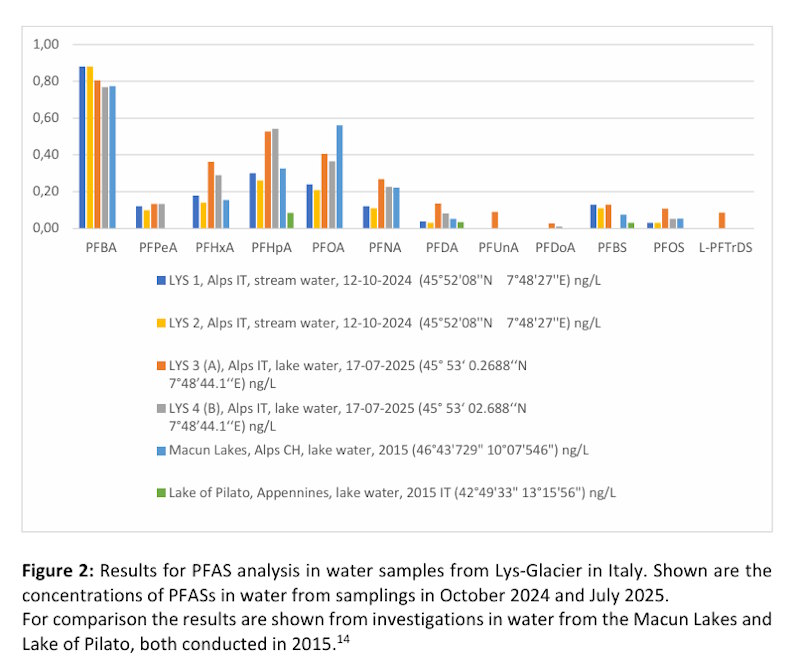
In all cases, PFAS were detected, with higher concentrations in the glacial lake than in the river, confirming the role of glaciers as reservoirs of persistent contaminants.
The report
The sum of PFAS identified varies from a minimum of 1.87 ng/l up to a maximum of 3.08 ng/l, values in line with those found in other alpine and high mountain areas in different parts of the world.
In all samples analyzed, the predominant substance was found to be perfluorobutanoic acid (PFBA), a short-chain (four carbon atoms) PFAS, used in various industrial products and often resulting from the degradation of more well-known and dangerous compounds such as PFOA. However, TFA (trichloroacetic acid), an ultra-short and highly mobile PFAS, which is now at the center of growing concern among European authorities, was not researched.
The results confirm what was already observed ten years ago by Greenpeace International in the Macun Lakes, in Switzerland, about 200 kilometers from Lake Lys. Further proof that no place is truly “pristine”.
Although these samplings do not constitute a systematic investigation, the picture is now clear: the contamination of the most remote areas of the planet is linked to known mechanisms, from long-distance atmospheric transport to direct human presence. To truly understand the scale of the problem and its long-term effects, Greenpeace highlights the need for more in-depth investigations into glacier meltwater.
Because even if the high altitude is contaminated, the problem is no longer far away: it is already descending into the valley.
PFAS are persistent molecules that can be transported to the peaks by rain and snow, says Alessandro Giannì of Greenpeace Italia. As long as these substances are used in abundance as they are today, their environmental concentrations will continue to increase. A legacy that we leave to future generations: we have a duty to intervene so as not to worsen the situation, banning these dangerous molecules and thus placing a limit on contamination.
Glaciers constitute a historical memory of the contamination of our planet: dangerous substances such as DDT and PFAS accumulate over time in the ice and can be dispersed again by melting caused by climate change: this could explain why the highest concentrations of PFAS were found in the lake during the second sampling. In our valleys and mountains, climate crisis and pollution therefore dangerously intersect with serious risks for human communities and ecosystems.
HERE is the complete report.
