

Once again we are talking about a group of substances that now seem to be everywhere. PFAS, chemical compounds used for decades in hundreds of industrial and household applications from food packaging to waterproof fabrics, have accumulated over time in water, soil and air. And now they inevitably end up in our glasses, whether we drink tap water or, as a new French survey confirms, whether we opt for bottled water.
The consumers’ magazine Que Choisirwhich had already detected worrying concentrations of PFAS in the tap water of 30 French municipalities as early as February 2025, has now turned its attention to bottled mineral and spring waters, subjecting 32 samples to laboratory analysis. The results confirm a fairly dramatic trend: there is no longer a water source that can be said to be completely safe from eternal pollutants.
The monitoring focused on the 20 PFAS indicated by a European directive, which sets an overall limit of 100 nanograms per liter (ng/l) for drinking water. For natural mineral waters, an even more restrictive value applies in France: 30 ng/l.
The good news is that, of the 20 PFAS monitored, only a few were detected, and only in three mineral waters and one spring water, often in modest quantities. The only significant exception concerns the Carrefour natural mineral water with added carbon dioxide, coming from the Perle spring in Ardèche: the sample contained 8 of the 20 PFAS monitored, for a total concentration of 21.7 ng/l — close to the French threshold of 30 ng/l.
The most serious problem, however, is the presence of four particularly dangerous pollutants: PFOA, PFOS, PFNA and PFHxS. Their combined concentration in the Carrefour sample reached 13.7 ng/l, far exceeding the 2 ng/l limit adopted by countries such as Denmark for these specific compounds. Not surprisingly, the retailer has announced the suspension of the sale of the product.
TFA: the pollutant that no one yet regulates
The most worrying data from the investigation, however, concerns a different substance: trifluoroacetic acid, or TFA, a PFAS for which there is not yet a maximum limit defined at European level. Released into the environment by refrigerants and pesticides, it is very persistent and suspected of being toxic to the liver and reproduction.
In the bottled waters analyzed, TFA proved to be by far the most widespread PFAS: detected in 21 out of 32 samples, and in 17 cases above 100 ng/l. The maximum value – 650 ng/l – was measured in Thonon natural mineral water, from Haute-Savoie. Followed by Vittel (440 ng/l), U Acqua Minerale dei Pyrenees (410 ng/l), Saint Antonin (370 ng/l) and Contrex (350 ng/l).
Among the 32 samples analyzed there are also brands that are very popular in Italy. San Pellegrino, for example, showed a TFA level of 100 ng/l – average for the sample, but still detected.
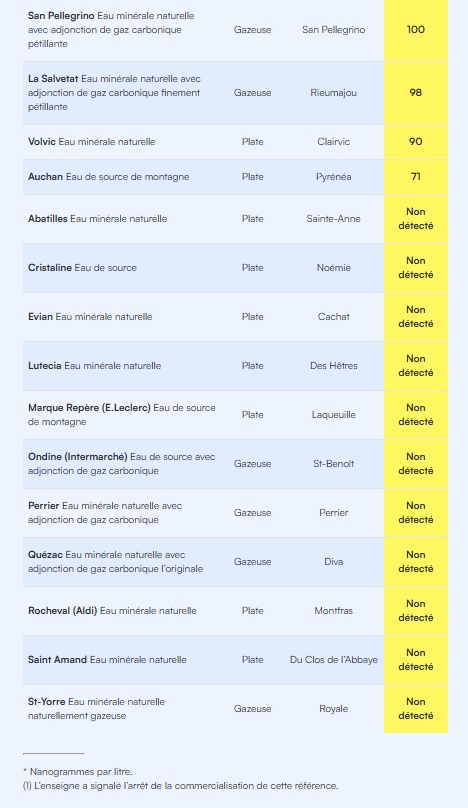
These numbers remain below the provisional threshold of 2,200 ng/l adopted by the Netherlands – the currently most protective country when it comes to TFA – but are destined to rise over time if nothing is done, given the persistence of the substance in the environment.
And in Italy? In our country, a limit value for TFA of 10,000 ng/l has been set, the application of which is expected from 12 January 2027. A considerably less restrictive limit than the Dutch one.
Even the deep aquifers are not safe
One of the most alarming aspects of the study is the confirmation that PFAS – and TFA in particular – now also reach deep underground springs, the ones from which mineral and spring waters sold in bottles come.
The problem is that, unlike tap water, mineral waters can only be subjected to very limited treatments. Activated carbon filtration, commonly used to remove PFAS from tap water, is not permitted for natural mineral waters. As Christophe Lekieffre, general delegate of the French Union of Spring and Natural Mineral Waters, explained, the technical options available are few, and do not include the most effective ones.
The French High Council for Public Health has asked the government to set a specific limit of 20 ng/l for the four most dangerous PFAS (PFOA, PFOS, PFNA, PFHxS), a recommendation that has not yet been met. And at a European level, the definition of a toxicological reference value for TFA is still awaited, the process of which has been postponed to July 2026.
