
What are PFAS and why do they worry scientists and institutions around the world
They call them “forever chemicals”, eternal substances. A name that says everything about their nature and the danger they represent for the environment and human health. PFAS — acronym for Perfluoroalkyl Substances, or perfluoroalkyl substances — are organic molecules characterized by the replacement of most of the hydrogen atoms with fluorine atoms. It is precisely this chemical structure that makes them extraordinarily stable and, at the same time, extraordinarily dangerous.
The presence of numerous carbon-fluorine bonds gives these substances particular physico-chemical properties: repellency to water and fat, high thermal resistance, surface activity. Characteristics that have made them the undisputed protagonists of decades of industrial development, finding use in a vast number of everyday applications and products.
Where PFAS are hiding: from the frying pan to dental floss
The list of products that contain PFAS is as long as it is surprising. In the agricultural sector they are present in irrigation water, chemical fertilizers and substances used to process raw materials. In food packaging — including those of major fast food brands such as McDonald’s and Subway, according to a recent European study — PFAS are a systematic presence. And containers made of biodegradable cellulose or bamboo, often perceived as more ecological, but which in reality also contain these substances, are not overlooked.
The list goes on with paints, floor waxes, household cleaning products, fire extinguisher foams, soaps, hairsprays, shaving cream, makeup, deodorants and even dental floss. In waterproof fabrics, carpets and tanned leather. And, perhaps in the product best known to the general public, in non-stick pans: Teflon, or polytetrafluoroethylene, owes its famous non-stick properties to PFAS.
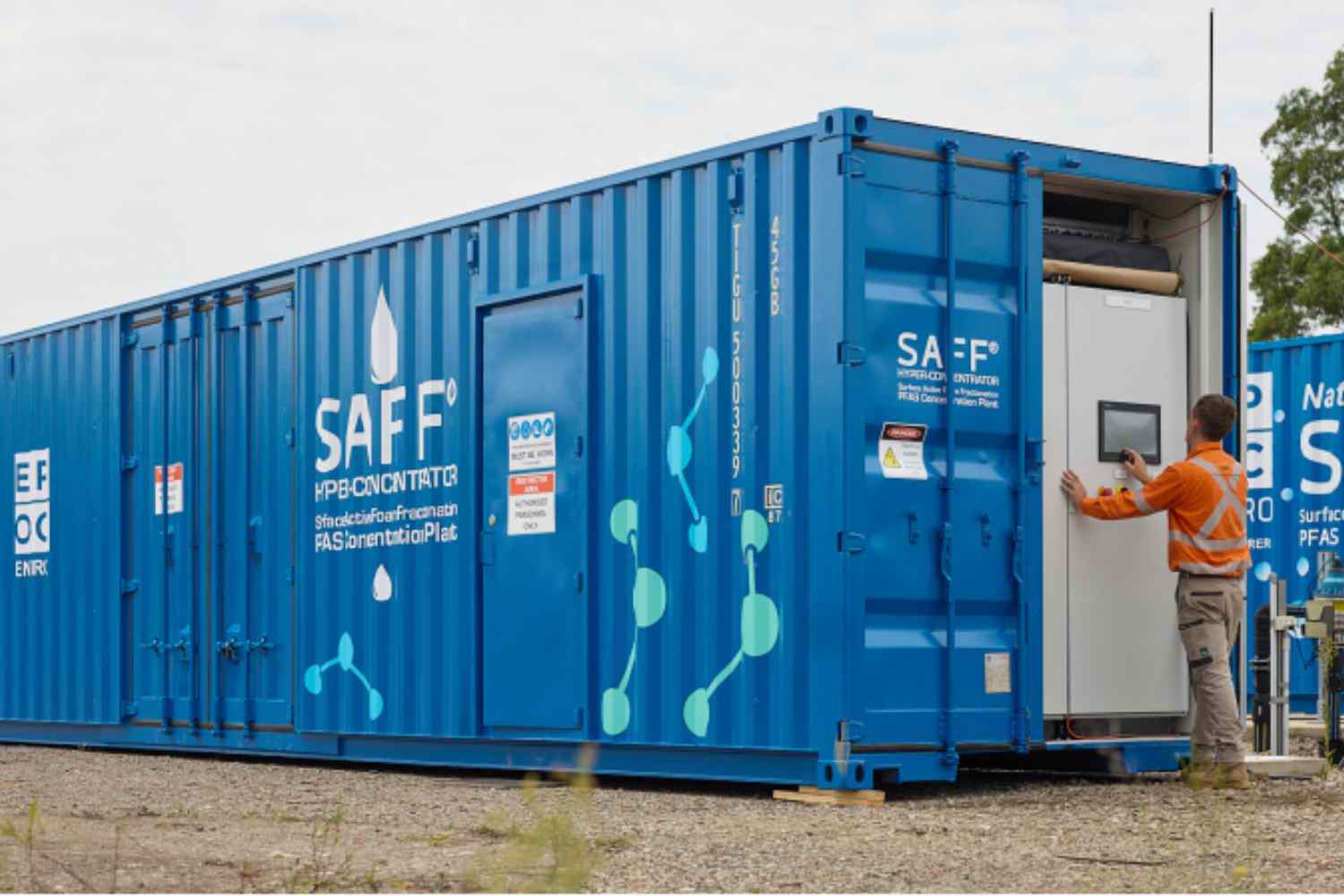
The technological answer: the first SAFF®40 arrives in Italy
In this complex and urgent scenario, concrete news arrives. On 19 February 2026, Erica Srl — distributor of Australian technology for Italy — formalized the agreement with Acqua Novara VCO, one of the most important water managers in Piedmont, for the installation of the first SAFF®40 system in Italy.
SAFF® stands for Surface Active Foam Fractionation: a technology patented and produced by the Australian company EPOC Enviro, already operational in over 40 sites around the world for the treatment of wastewater and landfill leachate. The operating principle exploits the chemical-physical properties of PFAS: inside a “plug & play” container, an air bubble system traps the molecules by concentrating them in an extremely small quantity of foam, allowing a removal of up to 95-99% of the main types of PFAS monitored, depending on the matrix treated and the initial concentrations.
The European and British distribution of the technology is entrusted to Cornelsen Group, which has chosen Erica Srl as its Italian partner. A choice that rewards a path that began in 2017, when the company began to systematically work on identifying innovative solutions for the abatement of PFAS.
Acqua Novara VCO: the experimentation that can open a national road
The system will be installed at Acqua Novara VCO SpA, manager of the integrated water service for 139 municipalities in the provinces of Novara and Verbano-Cusio-Ossola. The choice is not random: after several laboratory tests, the utility decided to start direct testing of the technology, confirming a declared orientation towards innovative, sustainable and highly effective solutions.
The arrival of the first SAFF®40 in Italy represents an important step in the path of technological innovation applied to the management of PFAS
declared Isabella Stilo, President of Erica.
Like Erica, we have been working since 2017 to identify concrete solutions, scientifically validated and already operational at an international level.
Along the same lines, Daniele Barbone, CEO of Acqua Novara VCO:
The launch of this industrial test is part of our integrated model of protection from PFAS pollution. Being the first to experiment with this solution in Italy is a tangible sign of our propensity for innovation and the desire to build, together with stakeholders, solutions to protect the local ecosystem.
The installation could represent a turning point for the treatment of wastewater contaminated by PFAS in Italy and pave the way for a nationwide diffusion of technologies that are finally up to one of the most difficult environmental challenges of our time.
