
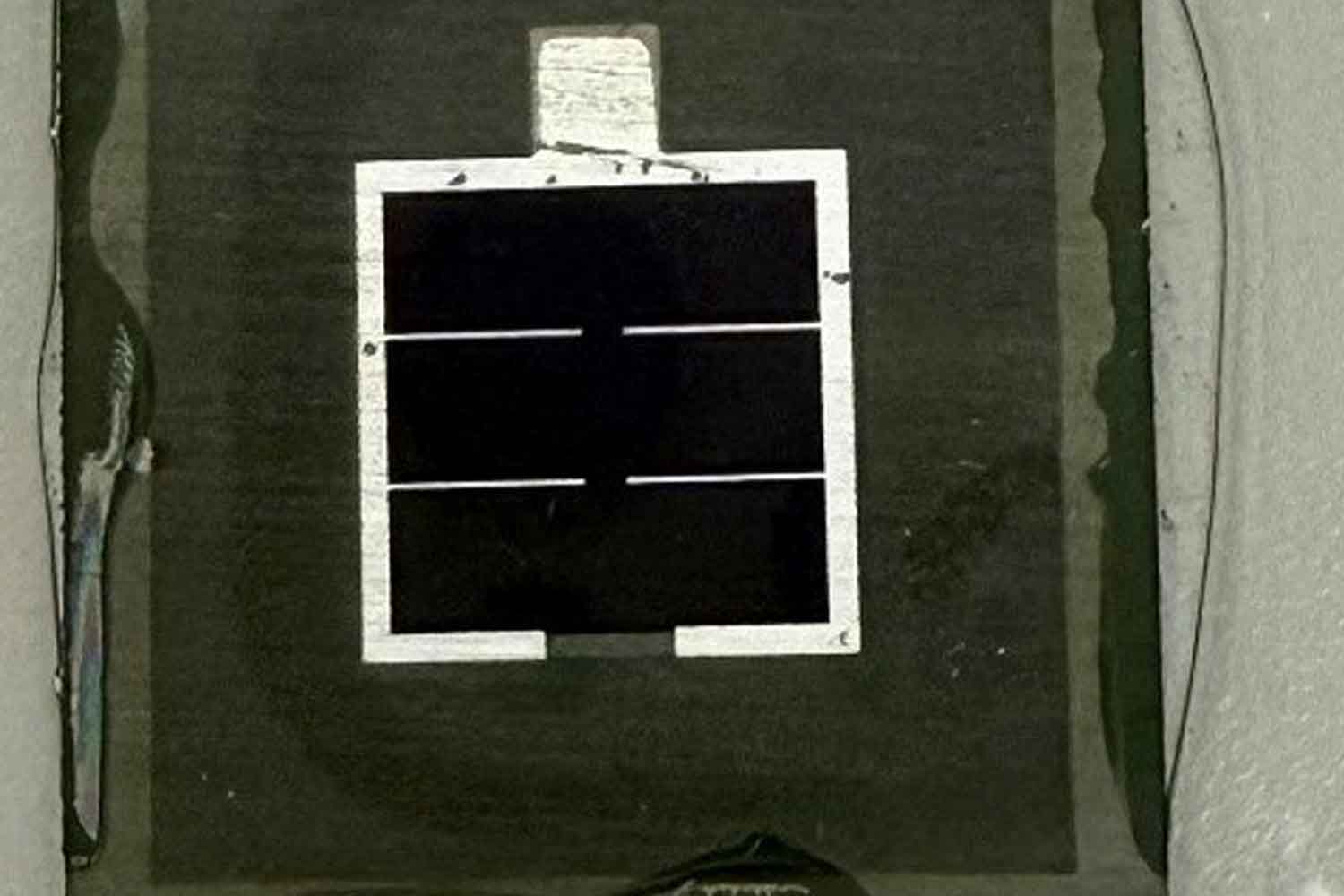
A team of researchers of Academia Sinicathe most prestigious research institute in Taiwan has announced an important milestone in the renewable energy sector. Scientists have developed one Solar cell tandem perovskite-silicio with two terminals (2T)capable of reaching an energy conversion efficiency of 31.5%.
According to an official declaration issued by the Institute, the research team is already committed to further improve the project. The objectives include the optimization of the production process, the increase in the surface of the cells, the improvement of the stability of the stratified components and the development of manufacturing methods suitable for large -scale industrial production.
“Our high efficiency has been obtained by reducing interface losses,” explained the team. This declaration underlines how the improvement of the technology behind the cells is crucial to obtain superior performance.
Structure and materials of the new Solar Tandem Cella
The tandem cell was made by combining innovative technologies for both the lower and upper section. For the lower device, the researchers used one Crystalline Etherlogical Solar Technology (HJT)without providing further specific details on the configuration.
The upper device, on the other hand, is based on a perovskite solar cell that integrates different advanced materials:
This combination of materials allows the cell to reach a high level of efficiency, while maintaining a compact and optimized design.
Comparison with the world efficiency records
Despite the success of the Academia Sinica project, the world record for the efficiency of the perovskite-Silicium tandem cells is currently detained by the Chinese Longiwhich in September 2023 reached an efficiency of 34.6%. Over the same year, the King Abdullah University of Science and Technology (Kaust) In Saudi Arabia he announced a cell with an efficiency of the 33.7%.
According to researchers of the Fraunhofer Institute for Solar Energy Systems (Fraunhofer ISE) In Germany, the maximum theoretical efficiency of the tandem solar cells could reach the 39.5%. However, to exceed this threshold, it will be necessary to introduce new cell architecturereplacing the Fullerene (C60) with a more transparent electrons transport layer and finding alternatives to the branch-stagno oxide (ito), which improve the overall transparency of the devices.
Other global progress in the tandem cells sector
Further innovations come from China, as shown by the perovskite-similes tandem cell developed by scientists of thePolytechnic University of the North-West of Xi’anin the province of Shaanxi. This four terminal cell, semi-transparent, integrates an advanced Protective branch oxide layer (in₂o₃)which not only improves overall efficiency but is also produced through a low -cost method and solvents. It is a more sustainable and easily scalable approach to industrial production.
The international competition to overcome the limits of photovoltaic efficiency, however, does not stop there. The Chinese company Longi has recently set up a new record by reaching the 33.9% of efficiency With a perovskite-Silicium tandem cell. This milestone is particularly significant as it exceeds the first time Theoretical limit of 33.7% Shockley-Qockley-Queisser For single junction cells, opening new possibilities for energy efficiency and productivity on a global scale.
Also the British company Oxford PVin collaboration with the Fraunhofer Institutecontributed to the revolution in the photovoltaic sector. Their announcement of an efficiency of the 25% For solar panels Tandem Perovskite-Silicio demonstrates the potential of this technology to revolutionize the market. Oxford PV is thus confirmed as a leading actor in the transformation of renewable energies.
The future of renewable energy is getting closer, and with each new efficiency record we approach a global energy system cleaner, sustainable and competitive.
