
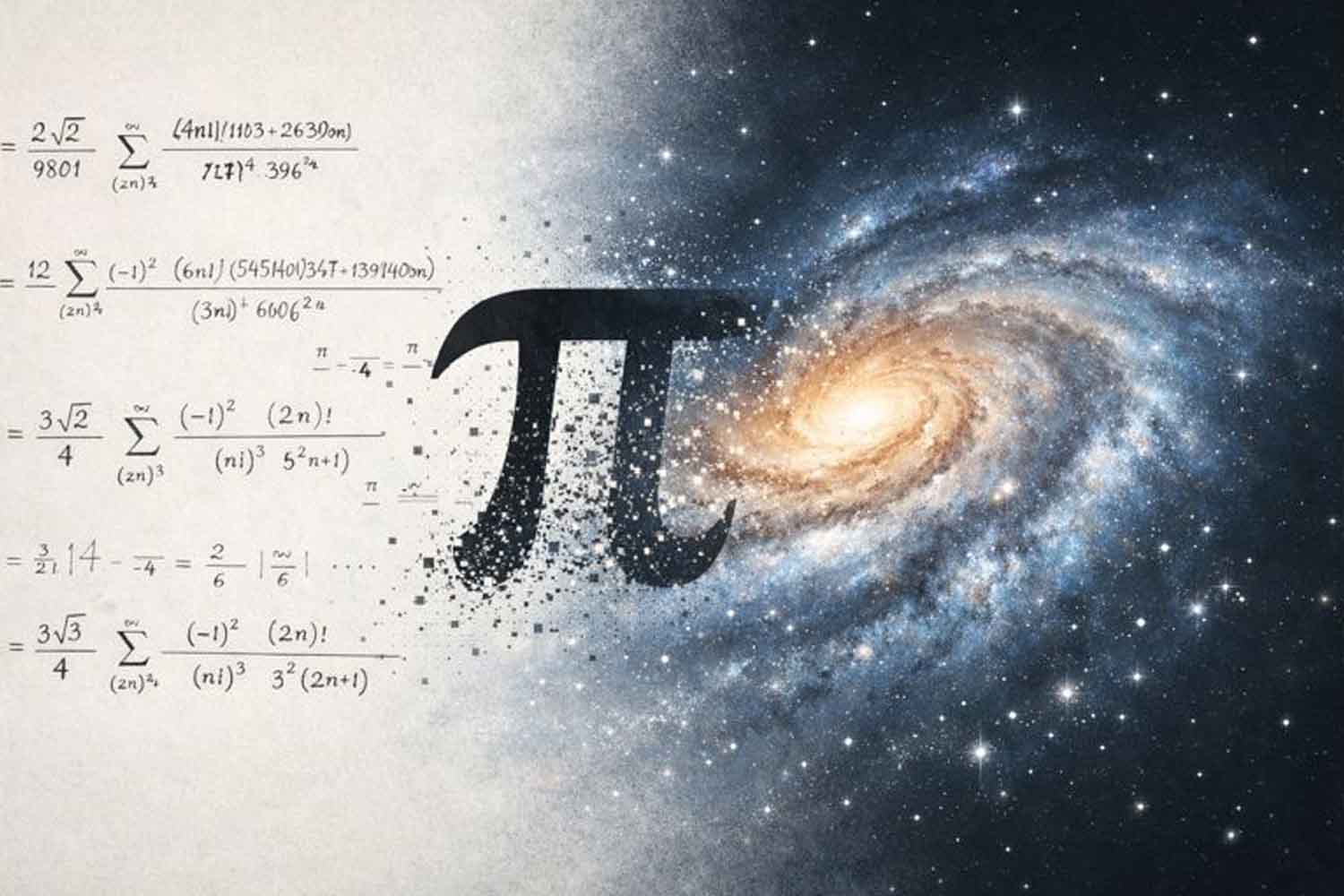
Sometimes mathematics seems distant from real life. Numbers, symbols, formulas that only live on paper. Yet, some intuitions born more than a hundred years ago are now returning to the center of scientific research because they help to understand how the universe works, from black holes to fluid turbulence. This is the case of Srinivasa Ramanujan’s pi formulasone of the most enigmatic mathematicians of the twentieth century.
In 1914 Ramanujan arrived in Cambridge with a notebook full of notes. They were inside 17 formulas to calculate 1/π which left the mathematicians of the time speechless. They were incredibly efficient: just a few steps were enough to obtain many correct digits of pi, much faster than any method known until then.
For decades those formulas were considered a masterpiece of pure mathematics. They worked, they were used, but no one could really explain why they were so powerful. There was a lack of connection with the physical world, with concrete reality. Today, however, something has changed.
A group of researchers fromIndian Institute of Sciencein India, discovered that the mathematical structures hidden behind Ramanujan’s formulas are the same ones used by modern physics to describe extreme phenomena: systems on the verge of transformation, materials that change state, up to theoretical models of black holes.
Who was Ramanujan and why his work continues to amaze us
Ramanujan’s story seems almost unreal. Born into poverty in southern India, with very little formal education, he taught himself mathematics, studying books he found by chance and going far beyond what was written. His formulas seemed to appear already complete, without demonstrations, as if he had simply “seen” them.
When he began sending his results to European mathematicians, many ignored them. Only one, G. H. Hardyhe understood that those ideas could not be the result of chance. He took him to Cambridge, where Ramanujan produced an impressive amount of results in just a few years, before falling ill and dying at just 32.
Among his most important legacies are the pi formulas. Even today, the most advanced algorithms for calculating pi are based directly on his work. Some recent calculations have reached hundreds of trillions of digitsusing methods that derive from his intuitions.
The turning point: when mathematics meets physics
The researchers wondered whether those formulas could arise “naturally” within a physical theory. The answer took them towards the conformal field theoriestools used to describe systems in extreme conditions, when normal laws stop working as we are used to imagining.
A simple example is water at the exact moment it stops being distinguishable between liquid and vapor. At that critical point, the differences disappear and the system behaves the same at any scale. This is precisely where these theories come into play.
The most particular versions, called logarithmicare used to describe complex phenomena such as the diffusion of fluids in porous materials, the formation of turbulence, some quantum states and even theoretical models of black holes. And it is here that Ramanujan’s formulas re-emerge, in an unexpected way.
Pi as the hidden key to extreme phenomena
By analyzing Ramanujan’s pi formulas with the language of modern physics, the researchers discovered that those mathematical expressions correspond to very specific physical quantities. Parameters that seemed abstract actually describe how a system reacts when it is disturbed, when it loses balance, when it approaches a radical transformation.
The result is also surprising from a practical point of view. Calculations that would normally require very long steps can be drastically simplified, reduced to compact expressions, just as Ramanujan did with pi.
The same mathematical scheme also appears in models that describe what happens near the horizon of a black hole, how perturbations propagate in space-time, and how matter behaves in extreme conditions.
When mathematics comes before reality
It’s not the first time this has happened. The geometry developed in the nineteenth century found application in general relativity only decades later. The mathematical transforms created to study heat are now the basis of digital images and data compression. Ramanujan fits into this tradition. Working in isolation, without knowledge of modern physics, he identified structures that are central to understanding the universe today. His work does not provide a definitive answer to the great mysteries of the cosmos, but it opens new paths.
The same researchers are now also finding these mathematical structures in the models of a expanding universe. A sobering detail: as we calculate the circumference of a circle, we may be using the same rules that govern the deeper fabric of reality.
