
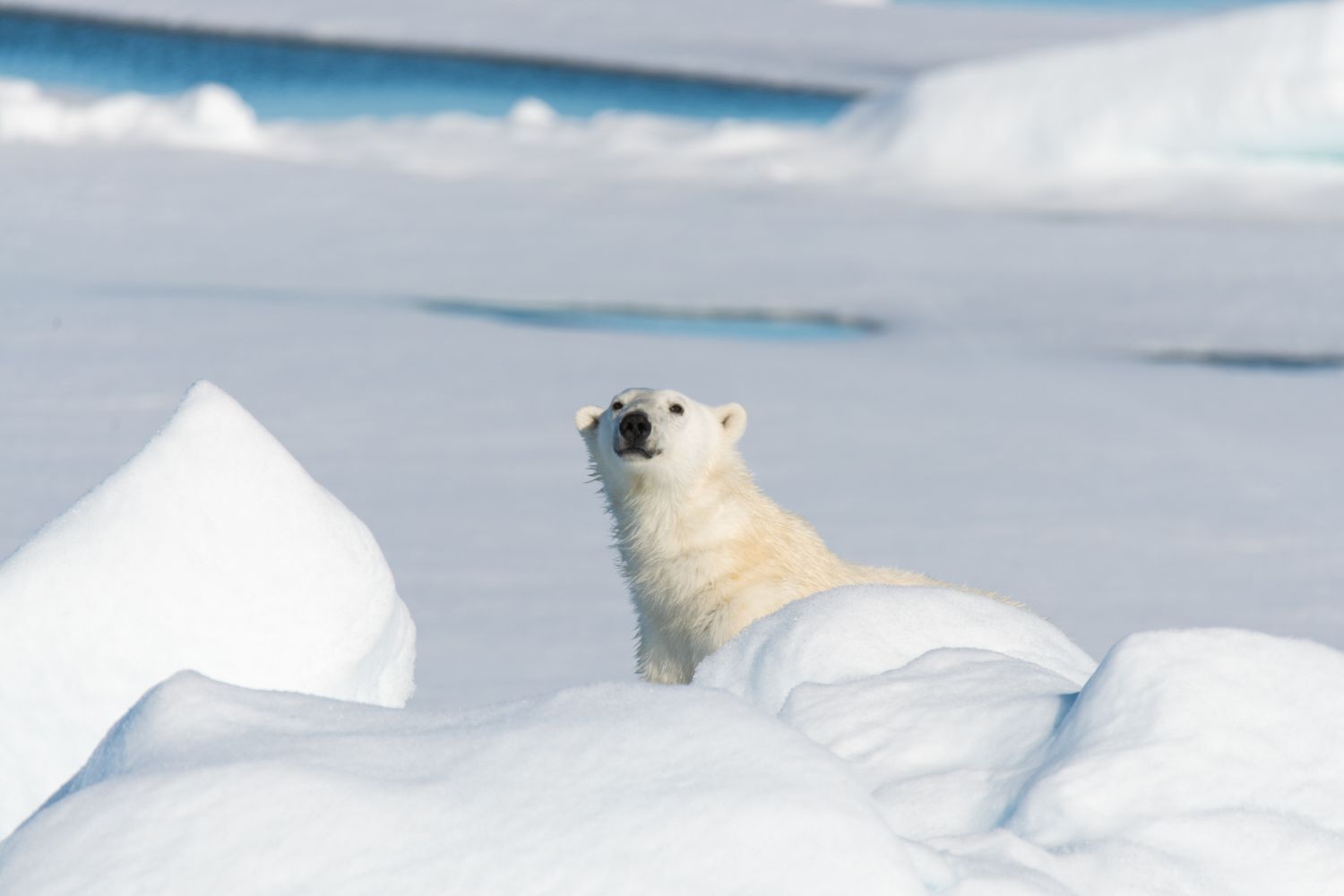
Some genes of polar bears living in southeastern Greenland are behaving differently in response to rising temperatures. This is good news for the species, which is in fact trying to adapt to climate change, but it is also further confirmation of what scientists have been saying for decades. The study was led byEast Anglia University (United Kingdom).
The research has specifically found that some genes related to heat stress, aging and metabolism are “reacting” to adapt to warmer climate conditions: the discovery suggests that these genes play a key role in how different populations of polar bears adapt or evolve in response to local climate and dietary changes.
More than two-thirds of polar bears are predicted to be extinct by 2050, with total extinction expected by the end of this century. The Arctic Ocean is showing ever-increasing temperatures, reducing the vital sea ice shelves used by bears to hunt seals, causing isolation and food shortages. This research is therefore particularly significant.
The researchers analyzed blood samples taken from polar bears in northeastern and southeastern Greenland to compare the activity of transposons – small, mobile portions of the genome that can influence the functioning of other genes – their relationship to temperatures in the two regions and associated changes in gene expression.
Temperatures in northeastern Greenland are colder and less variable, while in southeastern Greenland they fluctuate, and the latter is a significantly warmer and less frozen environment, thus generating the conditions for numerous challenges and changes to the local habitat, similar to the future conditions expected for the species.
DNA is the instruction booklet inside every cell, which guides the growth and development of an organism,” explains Alice Godden, lead author of the work. “By comparing the active genes of these bears with local climate data, we found that rising temperatures appear to result in a dramatic increase in transposon activity in the DNA of bears from southeastern Greenland. Essentially, this means that different groups of bears have different sections of their DNA modified at different rates, and this activity appears to be linked to their specific environment and climate.
In other words, polar bears are trying to adapt to the changing climate to survive.
This discovery is important because it shows, for the first time, that a unique group of polar bears in the warmest part of Greenland are using transposons to rapidly rewrite their DNA, which could be a desperate survival mechanism against melting sea ice.
But be careful: even if this research offers hope, it does not mean that polar bears are less at risk of extinction.
However, we must do everything we can to reduce global carbon emissions and slow rising temperatures
Over time, our DNA sequence can change and evolve, but environmental stress, such as warmer climates, can accelerate this process. This study is believed to be the first where a statistically significant link has been found between rising temperatures and DNA change in a wild mammal species.
Among other things, alterations were also found in areas of DNA gene expression linked to fat processing, important when food is scarce: this suggests that southeastern bears are slowly adapting to the cruder plant-based diets that can be found in warmer regions, compared to the predominantly fatty and seal-based diets of northern populations.
We identified several genetic hotspots where these genes were highly active, some of which were located in protein-coding regions of the genome, suggesting that bears are undergoing rapid and fundamental genetic changes to adapt to their disappearing sea ice habitat.
The work is based on a previous study led by the University of Washington, which showed that the south-eastern population of Greenland polar bears was genetically different from the north-eastern group, after the “separation” which occurred about 200 years ago.
The authors say that understanding these genetic changes is important to guide future conservation efforts and analyses, allowing us to understand how polar bears might survive in a global warming world and which populations are most at risk.
And no, these results should not reassure us at all: they actually represent yet another confirmation of climate change.
The study, financed by Natural Environment Research Council and give it European Research Councilwas published on Mobile DNA.
Sources: East Anglia University / Mobile DNA
