
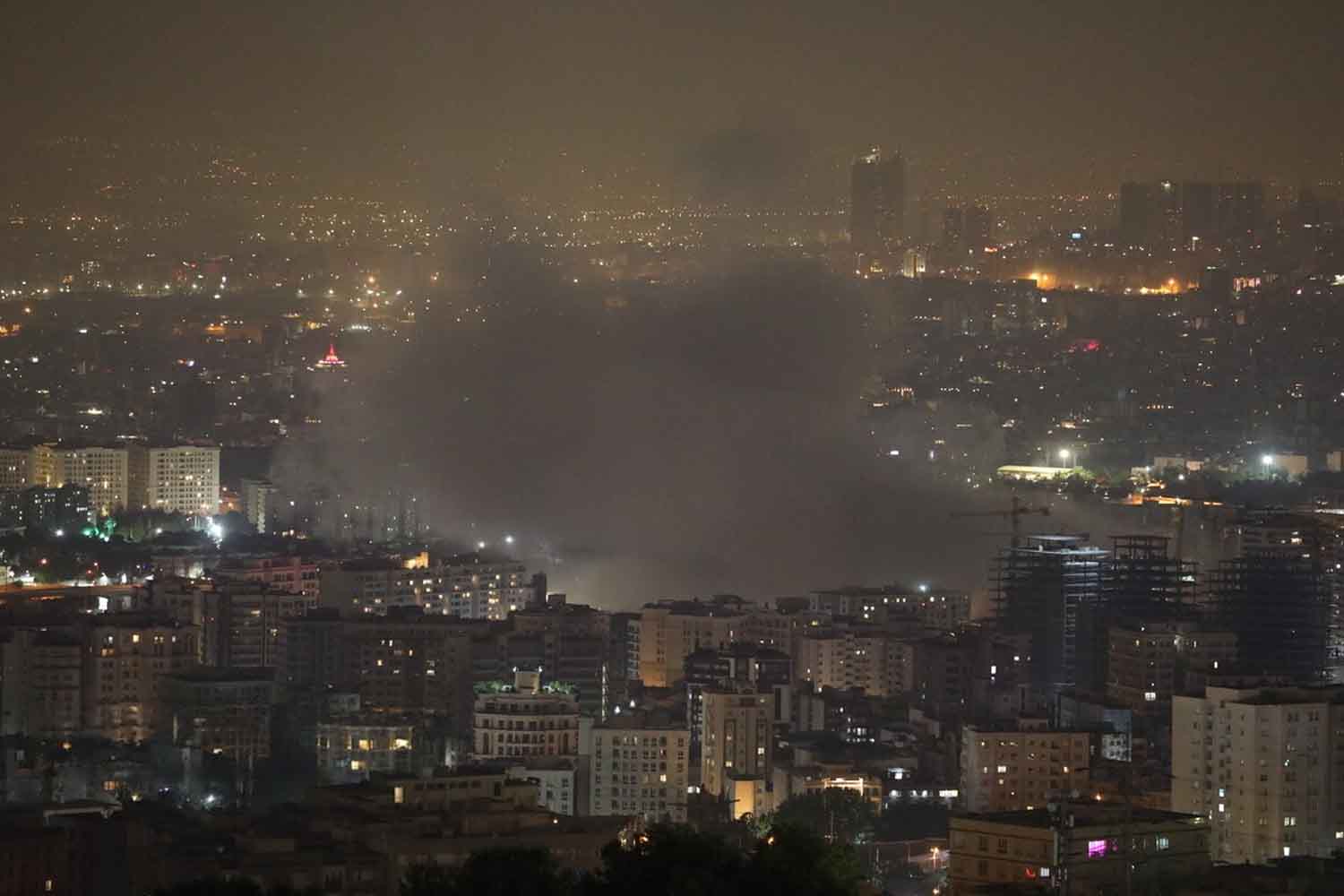
In recent weeks, with Israel bombing Iran and the United States covering everything with the lexicon of international security, I have begun to wonder when exactly we stopped bouncing in our seats when we hear the word “bombing”. Since when did society stop asking itself uncomfortable questions and start finding convenient answers?
The answer lies not in the palaces of power but within us, within the mechanisms with which the human brain transforms moral distress into something more manageable: it happens in the comments under posts, on talk shows, in conversations between friends over an aperitif. This is the moment when violence starts to sound reasonable. Indeed, necessary. Indeed, preventive.
The word “preventive” has become the most abused of the decade. Israel strikes first: pre-emptive strike. The United States supports: preventive deterrence. Iran responds: self-defense. Everyone has their justification, everyone has their technical language for not calling things by their name. And meanwhile the public debate turns into something that looks more like a football match than an analysis of what is really happening. Because the human brain, when the stakes are high, has an extraordinarily efficient mechanism to protect itself from moral distress. Scientists call it moral disengagement, and it works on everyone, no matter what flag they’re waving.
Why does the brain transform a bombing into a “reasonable” choice?
The concept was explored in depth by the psychologist Albert Bandura and systematically analyzed in a review published in 2016 (Moral Disengagement). It is a series of cognitive processes through which people are able to carry out, support or justify harmful actions without ceasing to perceive themselves as morally upright people. We are not talking about disturbed personalities. We are talking about ordinary people, with children, a job, a conscience.
According to the scientific literature, and in particular the study published on Aggressive Behaviorwhen violence is framed as necessary, defensive or inevitable, the brain autonomously reduces internal ethical conflict. The action changes label: an aggression becomes national security, a bombing on a civilian area becomes a surgical operation, destruction becomes prevention. The brain reclassifies everything with an ease that is almost envious.
The mechanism works through precise and documented strategies: moral justification, the diffusion of responsibility, the dehumanization of the enemy and advantageous comparison, or rather that automatic reflex that leads to saying “but they do much worse”. It’s not evil. It is psychological architecture. It’s the way the human brain manages the tension between “I consider myself a righteous person” and “I’m applauding a bombing of Gaza or Tehran.”
When these mechanisms are activated on a collective level – and in recent months they have been doing so quite evidently – violence stops being perceived as an ethical problem and becomes an acceptable strategic choice. First they say “it’s inevitable”. Then “it is necessary”. In the end it simply becomes the state of things, something that is no longer even worth commenting on.
What happens when the international order appears optional?
The pre-emptive strike, from the point of view of international law, lives in a gray zone built specifically to be comfortably inhabited. The system of rules born after the Second World War exists, it is written, it is signed: the United Nations Charter establishes that no state should resort to force without a clear mandate, without collective consensus, without at least going through the front door.
The problem is that that system doesn’t have a sheriff. It works as long as states voluntarily decide to respect it, and when a great power chooses to reinterpret the “right to preventive defense” for its own use – without a UN mandate, without consulting anyone – the rules stop being universal and become optional for those with enough strength to afford it.
The UN Secretary General explicitly criticized the attacks by Israel and the United States against Iran, citing the violation of sovereignty and the prohibition on aggression enshrined in the Charter itself. A criticism that remained, as often happens, suspended in the air without concrete consequences. When these violations are repeated and public opinion absorbs them as normal facts, the word “preventive” ceases to be a legal category and becomes something much simpler: an apology with an official stamp.
The glorification of “us” that makes those on the other side invisible
There is an even more disturbing passage highlighted by the study Ingroup Glorification, Moral Disengagement and Justice in the Context of Collective Violence. Research shows how the glorification of one’s own group concretely increases the likelihood of justifying violent actions against those perceived as outside that group.
It’s not a question of a sense of belonging, which is normal and healthy. The problem is when one’s group is idealized as morally superior, historically legitimized, above all criticism. At that moment, every dissident voice becomes betrayal and every external aggression is automatically reinterpreted as protection. The enemy ceases to be a person with a history, a family, a fear. It becomes a category, “Iran”, “the regime”, “terrorism”. Individual lives dissolve into geopolitical labels, which is an elegant way of saying that those people, in some corner of the brain of those observing from afar, have ceased to really exist.
This mechanism is particularly visible in the way in which Israel’s policy, supported financially and militarily by the United States, of striking first in the name of future security is portrayed. The pre-emptive attack is, by definition, a violence exercised against something that has not yet happened: a projection, a calculation, a prediction transformed into justification. Research on moral disengagement tells us that the more the “us” is sacralized, the more the “they” becomes expendable. And when the “us” is also the one that has one of the most advanced arsenals in the world, supported by the leading military power on the planet, the word “preventive” really risks becoming a safe conduct for anything.
It works just as efficiently on the other side, and to ignore it is to do exactly what you criticize. Let’s take the Iranian narrative: every Israeli provocation is framed as part of a plan of historical annihilation, every military response as the legitimate resistance of a people under siege. The language changes, since we are not talking about “surgical operations”, but about “defence of the Islamic nation”, yet the psychological structure is identical: moral justification, glorification of the group, dehumanization of the other. The ingroup is not Israel but the umma, or the Islamic Republic, depending on who is speaking. The “us” changes, the mechanism does not.
The same goes for Hamas and Hezbollah. Violence against Israeli civilians is systematically reframed as an act of anti-colonial resistance, which has the effect of shifting the moral burden from the action to its historical causes, a form of moral justification that is particularly effective because it contains elements of real truth, making it much more difficult to recognize as disengagement.
Then there is one last mechanism, perhaps the most convenient of all: the diffusion of responsibility. When violence is carried out by a state, by an army, by a coalition, the individual citizen perceives that he has no moral role in the matter. The decisions are “theirs”. Consciousness remains “mine”.
This disconnect allows us to support violent policies while maintaining an intact self-image, and it works in every latitude, let’s be clear. In Iran, in Israel, in the United States and even here, on the sofa, while shaking the phone. Think about the last time you saw a headline about a Hamas attack and thought “they had it coming.” Or the last time you saw a headline about an Israeli bombing and thought “at least someone stops them”. It doesn’t matter which one: both are moral disengagement. Your brain has already done its job before you finish reading the title.
The good news is that psychology also offers a way out. The studies cited show that awareness of disengagement mechanisms reduces the likelihood of automatically activating them. Understanding how the justification of violence works is already a first way to avoid falling for it. It doesn’t mean taking a geopolitical position (we already have that, or not). It means at least knowing that when a bomb is called a “preventive measure”, something in our brain has already been prepared to accept it. And recognizing that moment is, perhaps, the only truly useful gesture that can be done as spectators of this war.
You might also be interested in:
