
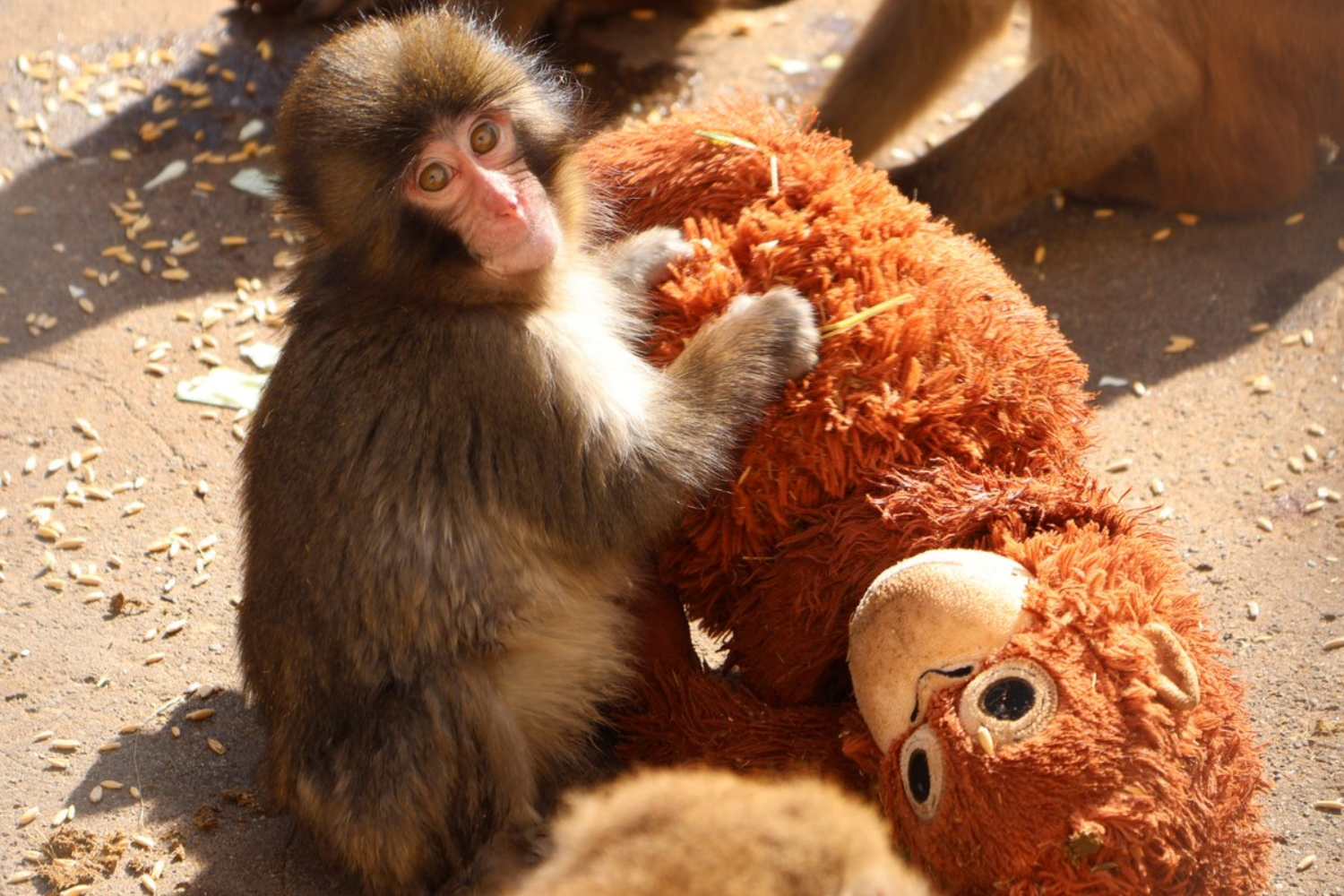
At the Ichikawa zoo, east of Tokyo, there is a small Japanese macaque who has conquered the internet holding an orange stuffed animal in his arms. His name is Punch, he is a few months old and has become the symbol of a story that mixes tenderness and fragility.
Born in the summer of 2025 and abandoned almost immediately by his mother, Punch was raised by keepers. In primates, maternal contact is not a detail but a biological necessity: the young cling to their mother’s fur for security, warmth and social learning. Without that presence, something inevitably remains suspended.
~お知らせ~
現在、サル山の中にぬいぐるみを持った子ザルがいます。
2025年7月26日に生まれ、放置されていたところから人工哺育で育ち、今年の1月19日から群れで過ごしています。
名前は「パンチ」という男の子です!
パンチの成長を暖かく見守ってください!#市川市動植物園 #ニホンザル#パンチ pic.twitter.com/jNpFSH0LOV— 市川市動植物園(公式) (@ichikawa_zoo) February 5, 2026
The object that replaces a hug
To help him manage his stress, the keepers introduced blankets and soft toys into the enclosure. Of all of them, Punch chose a plush toy in the shape of an orangutan, transforming it into a sort of emotional anchor. He sleeps hugged to that cloth body, he holds it when the other macaques reject him, he uses it almost as a shield in moments of uncertainty.
@allspeciesclub Rejected by his mother, but never alone.
Meet Punch, the 6-month-old baby macaque at Ichikawa Zoo who has captured the world’s heart. After his mother discarded him, this plush toy became his entire world. He doesn’t just play with it, he survives because of it. A reminder that everyone needs a place to feel safe.
#PunchTheMonkey #IchikawaZoo #Heartbreaking #AnimalRescue #BabyMonkey
♬ The Winner Takes It All – ABBA
The images made the rounds on social media, accompanied by the hashtag of encouragement dedicated to the little one. Thousands of users have shared photos and videos, saying they were moved by that puppy seeking comfort in an inanimate object. It is the clear expression of a need for attachment that crosses different species.
人工哺育から群れに戻った子ザルの「パンチ」
X上にも応援コミュニティができたそうです
本日コミュニティの皆様からあたたかい御寄附をいただきました
大切に活用させていただきます。#がんばれパンチ
↑このハッシュタグを付けてみんなの応援をパンチに届けよう!#市川市動植物園#ニホンザル pic.twitter.com/xk1gsLr0pb— 市川市動植物園(公式) (@ichikawa_zoo) February 6, 2026

The return to the group and the difficult adaptation
In January, Punch was gradually returned to the macaque group. Integration was not immediate: he did not fully learn the social codes typical of the species, because he missed those first months of observation and imitation. He approaches others, is sometimes rejected, then returns to the keepers or isolates himself with his stuffed animal.
Operators speak of slow but steady progress. Punch grows, gains weight, increases interactions. Yet that puppet remains a fixed presence, a sign that the path towards full socialization requires time and stability.
本日ご来園された皆様に心より御礼を申し上げます。
スタッフ一同これまで経験したことのない想定外の賑わいに大変驚いています。ゲート通過に時間を要し大変申し訳ありませんでした。
来週の三連休に向け、快適に楽しんでいただけるよう
準備を進めてまいります。#市川市動植物園#がんばれパンチ pic.twitter.com/PDCTM9sbI6— 市川市動植物園(公式) (@ichikawa_zoo) February 15, 2026
Tender yes, but destined for a life in captivity
Punch’s story is touching, sure. But it cannot be told without remembering that it takes place inside a zoo. No matter how well-kept the structures may be, a zoo remains a closed, controlled, artificial environment. Those are enclosures far from the natural habitat in which a macaque would live, explore and choose its own group.
Captivity is not a reduced version of freedom, it is another condition, where relationships, spaces and stimuli are inevitably limited. Punch didn’t go viral because it’s cute and cute and all good, but because something went wrong from the start. His resilience is real. Its sweetness too. But turning a story of forced adaptation into pure entertainment risks making us forget the essential: these animals should grow up in their habitat, not learn to survive behind a wire fence with a stuffed animal instead of a hug.
You might also be interested in:
