
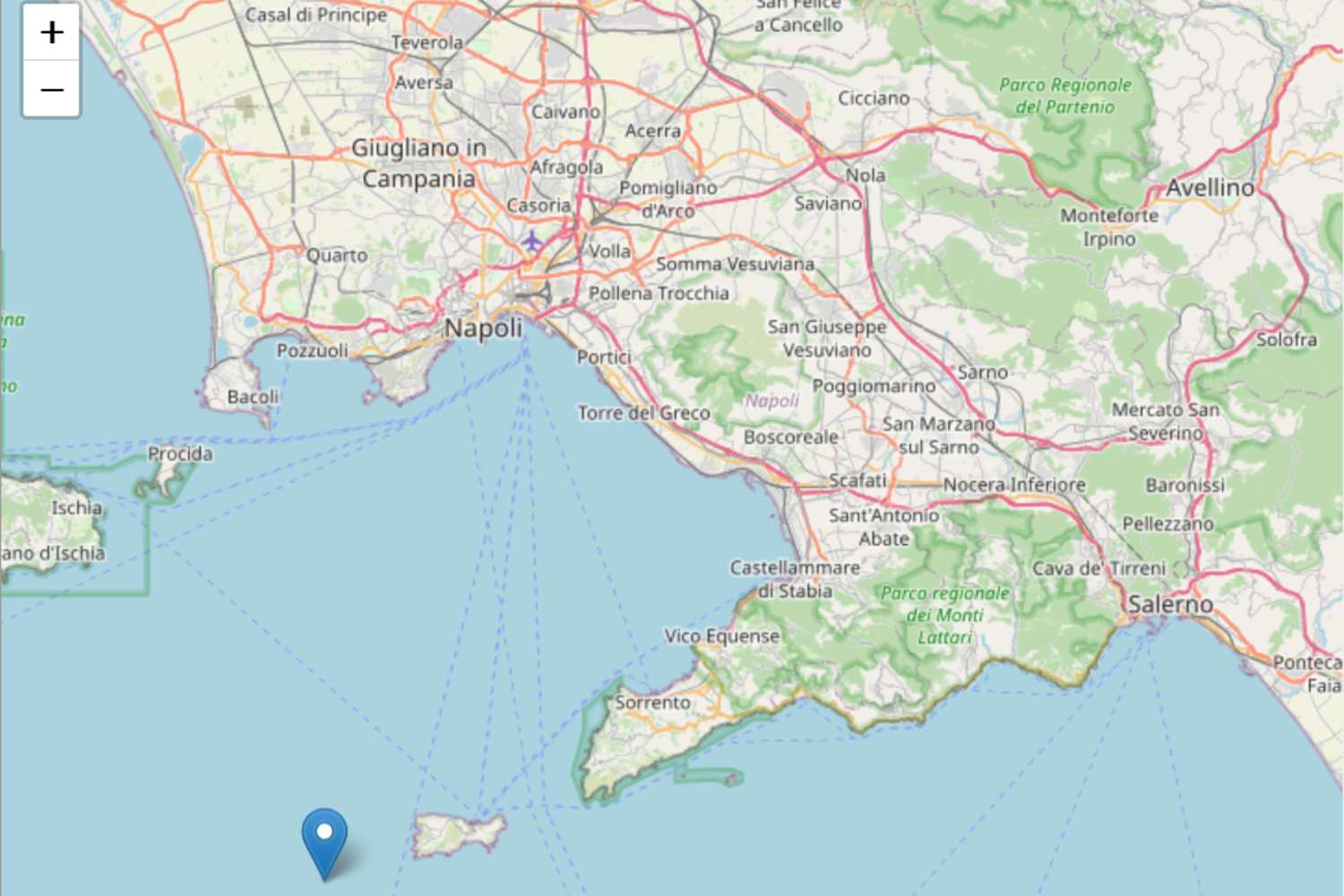
A strong earthquake has interrupted the quiet of the night in the Gulf of Naples. The seismic event was recorded at 00:03 today, March 10, with a magnitude of 5.9, and originated in the waters off the coast of Campania.
According to data released by the National Institute of Geophysics and Volcanology (Ingv), the epicenter was identified approximately 8 kilometers from Anacapri and 10 kilometers from the island of Capri. The earthquake was detected by the Seismic Room of Rome, which immediately analyzed the characteristics of the event.
Despite the epicenter being at sea, the shock was felt by many people. Reports have arrived not only from different areas of Campania, but also from other regions of Southern Italy overlooking the Tyrrhenian Sea. Some citizens reported having felt the movement even in other areas of the country, including parts of Northern Italy.
Preliminary data collected through questionnaires filled out by users indicate a level of macroseismic resentment between degrees III and IV on the MCS scale. A perceptible intensity, but which did not cause particular consequences on the territory.
Deep earthquake off the coast of Campania, ML 5.9, March 10, 2026 https://t.co/PFGD3cx37x
— INGVterremoti (@INGVterremoti) March 10, 2026
An earthquake much deeper than normal
What makes this earthquake particularly interesting from a scientific point of view is above all its exceptional depth. The earthquake was in fact recorded approximately 414 kilometers below the earth’s surface, a decidedly higher altitude than most Italian earthquakes. Normally earthquakes in our country develop in the upper earth’s crust, much closer to the surface. In this case, however, the event originated in the depths of the mantle, making it a rather rare phenomenon for the Campania area.
INGV experts explain that the earthquake is linked to a geological process typical of the southern Tyrrhenian Sea. In this region, for millions of years, a portion of oceanic lithosphere – called a slab – has been slowly sinking into the Earth’s mantle. This deep movement can generate a particular form of deep seismicity, which occurs especially along the areas close to the coasts of Calabria and Sicily, while it is less frequent off the coast of Campania.
The historical precedents and why the damage is limited
There have been no shortage of other earthquakes of this type in recent decades. Over the last 40 years, for example, several events with magnitudes close to 5.8 have occurred, some of which were recorded in 2016 at depths of over 200 and 400 kilometers.
Another significant earthquake was detected in 2010, with a magnitude of 5.4 and a depth of over 500 kilometers, while in 2023 a magnitude 4.2 earthquake was recorded off the coast of the Sorrento Peninsula. The most intense deep earthquake documented in the area dates back to 27 December 1978, with a magnitude of 5.9 and a depth of approximately 392 kilometers off the coast of Gaeta.
However, scholars underline an important aspect: the great depth of these earthquakes causes a strong attenuation of the seismic waves before they reach the surface. This means that, even when the magnitude is relatively high, the impact on the territory tends to be much more limited than shallow earthquakes. A fascinating and complex geological phenomenon that reminds us of how the Mediterranean subsoil is still a dynamic and continually evolving system today.
Delays on trains
The earthquake is also having repercussions on transport. Indeed, he provoked delays on the railway network that crosses the north of Naples. Northbound trains passing between Salerno and Napoli Centrale are accumulating delays between 25 and 100 minutes. In communications disseminated to Rome Termini station are also reported route changes and cancellations of some trips.
You might also be interested in:
