
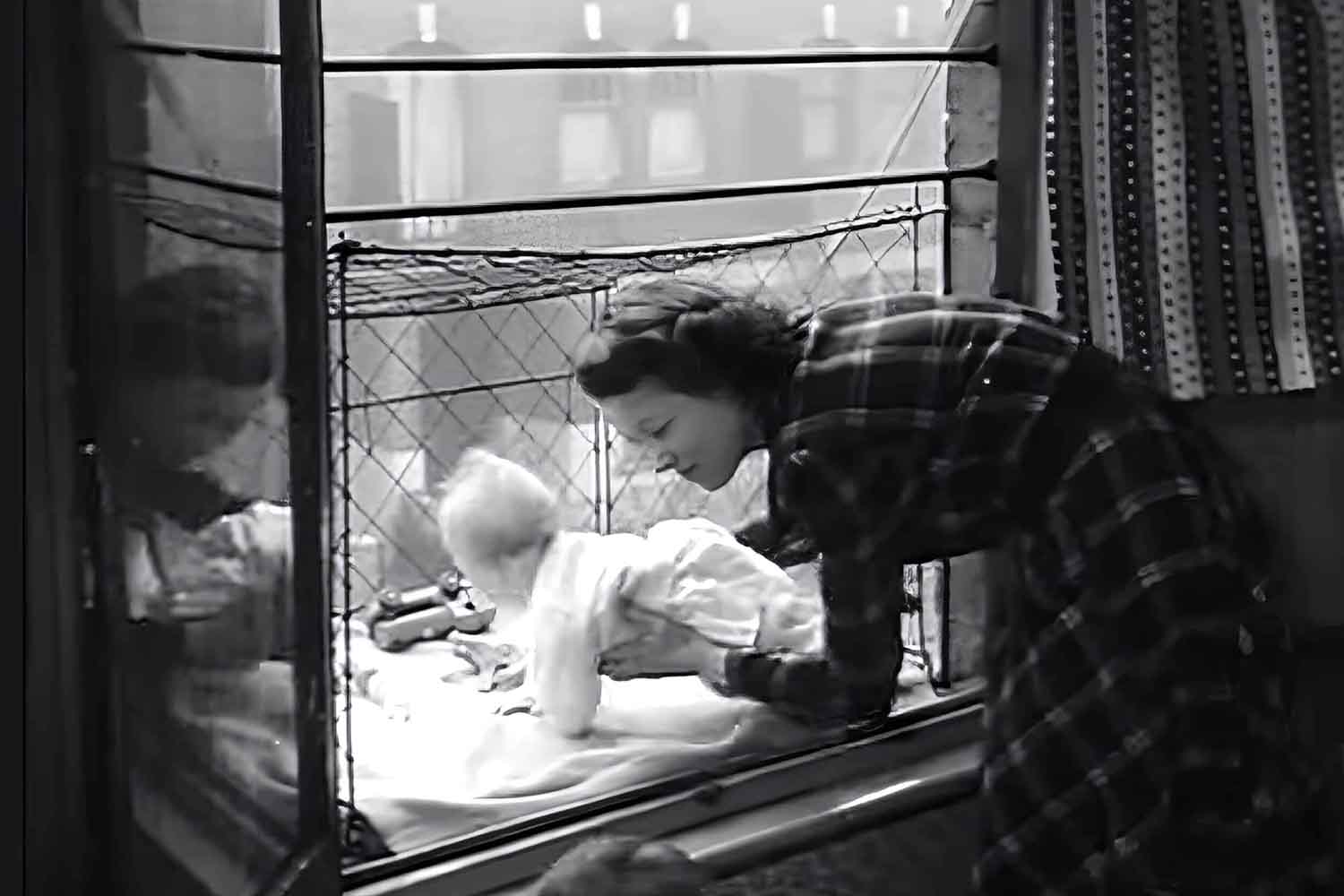
In the heart of the great industrial metropolises of the early twentieth century, when the smog of the factories entered the lungs and epidemics were more frightening than any fall into the void, the absolute priority was only one: breathing clean air. It is within this collective obsession for hygiene and health that one of the most surprising – and today almost disturbing – inventions dedicated to childhood was born: baby cages, also known as baby cage.
Today the idea of suspending a newborn baby out of the window would cause social services to intervene within minutes. In the twenties and thirties, however, it was considered a modern, sensible, even recommendable solution.
In cities like London and New York, apartments were small, overcrowded, and lacked balconies and gardens. Families lived in houses where the air stagnated and sunlight barely entered. The medicine of the time, still influenced by the “miasma” theory, attributed the spread of diseases such as tuberculosis and cholera to that closed air. Doctors reiterated that fresh air was essential for children’s health, and parents tried to adapt.
So someone had an idea that today seems like something out of a dystopian novel: hooking a small metal structure to the window, creating a sort of suspended balcony and placing the newborn on it for a few hours a day. The child remained safely inside a cage with a grilled floor, top cover and sturdy anchoring system, while breathing air considered healthier than that of the apartment.
The scene, seen with contemporary eyes, gives shivers. Seen with the mentality of the time, it represented a form of attention and care.
Emma Read’s patent and the idea of progress
In 1922, the American Emma Read filed the patent for her “Portable Baby Cage”, formalizing an intuition that was already circulating in the most innovative urban environments. His goal was clear: to give children living in city buildings access to sun and ventilation without forcing their mothers onto the streets.
The structure included a metal base, a fixing system designed to support the weight and superior protection against rain and direct sun. Everything was thought out in a practical way, consistent with the idea of progress that ran through the 1920s.
It is said that Eleanor Roosevelt also installed a similar device in her New York apartment, sparking mixed reactions among her neighbors. Safety concerns coexisted with the widespread belief that outdoor air was natural medicine.
If we look at the baby cage in its historical context, very concrete reasons emerge: ensuring oxygenation for newborns, compensating for the absence of green spaces, following medical recommendations on exposure to sunlight, optimizing tiny homes. The invention embodied a practical answer to a real problem, with the scientific knowledge available at the time.
From the fear of miasmas to the awareness of modern pollution
With the emergence of microbial theory and the progress of medicine, attention shifted from harmful vapors to bacteria and viruses. After the Second World War, baby cages gradually disappeared from London facades, thanks to urban reconstruction and the introduction of more rigorous safety regulations.
The paradox is evident: while in the early twentieth century there was an attempt to protect newborns from stagnant air by suspending them out of the window, in the following decades cities became filled with traffic and fine dust. Today we talk about indoor air quality, purifiers with HEPA filters and PM2.5 monitoring, and we know that urban air can be loaded with invisible pollutants.
Baby cages remain the symbol of an era in which trust in technique was intertwined with a different idea of risk. They tell the story of parents who wanted to do the best for their children, relying on the scientific certainties of the time. They also tell how the concept of safety evolves together with knowledge.
Looking at those photographs today means observing a fragment of the past in which health passed through a window open onto the void. It makes you smile, worries you, questions you. And it reminds us that every generation is convinced that it has found the best solution, until the future forces it to review everything.
You might also be interested in:
