
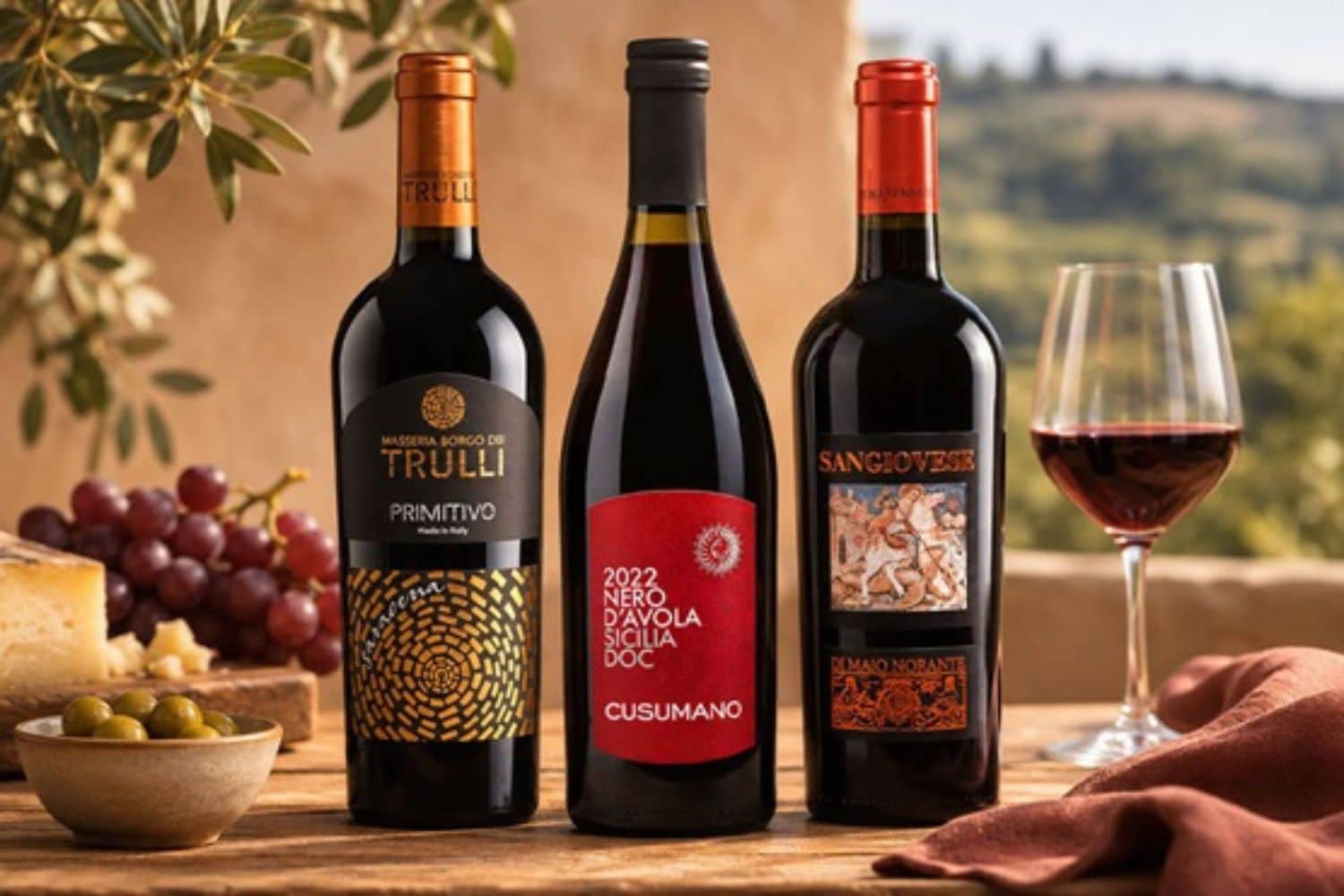
Choosing a good red wine from the supermarket without spending too much is possible, as demonstrated by the new test by Altroconsumo, which examined 48 Italian bottles through laboratory analyzes and blind tastings. The results confirm that price is not necessarily synonymous with quality: among the products that obtained the best ratings there were also two labels that cost less than 10 euros. Taking first place is a Primitivo from Puglia, while two wines from Southern Italy win the Best Buy award thanks to the excellent balance between quality and price.
The two best red wines under 10 euros according to Altroconsumo
Among the labels that obtained particularly positive results in the test, two southern wines stand out, both with a price of less than 10 euros. These are the Sangiovese Terre degli Osci IGT 2022 by Di Majo Norante and the Nero d’Avola Sicilia DOC 2024 by Cusumano. Both achieved 76 points out of 100 and the Best Purchase award.
By Majo Norante Sangiovese Terre degli Osci IGT 2022
The first of the two wines comes from Molise and is produced with pure Sangiovese grapes. The vinification and refinement take place exclusively in steel. Fermentation involves maceration on the skins which lasts about a month, followed by complete malolactic fermentation, a process which helps to make the wine softer. After the refinement period, the bottle rests for another three months before being released on the market. The name Terre degli Osci IGT recalls the Osci, an ancient Italic people who inhabited these areas.
The wine has an alcohol content of 13.5% and obtained 76 points out of 100, in addition to the Best Buy recognition. One of the aspects appreciated by Altroconsumo concerns the sulphite content, equal to approximately half the maximum limit for red wines. The tasting also returned a positive opinion: the tasters appreciated the aromatic intensity and finesse of the aromas, characterized above all by fruity hints. On the nose there are hints of morello cherry, dried plum and violet. The structure is also good, accompanied by a pleasant persistence.
Cusumano Nero d’Avola Sicilia DOC 2024
The second Best Buy comes from Sicily. Cusumano Nero d’Avola Sicilia DOC 2024 is made from 100% Nero d’Avola grapes, the most widespread black grape variety on the island.
Processing begins with destemming, which is followed by cold maceration on the skins for two days, at a temperature of 10°C. This phase allows the grapes to give off color and aromas. The must then ferments at temperatures between 26 and 28 °C. Subsequently the wine remains for at least five months on the fine lees, i.e. the residues of the yeasts that settle at the bottom of the tank. This step helps to enrich its complexity, before further refinement in the bottle.
Also in this case the final score is 76/100, with the recognition of Best Purchase. The alcohol content reaches 13.5% and the sulphite content is particularly low: just under half the limit set for red wines. The tasters appreciated the intense aroma, with a prevalence of fruity notes, the good body and the aromatic richness that accompanies the finish. In the glass, especially hints of currants, ripe plums and red fruits emerge.
What is the best red wine in the Altroconsumo test?
First place in the ranking goes to Masseria Borgo dei Trulli Primitivo Salento IGP Saracena 2024, an Apulian wine produced with 100% Primitivo grapes. The raw material comes from vineyards located in the municipality of Maruggio, in the province of Taranto, in the area called Saracena.
Production involves a particular step: before vinification, the grapes are left to dry for about ten days in wooden boxes. This technique allows you to naturally concentrate the aromas and color. Fermentation takes place in steel, at a controlled temperature between 23 and 25 °C, for a period of between eight and ten days. The wine is then transferred to barrique, where it ages for eight months and acquires greater complexity and harmony.
The result of the tests is particularly positive: with 89 points out of 100, Masseria Borgo dei Trulli wins the title of Best red wine of the test.
The alcohol content is 15% and the sulphite content is relatively low, equal to just over half the limit allowed for red wines.
During the tasting, the experts especially appreciated the intense and complex aroma, the structure and the notable aromatic persistence. Among the recognizable scents, black cherry, plum and undergrowth emerge, accompanied by toasted and spicy nuances reminiscent of cinnamon.
How the red wine test was conducted
The test is part of the broader work carried out by Altroconsumo for the 2027 Wine Guide, which examined over 100 products including red, white and rosé. For the ranking of reds, 48 Italian bottles were considered, subjected to two different types of evaluation: laboratory analysis and tastings by expert tasters.
The checks concerned in particular:
How to choose a good red wine at the supermarket
To orient yourself among the numerous bottles on the shelves, Altroconsumo’s first advice is to carefully read the label. This is where you will find the main information to understand which product you are purchasing.
Before choosing, it is useful to be clear which type you prefer: a young or refined wine, still or sparkling, dry or softer. The area of origin and the alcohol content can also help you identify a bottle suited to your tastes and the occasion. The label, however, does not allow us to predict with certainty whether a wine will meet our preferences. The final judgment depends on the tasting. This is why Altroconsumo suggests trying different products, comparing them and being guided by your own sensations.
Does spending more mean buying a better wine?
The analysis of the 48 bottles demonstrates that price does not always represent a reliable indicator of quality. This is confirmed by the two Best Buys in the ranking, the Sangiovese Di Majo Norante and the Nero d’Avola Cusumano, both capable of reaching 76 points out of 100 despite costing less than 10 euros.
An interesting fact also concerns the lower part of the ranking: in the last three positions there are wines belonging to higher price ranges. Among these there is even a bottle that exceeds 16 euros.
In short, cost is not enough to establish how good a wine is. Even among the supermarket shelves you can find convincing labels without necessarily orienting yourself towards the most expensive ones. For the complete ranking you can consult the Altroconsumo comparator
