
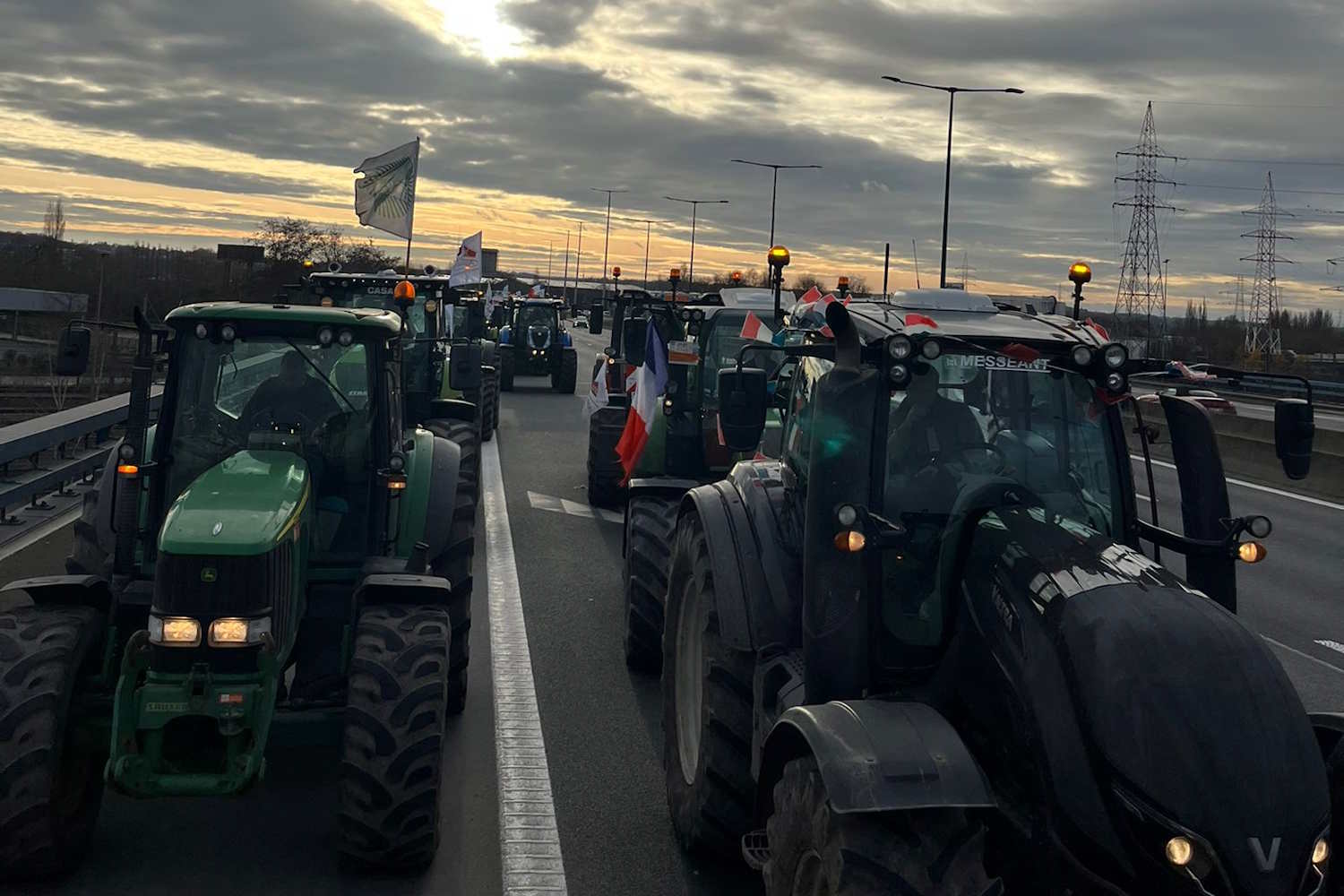
Brussels besieged by tractors. Since the night, the horns of agricultural vehicles have resounded in the streets of the Belgian capital, where thousands of farmers have arrived to protest against the Mercosur agreement and the new redistribution of European funds, judged to be penalizing for the entire agricultural sector.
The mobilization coincides with the last European Council of 2025, called to find a solution on the financing of Ukraine for the two-year period 2026-2027. A complicated summit, marked by the resistance of some countries – including Belgium – on the use of frozen Russian assets and on the hypothesis of alternatives to the simple loan. In the background, the pressure from the United States and the need for Europe to demonstrate, with facts, that it is still capable of playing a credible role.
Farmers dumped manure in front of the European Parliament, while firecrackers and smoke bombs transformed the European Quarter into a red zone guarded by a massive deployment of security forces. A day of protests which also saw Italian delegations arriving with the flags of Coldiretti and Confagricoltura should end at Place de Luxembourg.
Tension rose when some protesters threw manure at the police deployed in front of Parliament, provoking a response with water cannons and smoke bombs. Meanwhile, it is filtering through European diplomatic circles that no agreement will be reached on Mercosur at this summit: the opposition of France and Italy remains strong and weeks of negotiations will still be needed.
View this post on Instagram
What is Mercosur?
Mercosur (Mercado Común del Sur) is an international organization founded in 1991 with the aim of economically integrating the countries of South America. Founded by Argentina, Brazil, Paraguay and Uruguay, Mercosur aims to liberalize trade, adopt common regulations in key sectors such as the environment, competition and the protection of intellectual property, and create a common South American market. Over the years, other countries have joined Mercosur as associate or observer members, including Chile, Bolivia, Peru, Colombia, Ecuador and Venezuela.
The requests: stop dumping and equal rules for everyone
We have explained why farmers are in the streets – declares Copa-Cogeca president, Massimiliano Giansanti. Agriculture is a strategic sector for the European Union. We guarantee food safety and protect the main agri-food market in the world. We cannot open the doors to products that do not meet our own standards. We demand real reciprocity in all trade agreements.
On the day in which the Belgian capital is locked down for the last European Council of 2025 (there is discussion among the 27 to find a solution on financing for Ukraine for 2026-2027), in fact, European farmers are contesting the agreement with Latin America, Mercosur precisely, – to which Europe is negotiating a possible accession – and the new distribution of European funds which would penalize the entire sector agricultural, particularly Western Europe, especially France, Germany and Italy.
Concerns about the prospect of an influx of South American products into Europe (beef, sugar, soya) are added to those linked to the reform of CAP subsidies, which the European Commission is accused of wanting “dilute” in the European budget. The French FNSEA has planned a strong mobilization, with “more than 10,000 farmers” expected, including a large French contingent. It is “request clear choices from heads of state and the European Commission for the future of European agriculture“, argued the main French trade union.
A clear message, which arrived amid horns, manure and fire hydrants: without a change of direction on agricultural and trade policies, the rift between Brussels and those who work the land is destined to widen.
