
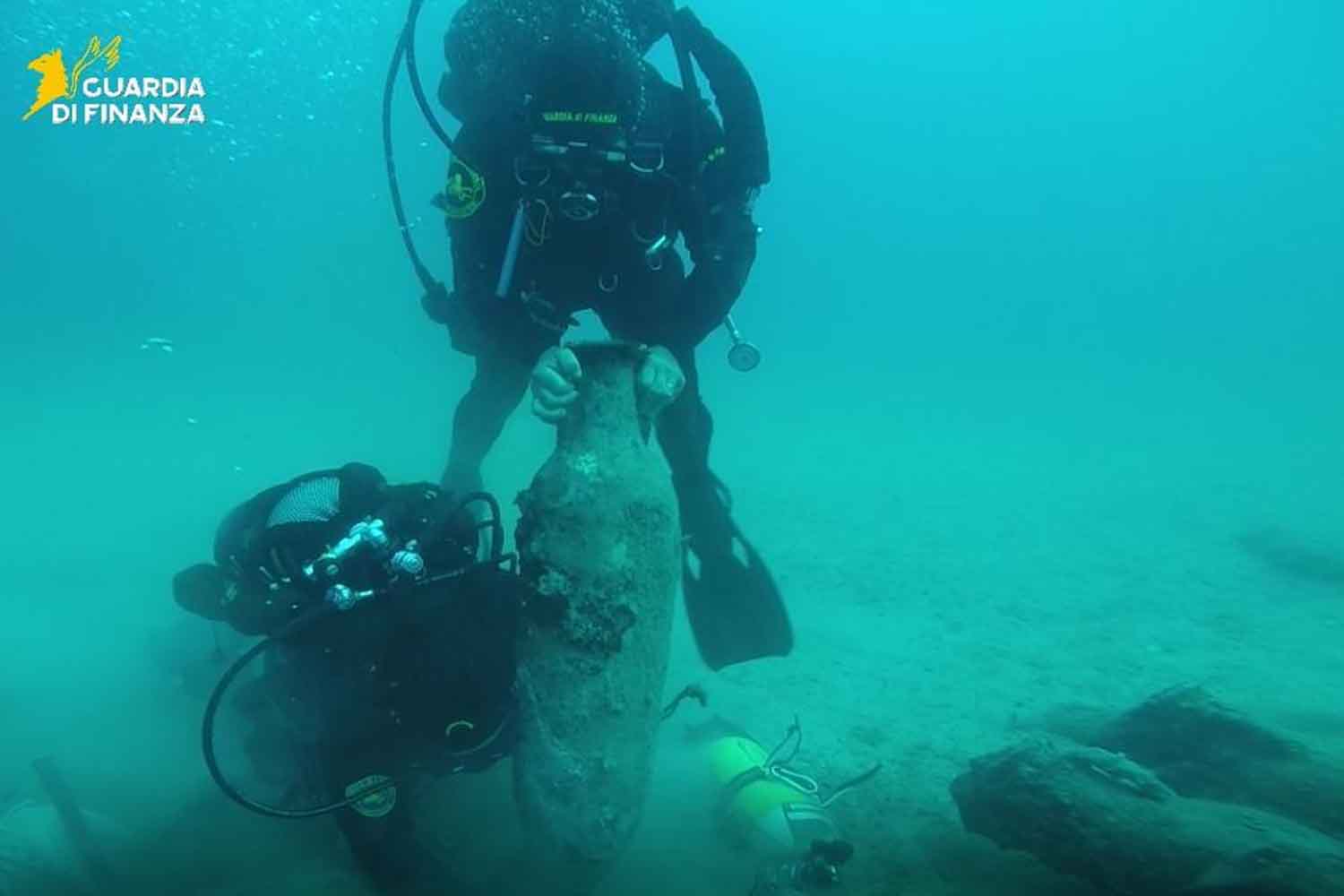
For over six months it remained hidden under the silence and under the seaprotected from prying eyes and possible looting. Today, however, the news can finally be told: a Roman ship with a load of garum was spotted off the coast of Gallipolithe famous fish sauce considered a true delicacy on the tables of the Empire. A discovery unprecedentedwhich combines archaeology, food history and protection of submerged heritage.
The wreck belongs to a large Roman cargo shipdatable to 4th century ADsunk in Ionian Sea while sailing along one of the main trade routes of the time. The first investigations conducted by archaeologists and experts indicate one North African originrecognizable above all by typology of amphorae and some structural characteristics of the hull.
And that’s exactly it contents of those amphorae to make the find exceptional. According to preliminary reconstructions, the ship was carrying garumthe most famous liquid fish sauce of antiquity, considered a luxury product and highly appreciated by the Roman elite. A precious condiment, the result of a long and complex process, which today we could ideally approach anchovy saucehis modern heir.
Garum was obtained from slow maceration of fish entrails, small fish such as sardines, anchovies and mackerelbut also from tuna remains, salt, aromatic herbs and spices. The result was an intensely savory liquid, used to flavor meat, fish and vegetables, and capable of generating real trade on an imperial scale.
A discovery kept secret to avoid looting
The state of conservation of the finds it is one of the aspects that most strikes scholars. The amphorae lie on the seabed in excellent condition, offering a nearly intact photograph of an ancient trade cargo. Precisely for this reason, immediately after the discovery, a clear decision was made: maximum confidentiality.
The discovery, which occurred in June 2025was kept secret for over six months, with the aim of protect the underwater deposit and its extraordinary information potential. From the first moment, the area was subjected to continuous monitoring, 24 hours a dayto prevent any attempt at looting.
From discovery to funding
At the basis of the identification of the wreck is the joint work between the Superintendency of Archaeology, Fine Arts and Landscape for the provinces of Brindisi, Lecce and Taranto, the Aeronaval Operations Department of Bari and the Naval Operations Section of the Guardia di Finanza of Gallipoli.
The vessel was spotted during normal control activities at sea of the Financial Police. The modern on-board instruments reported an anomaly on the seabed, which was subsequently verified thanks to the dives of the II Taranto Diver Unitin close collaboration with the Superintendence.
In the meantime, the funds have also arrived: 780 thousand eurosallocated by the Superior Council of Cultural and Landscape Heritage, will allow the operations to be started documentation, archaeological investigation and safety of the wreck.
They will start in the next few months systematic surveys and study activities with the most modern underwater investigation technologies. These steps will prepare the ground for the complex archaeological excavationthe controlled recovery of the amphorae and the delicate conservation operations, in compliance with the principles of UNESCO Convention for the Protection of Underwater Cultural Heritage.
The discovery is not just news for professionals. It tells of an ancient Mediterranean made of exchanges, knowledge and nutritionof routes that connected North Africa to the Messapian peninsula, then called Calabria.
It is a story that talks about food, sea resources and an ante litteram circular economy, in which even what was considered “waste” became a product of the highest value. And perhaps this is also why this discovery is so fascinating: because it reminds us that the sea, if respected and protected, continues to give us back valuable lessons from the past.
