
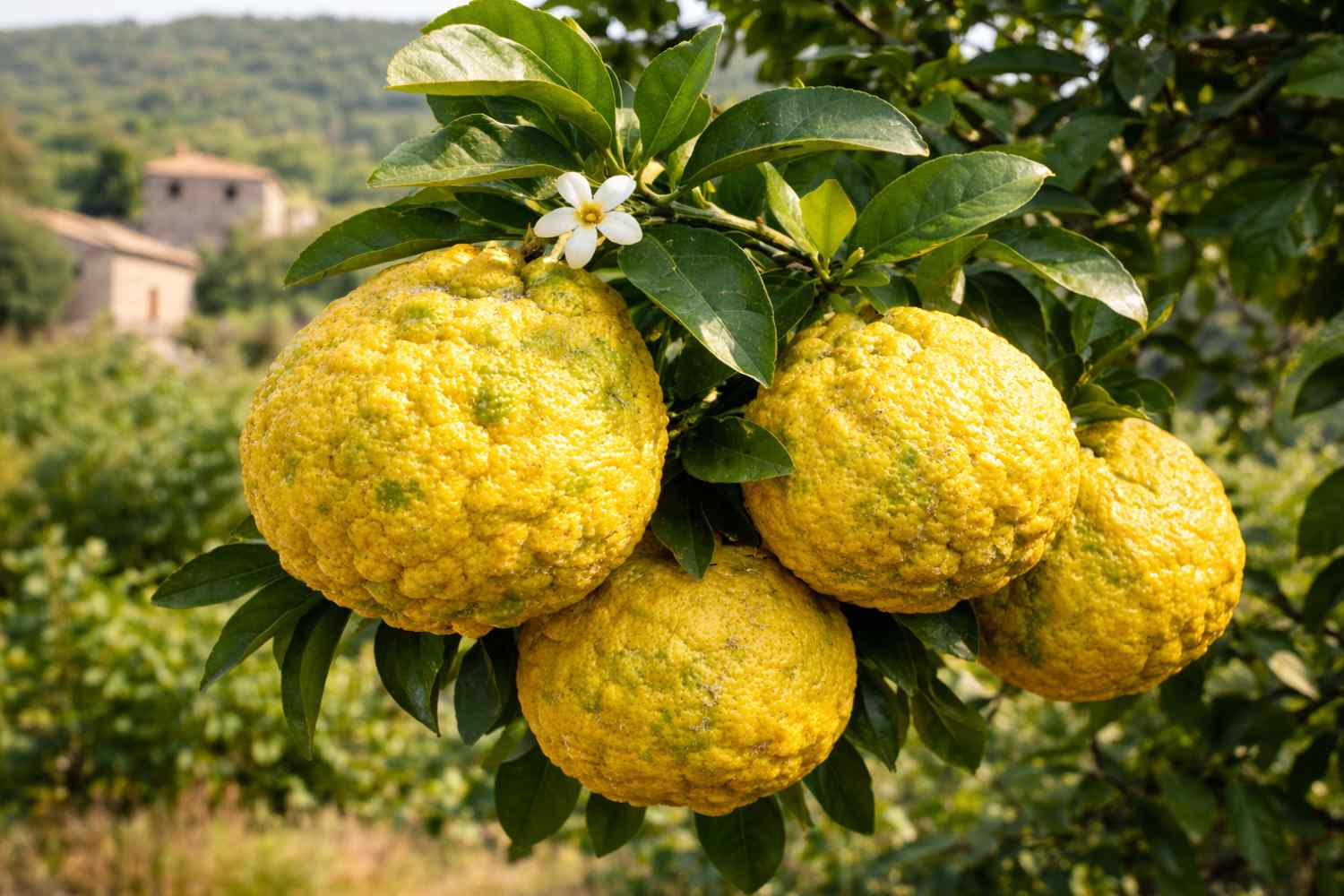
In the heart of the Baronia, between Siniscola, Posada, Torpè and the neighboring towns up to Orosei, a citrus fruit grows that has no equal in the world: sa pompìa, an endemic variety of Sardinia that for centuries has remained on the margins of scientific knowledge, preserved almost exclusively by local agricultural and gastronomic memory.
Only in 2015 did this fruit obtain a formally recognized botanical classification, Citrus limon var. blowjobovercoming the old and imprecise name of Citrus × monstruosaan expression with which an attempt was made to describe its irregular and surprising appearance. Until a few decades ago, the trees registered numbered just a few hundred specimens, concentrated in a very narrow geographical area, an element that makes the pompìa one of the rarest citrus fruits of all.
View this post on Instagram
How pompìa is made: an unconventional citrus fruit
At first sight the pompìa resembles a large cedar, but the external surface is marked by protuberances and tubercles which give it an almost sculptural appearance; the shape is sub-globose, irregular and slightly flattened at the poles, with an average weight of around 300 grams, although there is no shortage of smaller, smoother specimens with advanced maturation.
The peel, up to 15 millimeters thick, is dominated by a highly developed albedo – the internal white part – responsible for the compact consistency and fleshy structure that becomes the protagonist in the kitchen. The pulp, divided into a dozen light segments rich in seeds, contains an extremely acidic and astringent juice, so intense that it is inedible raw: it is precisely this characteristic that makes pompìa unique among citrus fruits, because it can only be consumed after long cooking which radically transforms its aromatic profile.
The tree, similar to that of the orange but with thorny branches similar to the lemon, flowers in April while the fruit ripens between November and January, a period in which the harvest, strictly manual, guarantees the integrity of the peel intended for artisanal processing.
View this post on Instagram
Uncertain origins between history and botany
The roots of the pompìa remain shrouded in a margin of uncertainty which has fueled divergent studies and hypotheses: according to the most accredited theory it is a natural hybrid between cedar and lemon, while other scholars favor a cross between cedar and bitter orange or grapefruit.
The first documentary traces date back to the seventeenth century, when the Jesuit Giovanni Battista Ferrari in the treatise Hesperides (1646) describes an “Aurantium citratum” which many identify with the pompìa; in the same period, a statistic drawn up by order of the Viceroy records cultivations in the Oristano area, a sign that this citrus fruit was already present on the island in modern times.
After centuries of marginal cultivation, the turning point came at the end of the 1990s, when a social agriculture project took shape in Siniscola which started new plants and prevented the definitive disappearance of the species.
The Slow Food Presidium and rebirth
In 2004, the Slow Food Presidium dedicated to sa pompìa was born, an initiative that brings together local producers with the aim of safeguarding the agricultural biodiversity of the Baronia and defining rigorous regulations for cultivation and transformation.
From that moment on, the pompìa enters the circuits of quality food and wine, participates in national and international events and returns to being cultivated continuously, recovering a heritage that risked remaining confined to a few domestic plants. Today it is included among the Traditional Agri-Food Products of Sardinia and continues to be linked to a specific geographical area, a factor that strengthens its identity and traceability.
Because it is only eaten cooked
The pulp of the pompìa is so sour and rich in bitter components that it is unpleasant to the palate if consumed fresh; the long cooking in water and honey, which can exceed five or six hours, modifies the structure of the albedo and softens its intensity, generating a balance between sweetness and bitter aftertaste which constitutes the distinctive feature of traditional desserts.
An essential oil with a high concentration of limonene is also extracted from the peel, used in small artisanal productions for cosmetic and liquor preparations, while studies conducted in universities have highlighted the presence of phenolic compounds with antibacterial and antioxidant activity.
Sa pompìa intrea: the typical dessert
The gastronomic symbol par excellence is sa pompìa intrea, a preparation handed down orally by the women of Siniscola which involves manual emptying of the fruit, boiling of the albedo and slow candying in wildflower honey until obtaining a compact and amber consistency. The result is an intense dessert, sweet but with a persistent bitter note, traditionally served on solemn occasions.
From the same raw material are born the pompìa jam, the liqueur served cold as a digestive and the s’aranzata siniscolese, a wedding dessert made with candied peel and almonds arranged on orange leaves, as well as recent experiments which include liqueur creams and flavored craft beers.
How to prepare
Preparing honey pompìa takes time but not complications. We start by carefully washing the fruit and scraping off the outermost yellow part of the peel, in order to tone down the more intense bitterness. With a small knife, make two openings at the poles and delicately extract the internal pulp, being careful not to break the albedo which must remain intact.
The white shell obtained is immersed in cold water and brought to the boil for about ten minutes; the operation can be repeated a second time to further lighten the astringency. After letting it dry for a few hours, place it in a saucepan, covering it with wildflower honey slightly diluted with a little water. Cooking must be slow, over a gentle flame, and can last up to five hours, during which the honey must be added little by little as it is absorbed.
When the surface takes on an amber color and the consistency becomes soft but compact, turn off the heat and leave to cool completely in its syrup. Served at room temperature, perhaps with some toasted almonds alongside or with a spoonful of fresh ricotta, the honey pompìa finally shows its character: sweet, intense, with a bitter finish that distinguishes it from any other candied citrus fruit.
It is this slow, almost ritual transformation that explains why pompìa is not eaten raw and why, once cooked, it becomes one of the most identifying flavors of Sardinia.
Biodiversity to be defended
Sa pompìa is not just a botanical curiosity, but a concrete example of how a territory can preserve a unique species for centuries, transforming an agronomic limit – the impossibility of consuming it raw – into a cultural and gastronomic value. In an era in which varietal homologation reduces global agricultural diversity, this citrus fruit endemic to Sardinia demonstrates that the protection of local cultivations can generate economy, identity and awareness, keeping alive a history that continues to ripen between November and January under the Barony sun.
