
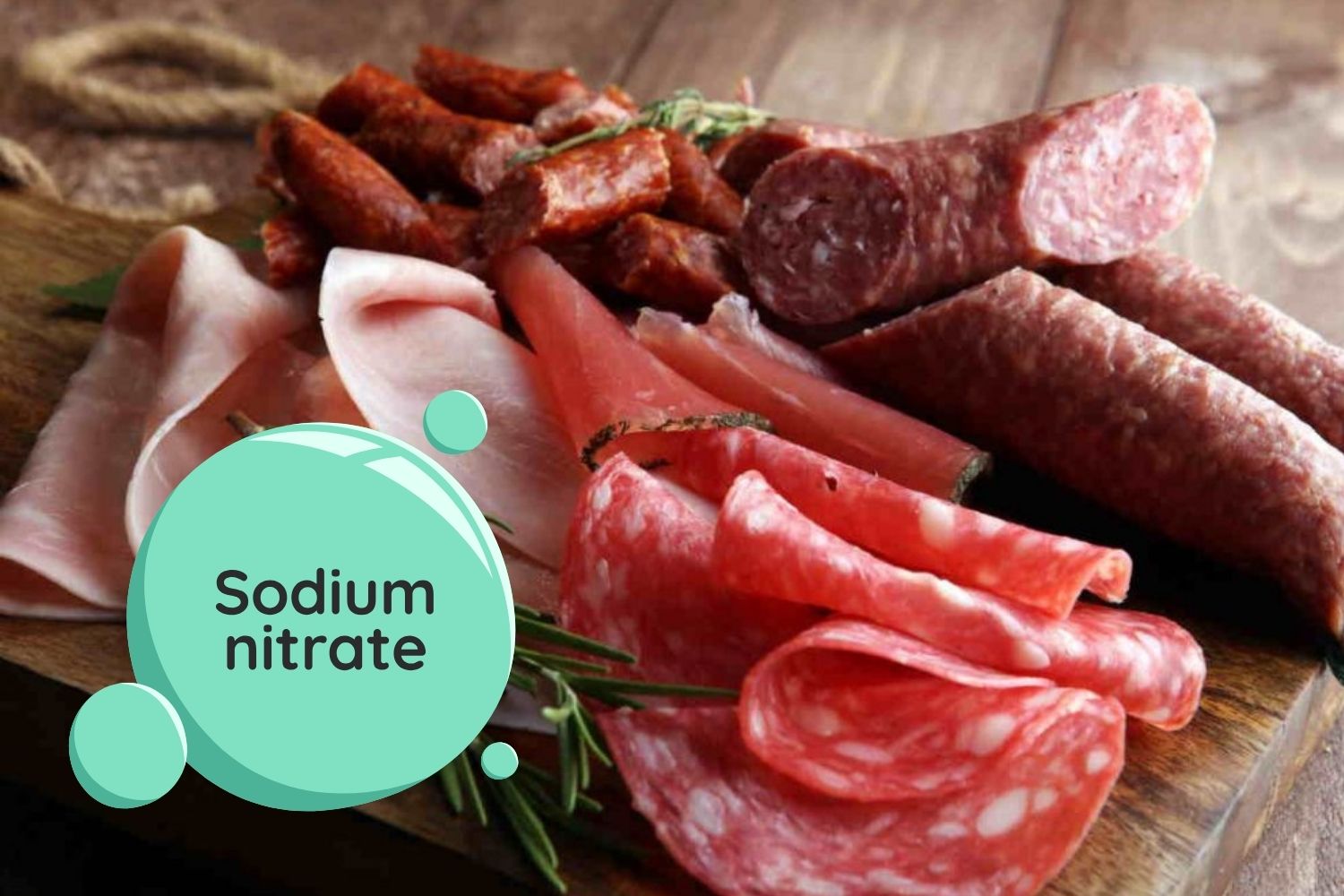
The EU Regulation 2023/2108 will officially enter the 9 October, which establishes new limits to the use of nitrite and nitrates in meat products, including salami and sausages, but also in cheeses and fish products. Finally, after decades of almost undisturbed use, these substances known for their potential health risk, will be more strictly regulated.
But first of all let’s try to understand exactly what we talk about.
What are nitrite and nitrates and what they are for
Nitrite (E249, E250) and nitrates (E251, E252) are chemicals used as food additives for the conservation of meat, some cheeses and fish products. Their main function is to prevent the growth of dangerous bacteria, including the Clostridium botulinumresponsible for botulism, and other microorganisms such as Listeria and Salmonella.
These compounds are used in different types of cured meats, such as ham, salami, mortadella, bacon and seasoned sausages, also helping to maintain their color-red-red color. In addition to the conservation and aesthetic aspect, they also help prolong the duration on the shelves, making it possible to distribute on a large scale.
But, although effective as preservatives, nitrites and nitrates involve health risks: they can in fact lead to the formation of nitrosamines, some of which are carcinogenic.
What changes for salami and cheeses
With the new regulation, the maximum quantities allowed will be reduced: for seasoned salami with dry salting, the nitrite limit will drop from the current 100 mg/kg to 65 mg/kg, while the unused meat products will go from 150 mg/kg to 80 mg/kg.
Even the sterilized products, such as canned meat, will see a halving of the limits, from 100 mg/kg to 55 mg/kg as well as the cooked salami in which the quantities of maximum nitrites descend from 100 to 55 mg/kg.
As for cheeses, however, the nitrate limits will be reduced from 150 mg/kg to 75 mg/kg.
The main novelty, however, concerns the way in which nitrite and nitrates are measured. In the past, reference was made to sodium or potassium salts, while now the concentration will be calculated in terms of active ions (no₂⁻ and no₃⁻), that is, in the form actually present in food. This more accurate approach allows you to have a real picture of the consumer exposure and to reduce the risks related to nitrosamines.
For companies it means reviewing recipes, production processes and monitoring of suppliers, ensuring that the new limits are respected throughout the supply chain.
The products concerned
The list of products affected by this new legislation is very long and includes different types of salami and sausages, each of which can contain nitrite or nitrates used for conservation and to ensure food safety. Among these we find the bacon and frankfurters, cooked products in which nitrites serve to prevent bacterial growth and maintain color.
There is also no lack of smoked raw ham, such as speck, which can contain nitrates to encourage conservation, and cooked sausages such as cooked ham, cotechino and zampone but also salami in its many variants.
For some traditional cured meats (obtained with salting or particular methods) it is difficult to calculate the dose of nitrite or nitrates, therefore specific limits are planned for these products.
Some aged cheeses or semi -players are also part of the legislation. They are above all hard -paste variants, semi -like or semimolle.
Because the measure is important
The decision of the European Union is part of the European Plan for Fight against Cancer. The goal is to minimize the health risks deriving from nitrites and nitrates in cured meats, without compromising the microbiological safety of food, which these compounds contribute to guaranteeing.
The European Food Safety Authority (EFSA) has updated its opinions several times, establishing the daily doses admissible for nitrite and nitrates and confirming the possible risks, in particular for children and more exposed people. The studies have highlighted a link between nitrite/nitrates present in the processed salami and some tumors, in particular of the colorectal.
For this reason, the European legislation lowers the thresholds of nitrite and nitrates, trying to minimize the formation of potentially carcinogenic substances such as nitrosamines, while maintaining the preservative role of these additives and safeguarding the flavor and quality of the salami.
But let’s not forget that even if the limits will soon be lowered, the salami remain a food to be consumed in moderation (if not to avoid completely).
