
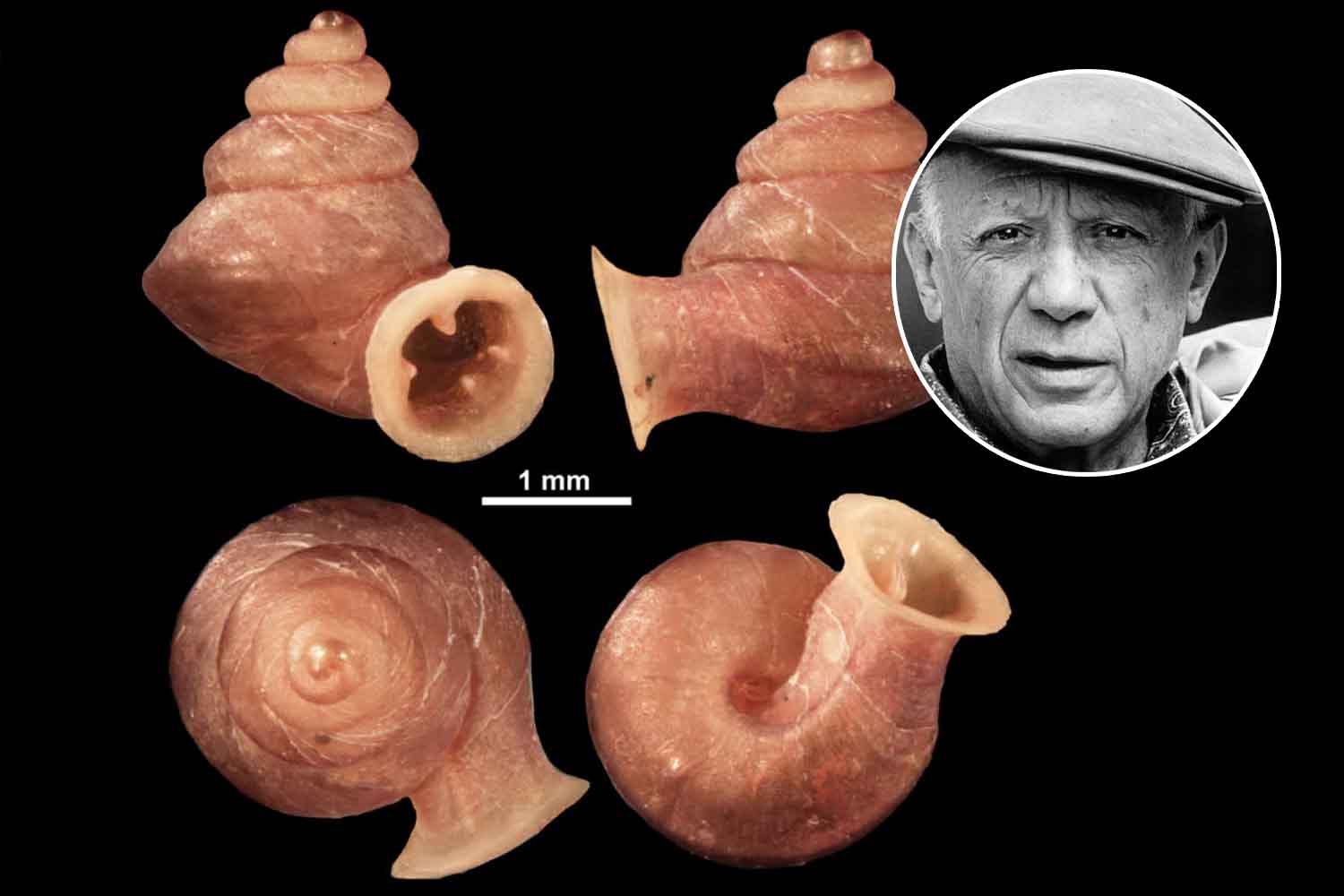
In a remote National Park of Thailand, a group of malacologists identified a new, tiny species of snails that, despite the small size – just three millimeters of length – He immediately attracted attention thanks to his Extraordinarily unusual shell shape. Unlike the typical smooth spirals associated with snails, the shell of this new species presents Net and quite square cornersrecalling the style of artistic cubism. The comparison with Pablo Picasso It was immediate: hence the name chosen to baptize the species, Anauchen Picasso.
Sculptural shells and toothed openings
The discovery of Anauchen Picasso is part of a much wider project led by the Serbian doctoral student Vukašin Gojšinawith the supervision of his Hungarian mentor Barna Páll-Gergery. The goal: explore and catalog the microspecies of terrestrial molluscstiny creatures that often do not exceed five millimetersa little larger than a rice grain.
The result was the publication of a monograph of 300 pages in the scientific magazine Zoodyswhere they are described 46 new species from Cambodia, Myanmar, Laos, Thailand and Vietnam. Only the genre Anauchen saw the addition of 17 new species.
These tiny molluscs hide an impressive complexity: theirs intricate and artistically wrapped up shellswith openings sometimes equipped with Department -like structuresprobably serve as Defense against predators. Some species have a last spira of the shell that bends up or down, creating a spiral shape inverted Which, even similar to an inexperienced eye, is crucial to distinguish the different species, as the researchers pointed out.
Despite the small size, these shells are authentic masterpieces. Their structural complexity is exceptional.
The microspecies are already at risk
Although they may seem irrelevant to an external observer, these very small snails represent vital testimonies of evolution and biodiversity. The karst landscapes of Southeast Asia, characterized by limestone rocks, are Biodiversity outbreaks And the snails are silent ecological indicators. Because of theirs limited mobility and adaptation to highly specific micro -environmentseach species tells a unique story of Geographical isolation and evolutionary adaptation.
However, many of the new species described were found in single caves or rocky wallsmaking them extremely vulnerable to environmental threats. There limestone quarry for the production of cementwidespread practice in the region, represents a concrete danger. This is the case of Anauchen Evaniduswhose name derives from the Latin “evanidus” – or” that disappears ” – because the area in which it was discovered it may have already been destroyed from mining activities.
Furthermore, some species are not the result of recent explorations but of specimens preserved for decades in the drawers of the Florida Museum of Natural Historycollected in the 80s and remained. With the use of modern tools and a new lookthe researchers have finally been able to classify them, even if the places where they lived they could now have disappeared.
In a context where Deforestation and mineral activities advance relentlesslythe survival of these molluscs – often confined to individual hilly reliefs – it is in imminent danger. Some of the species listed in the study they could already be extinctthus representing:
These snails are works of art hidden in the undergrowth, carved by time and geology. Each dentated spiral, every inverted curve, every cubist shape is a miniature archive of survival.
