
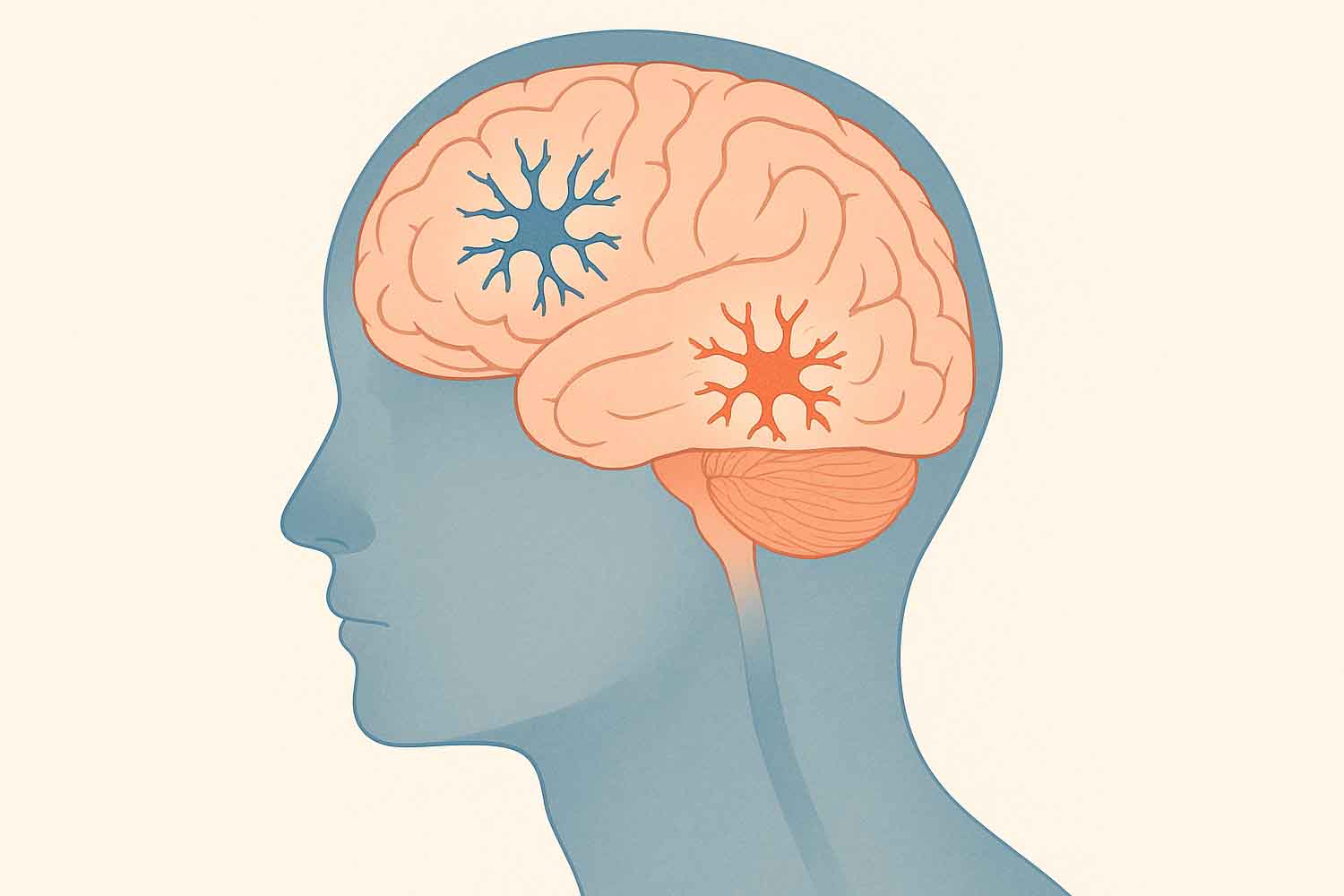
For decades we have described the brain as a huge open space full of hyperactive neurons: those that make decisions, process thoughts, transform intuitions into actions. Around them, a network of chemical messengers, hormones, which keep communications, rhythms and reactions in order. A fascinating, complicated, often unpredictable system. Yet someone is always missing in this narrative. A silent, little celebrated group, considered for years a simple “maintenance service”: microglia.
These cells, which belong to the brain’s immune system, have long been described as cleaners that remove cellular debris, protect against infection and keep the environment tidy. End of role. Instead, today we discover that this underestimated category could have much more power than we imagined, especially when we talk about anxiety, that feeling of alertness that sometimes protects us and other times overwhelms us.
Two microglia, two opposite functions
Scientists have identified two populations of microglia, different from each other in emotional functions, despite being almost indistinguishable in appearance. A seemingly minimal detail that however changes everything.
It is a duo that we could describe like this:
A binary system, almost like two emotional pedals: one prepares us to react, the other prevents that reaction from becoming unmanageable. This new interpretation confirms a suspicion that many neuroscientists have had for some time: anxiety does not arise only from disordered thoughts or stressful events, but also from a much deeper biological balance than we imagine. The point is not to “turn off” anxiety, but to prevent its volume from remaining stuck at maximum.
Microglia and anxiety: what changes for us
The key to understanding is surprising: if these two populations of microglia maintained a harmonious relationship, our brain would be able to better modulate the intensity of our emotions. However, when the “accelerator” part prevails, we may experience persistent anxiety, difficulty in reducing the state of alertness, cyclical thoughts that do not subside, a tendency towards repetitive or compulsive behaviors.
Likewise, when the brake system does not work as much as it should, the mind risks remaining constantly in “fight/flight” mode, even when there is no real danger. Scientists talk about a possible paradigm shift: not an “exaggerated” emotion, not a brain that “decides to worry too much”, but a lack of immuno-emotional harmony. Yes, because microglia are part of our immune system. And if this double internal command really existed, anxiety would also become an immunological issue.
A new frontier
Today the scientific community considers it increasingly probable that these two populations of microglia also play a similar role in the human brain. It would not be an exception: in many living species the microglial system follows comparable patterns.
And if that were the case, it would change the way we deal with anxiety disorders. No longer just drugs that try to “calm down” the neurons or psychological interventions that teach you to manage thoughts and reactions, but also, in the future, treatments that could aim to strengthen the brake microglia, to restore internal calm. reduce the hyperactivity of accelerator microglia and restore a more natural balance of the emotional system
A perspective that combines psychology, immunology and neuroscience, paving the way for what some already define as “psycho-immunology”.
A more complex (and more intelligent) brain than we think
In all of this, perhaps the most fascinating thing is the simplicity with which we tend to underestimate what we don’t see. For years we believed that neurons did everything: they decided, they tried, they made mistakes, they got agitated. The microglia were only “on duty”. And now we discover that, without these cells, the brain would lose the ability to modulate one of the most primitive and most important emotions for our survival: anxiety.
An emotion that, if well regulated, protects us. If poorly calibrated, however, it can turn into a constant noise, an engine that continues to hum even when it shouldn’t. And yes: perhaps the problem is not “being too sensitive”. Maybe it’s that some cells in there are using the wrong pedal.
You might also be interested in:
