
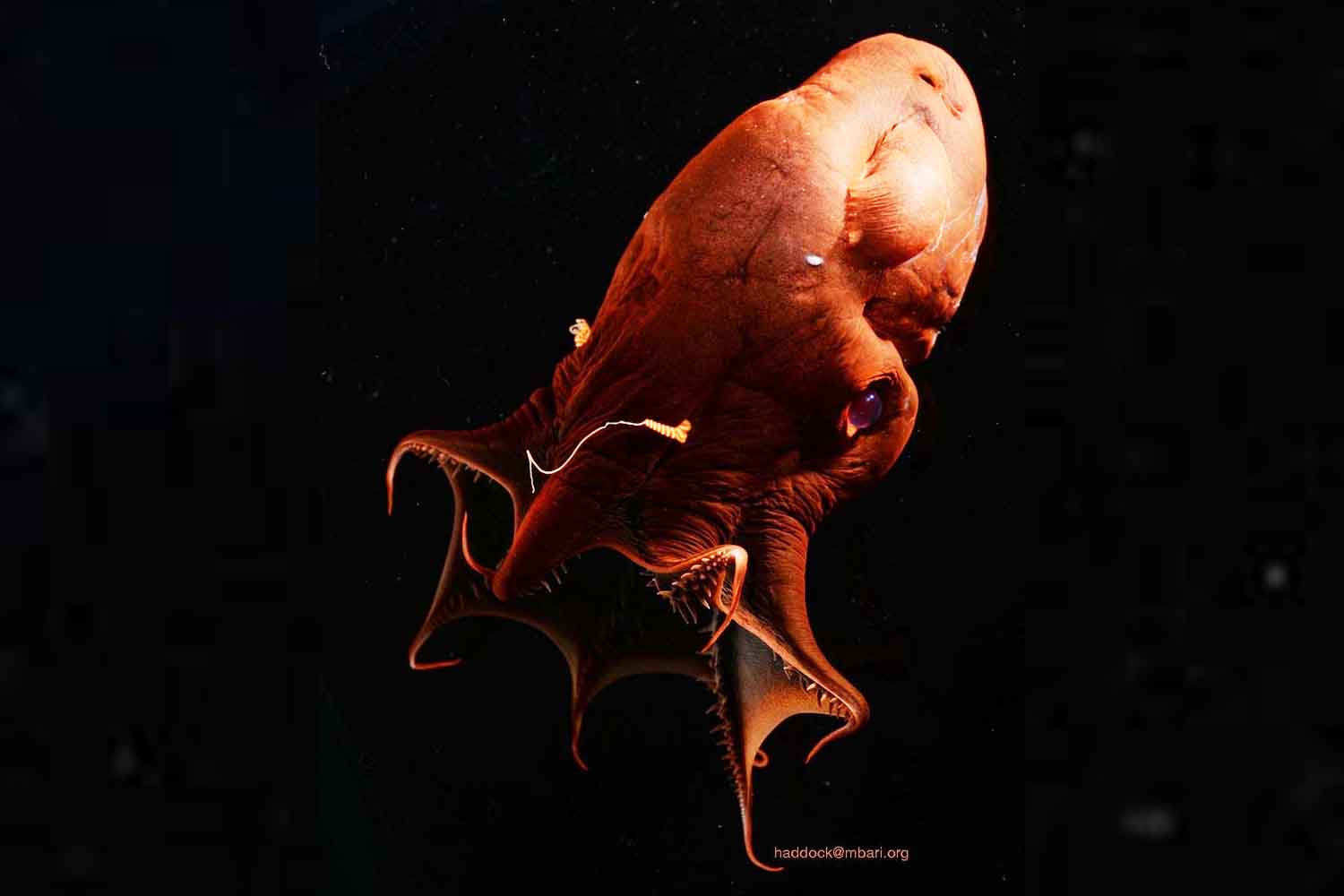
About eight hundred meters below the surface, where the sea stops being blue and becomes black like a blackboard, a being moves that seems to have been designed more by imagination than by nature. It has tentacles that light up, a cloak that wraps it like a curtain and two thin filaments that oscillate in the water like listening antennas. It’s the vampire squid, Vampyroteuthis infernalisthe “gentle monster” of the abyss.
The name would make you think of a ferocious predator, but there is nothing vampire-like about it. It doesn’t hunt, it doesn’t eat fish, it doesn’t suck blood. Instead it collects debris and particles that float in the ocean areas poorer in oxygen, a “marine snow” that slides in front of it as if it were cosmic sand. He does it with the patience of someone who doesn’t need to run anywhere.
For those who observe it for the first time, the eyes are especially striking: enormous, almost disproportionate, slow to fix any luminous trace that manages to creep into that eternal darkness. They are wide open windows in an unforgiving environment, and the tangible sign of a very ancient evolution.
An ancient creature that holds a gigantic genetic heritage
The real surprise, however, does not come from its appearance, but from its genome, which an international group of researchers has just sequenced in a study published in iScience (“Giant genome of the vampire squid reveals the derived state of modern octopod karyotypes”).
The result shocked everyone: the vampire squid has over 11 billion base pairs, a size four times larger than the human genome and the largest ever recorded in a cephalopod. A monumental genetic archive, almost excessive for such a discreet animal.
The most interesting aspect, however, lies in its structure. Although it belongs to the Octopodiformes, the same group as octopuses, its DNA resembles that of squid and cuttlefish in many ways. This element, which may seem like a technical detail, has overturned a deep-rooted belief: the common ancestor of octopuses and squids – which lived about 300 million years ago, well before the dinosaurs – had a body organization more similar to that of squids.
This is stated by Dr. Oleg Simakov, author of the study, who defined the discovery as “a missing piece in the evolutionary history of cephalopods”. It is as if the vampire squid had kept aside, with almost obstinate care, an ancient genetic model that the rest of its family then reshuffled, rewrote and transformed into something else.
How octopuses became what they are
The behavior of modern octopuses – their intelligence, ability to manipulate objects, fluid movements and surprising adaptability – is the result of unusual evolution.
In fact, the study shows that octopuses have not developed new genes, as often happens in great evolutionary revolutions. Instead, they went through a massive process of reorganization of the genome: shifts, fusions, internal mixing as if someone had taken all the pages of a manual and reassembled them without following the index. The vampire squid, however, seems to have chosen the opposite path: to conserve rather than change. Remaining faithful to a primordial form, like an ancient manuscript that has remained intact while the language around it evolves, becomes contaminated, reinvents itself.
This quiet genetic immobility is why scientists often call it a “living fossil.” Not in the sense of an immobile relic, but as a witness to a past that continues to breathe in the depths of the sea. His way of life confirms this role: he does not need to hunt, nor compete, nor chase. Navigate an oxygen-poor world thanks to a slow, calibrated, almost meditative metabolism. He survived because he was in no hurry to change.
You might also be interested in:
