
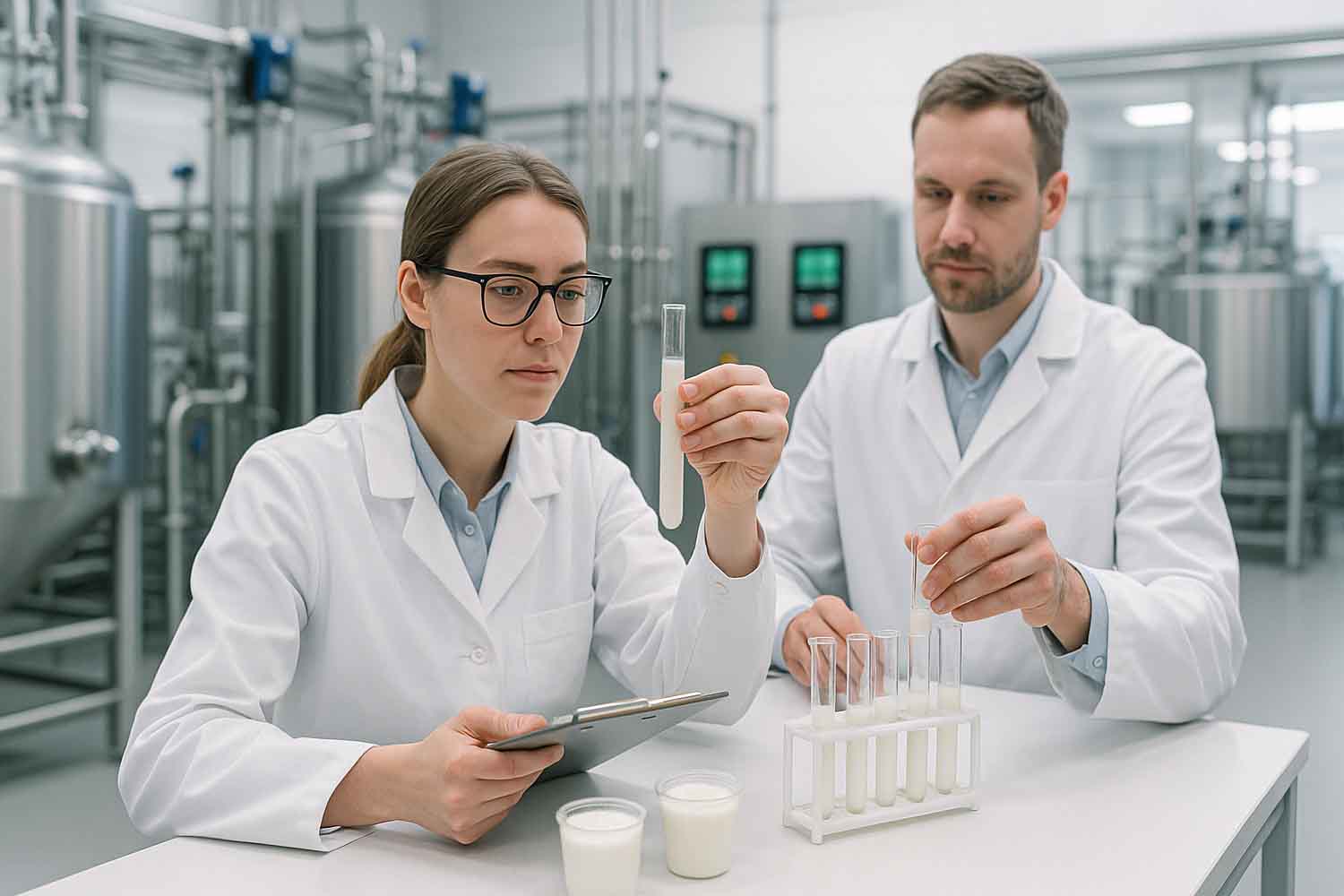
A new methodology developed by scientists of DTU National Food Institute In Denmark he promises to revolutionize the industrial production of the yogurtmaking it at the same time cheaper And more sustainable. The researchers, led by the Associate Professor Christian Solemhave developed a system capable of reduce up to 80% the use of expensive bacterial crops commonly employed, at the same time extending the shelf life of the finished product.
According to Solem, who has been studying the metabolism of the lactic bacteriathe idea was born from a simple but effective intuition:
We wondered what would happen if we let the bacteria acidify, without however allowing them to multiply. It was a real moment Eureka.
The new process is based on a double controlled fermentation with two temperatures
Traditionally, the production of yogurt involves the addition of a relatively high amount of Starter crop to milk, which is then fermented at 42 ° C for 4-6 hours. Once the desired acidity is reached, the product is cooled. However, this method presents some critical issues:
The new approach drastically reduces these problems. The researchers use only the 20% of the usual quantity of starterstarting fermentation at 42 ° C. After a few hours, the temperature comes increased to 51 ° Cwhere bacteria stop replicating but they continue to produce lactic acid. As Solem explains:
It’s like putting bacteria on a treadmill: they don’t move, but they continue to work.
This thermal passage also has a second advantage: it acts as delicate pasteurizationeliminating up to 99.9% of yeasts and mold that otherwise would accelerate the deterioration of the product.
Post-acidification farewell, welcome extra duration
One of the main problems in the conservation of yogurt is the post-acidificationresponsible for a too acidic, bitter taste and the separation of liquid and solid phases. The DTU method has shown to eliminate this phenomenoneven in the presence of known crops to be particularly subject to it.
There Post-Doc SHUANGQING ZHAO researcherthe main author of the study, said:
We tested the procedure with three different types of starter crops and in all cases the post-acidification has disappeared.
It has not yet been precisely quantified how much the duration of conservation extends, but scientists estimate that it can largely exceed the current 3-4 weeksopening new possibilities for distribution on long distances and a significant one Reduction of food waste.
Today, dairy companies use up to 0.18 grams of starter per liter of milk. Considering the global scope of production, this is a significant expense. Reducing this quantity of five times, as suggested by the new technique, means remarkable economic saving.
Also, one longer conservation duration allows a more flexible and less fragmented productionwith positive impacts also on the management and sanitization of the plants, as explained by Solem:
Yogurt is usually produced in large lots, each of which then requires cleaning and reconfiguration of the systems. With a longer conservation, more continuous and less complex productions could be planned.
According to data, each person in the world consumes on average Almost 12 kilos of yogurt per year. The implications of this innovation, therefore, go far beyond the single factory: they could influence the entire global supply chain.
