
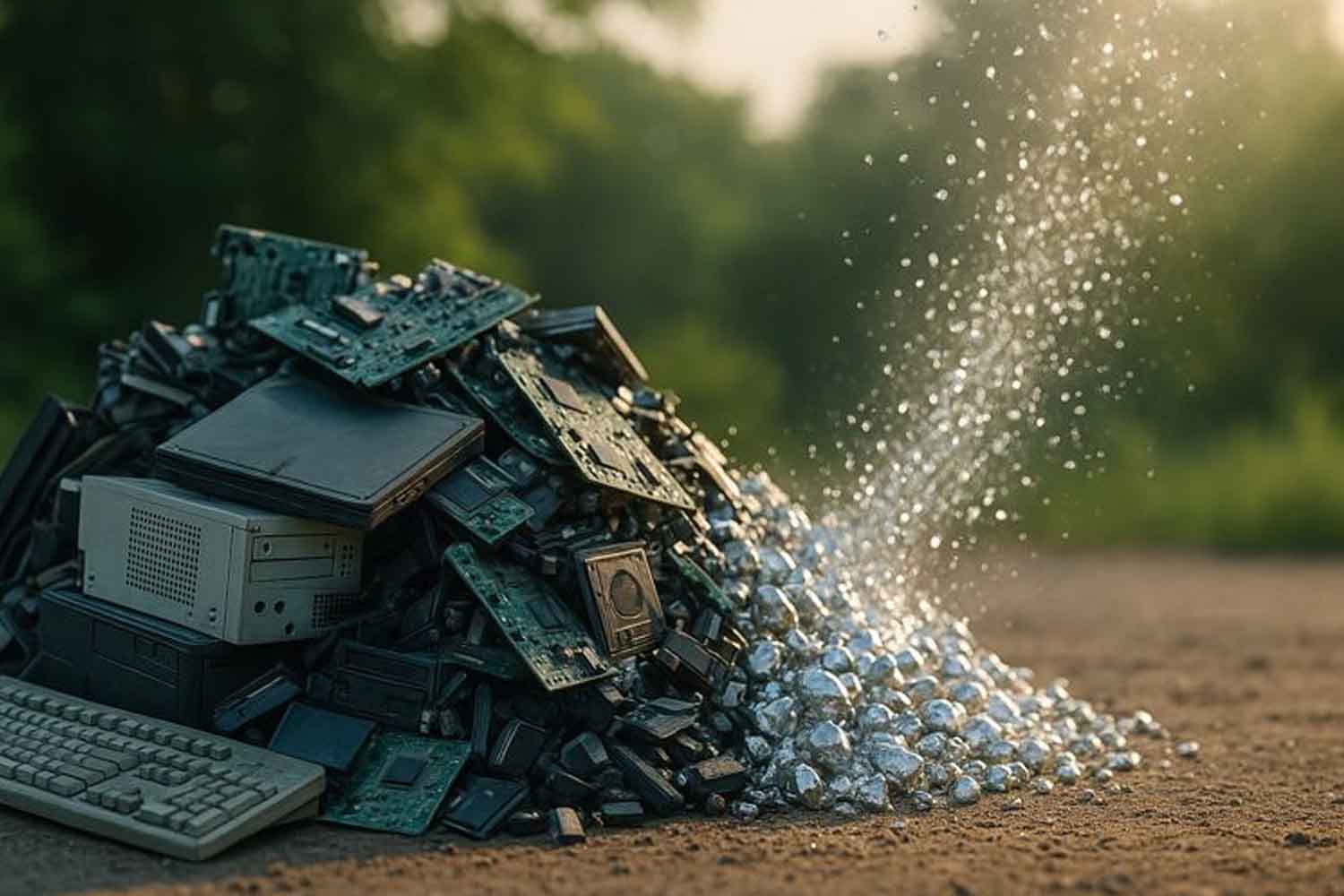
There is a metal that we use every day without realizing it. It is inside smartphones, computers, keyboards, but above all in solar panels that should help us get out of the fossil fuel era. It’s silver. Precious, irreplaceable in many technologies, yet still little recycled. Today only about a fifth of the silver circulating in the world comes from recovery, while the rest continues to be mined using invasive and often dangerous processes.
But now something is changing. Research comes from Finland that could make silver recycling simpler, safer and finally consistent with the idea of ecological transition. No cyanide, no aggressive acids: all you need are molecules similar to those of vegetable oils and a little light.
How the new technique developed in Helsinki works
The work was coordinated by Anže Zupanc, a researcher at the University of Helsinki, who has long been studying more sustainable alternatives to classical metal extraction methods. The objective was clear: to find a way to dissolve and recover silver without resorting to highly toxic substances, such as cyanide, still widely used in mines today.
In the laboratory, the researchers chose to start from fatty acids, organic compounds present in many oils of vegetable origin. Upon contact with metallic silver and the addition of hydrogen peroxide, the surface of the metal slowly oxidizes and the silver passes into solution in the form of ions. The process occurs under mild conditions, without extreme temperatures or dangerous reagents, and still manages to dissolve significant quantities of metal.
Once dissolved, silver binds to acids forming easily separable salts. With a simple step, these substances crystallize and the unconsumed acids can be recovered and reused. This is where the concept of circular economy stops being a slogan and becomes applied chemistry.
The next step is perhaps the most fascinating, because it shows how far the process is from the traditional industrial imagination. The crystals obtained are exposed to visible light, that emitted by normal fluorescent lamps. The light energy is sufficient to transform the ions back into pure metallic silver, in the form of solid particles.
The hydrogen peroxide used during the process simply degrades into water and oxygen. No toxic waste remains, no persistent contaminants are produced. Ultimately, the recovered silver can be filtered and reused, while the organic reagents become available for a new cycle. It is a system that works like a closed circuit, designed from the beginning to reduce waste and risks.
Urban mining
This technology has also been tested on real materials, not just laboratory samples. The researchers applied it to silver-coated keyboard components, common items that easily end up in electronic waste. The method succeeded in separating the silver from the polymers and other metals present, leaving much of the basic structure intact.
It is a concrete example of urban mining, the idea of recovering precious raw materials from the products we throw away, instead of continuing to dig new mines. An increasingly necessary approach, if we consider that many electronic devices have very short life cycles and end up in landfill with highly valuable materials still inside.
Another not secondary aspect concerns safety. The fatty acids used in the process are biodegradable, low-acid and non-volatile. This means less dangerous working environments and systems that are easier to manage than those that use strong mineral acids.
Silver is one of the hidden pillars of the energy transition. Photovoltaic cells, for example, depend on conductive pastes rich in this metal. In 2023 alone, the solar industry used over 190 million ounces of silver, an amount that is steadily increasing. With the electrification of transport, industries and infrastructure, the pressure on resources will continue to grow. Silver recycling will not completely replace mining, but it can reduce its impact by recovering metal that is currently lost in waste.
If this technology is adapted on an industrial scale, every device that reaches the end of its life could become a small urban mine. Less excavation, less toxic substances, less risks for communities and the environment. The study was published in the journal Chemical Engineering Journal and represents a concrete step towards a materials industry more consistent with the promises of sustainability.
You might also be interested in:
