
Plastic is everywhere: in the clothes we wear, in the containers we use every day, even in the water we drink. We have produced so much that it is now found in the seas, in polar ice and even in our body. Still, continuing to do without it seems impossible: it is comfortable, resistant, cheap. But also harmful, polluting and almost indestructible.
Today, however, there is a concrete hope that something is about to change. In Japan, a group of researchers from the University of Kobe has found a way to produce biodegradable plastic more resistant than the traditional one, using none other than a bacterium: the Municipality Escherichia coli. The discovery could revolutionize the plastic sector, offering an ecological and effective solution to plastic pollution.
The heart of the discovery is a new molecule, biodegradable and more resistant
The bottles we drink every day, packaging and many plastic objects are made of pets, a very resistant type of plastic that is obtained from oil. To make it so hard is the Terephtalic acid, a substance that however does not degrade easily and remains in the environment for decades, if not centuries.
Scientists have been looking for a substitute for biological origin for years, that is, a natural molecule that can guarantee the same performance, but without damaging the environment. One of the most promising is 2.5-PDCA (2.5-pyridincarbossilated), a molecule with a small but fundamental difference compared to terephtalic acid: it contains a nitrogen atom in its chemical structure.
It seems a detail, but this small change allows you to create stronger and at the same time biodegradable plastics. The real obstacle, to date, was to produce it efficiently and without creating waste or toxic substances.
How the new method works
In the past he had already tried to create the 2.5-pdca starting from a molecule called PCA, but the process was complicated, full of unnecessary passages and led to unwanted waste. The intermediate molecule broke easily before becoming useful.
The Japanese team, led by doctors Shuhei Noda and Tsutomu Tanaka, thought out of the box. They decided to use another molecule, called PABA (P-Mininobenzoic acid), which already has the nitrogen atom in the right position. So they avoided the unstable passage and managed to obtain a cleaner, direct and effective chemical reaction.
They then compared the two methods, modifying two different strains of the bacterium E. coli: one followed the old method, the other one. The result was clear: the new road is much better, because it produces more plastic, in less time and without toxic waste.
From sugar to plastic
But it’s not over here. The researchers went further: they transformed E. coli In a real living factory, capable of taking sugar (glucose) and converting it directly into the desired plastic. To do this, they had to change the bacterium DNA with very advanced genetic engineering techniques.
During the experiments, they came across an unexpected problem: one of the enzymes introduced produced hydrogen peroxide (H₂O₂), a substance that ended up damaging the entire process. The solution was to add a compound that neutralizes peroxide, allowing the system to function correctly.
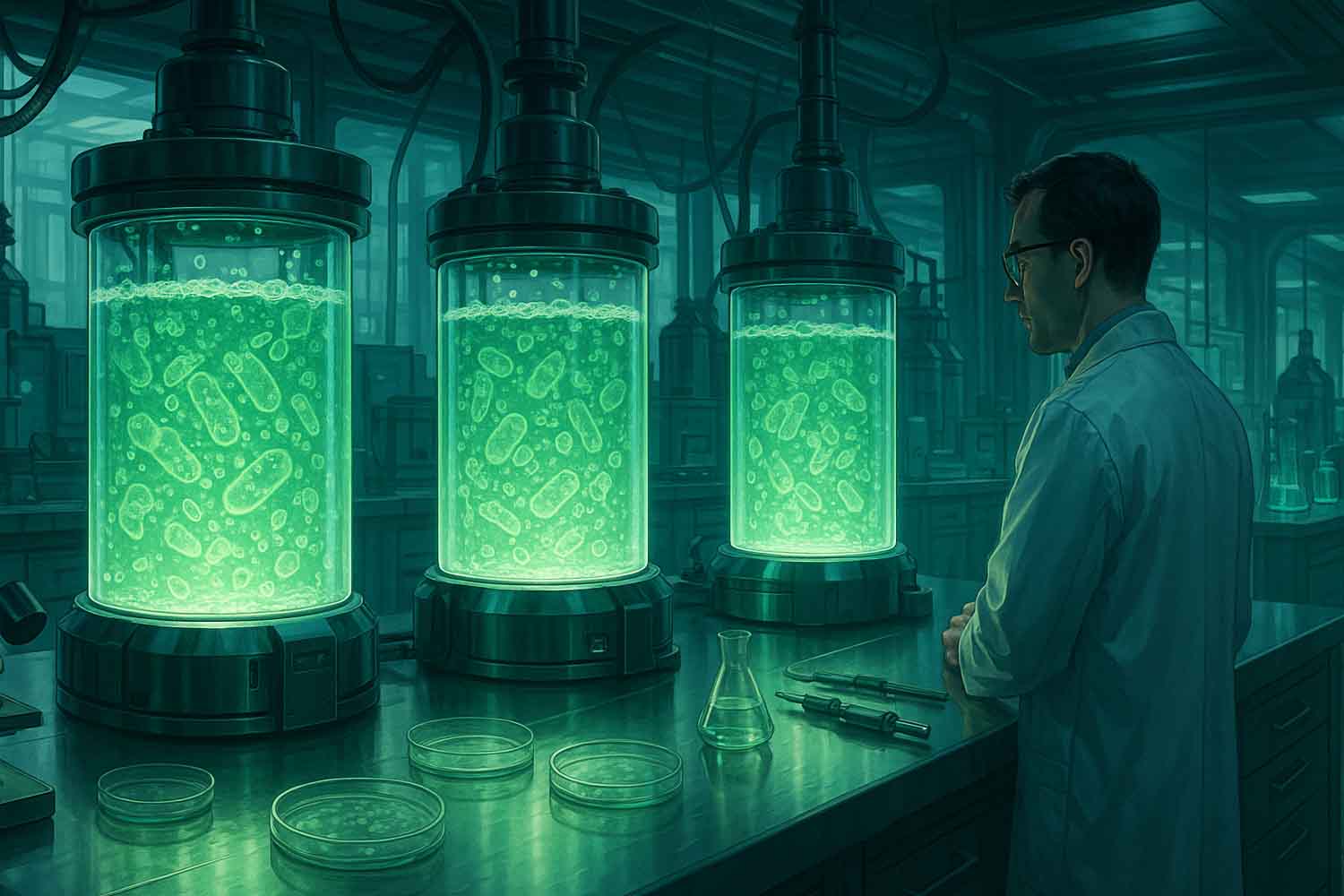
At that point, the team decided to move the experiment from the tubes to a biorector from one liter, that is, a controlled container where variables such as temperature, pH and oxygen can be managed.
In just six days (144 hours), the bacterial culture produced the highest quantity ever recorded of 2.5-pdca via microbial fermentation. A real record.
A turning point that can change everything
This experiment is not just a scientific curiosity: it could really change the way we produce plastic in the future. It is a solution that does not depend on oil, it is more sustainable, and could reduce the enormous environmental impact of traditional plastic.
We are still far from a large -scale industrial production, but the road is traced. As Dr. Tanaka explains, there are still obstacles to overcome, especially cheap, but technology is closer than ever to reality.
Thanks to this work, we could one day produce plastic no longer polluting with refineries, but using sugar -powered bacteria, in a clean, natural and effective process.
You may also be interested in:
