
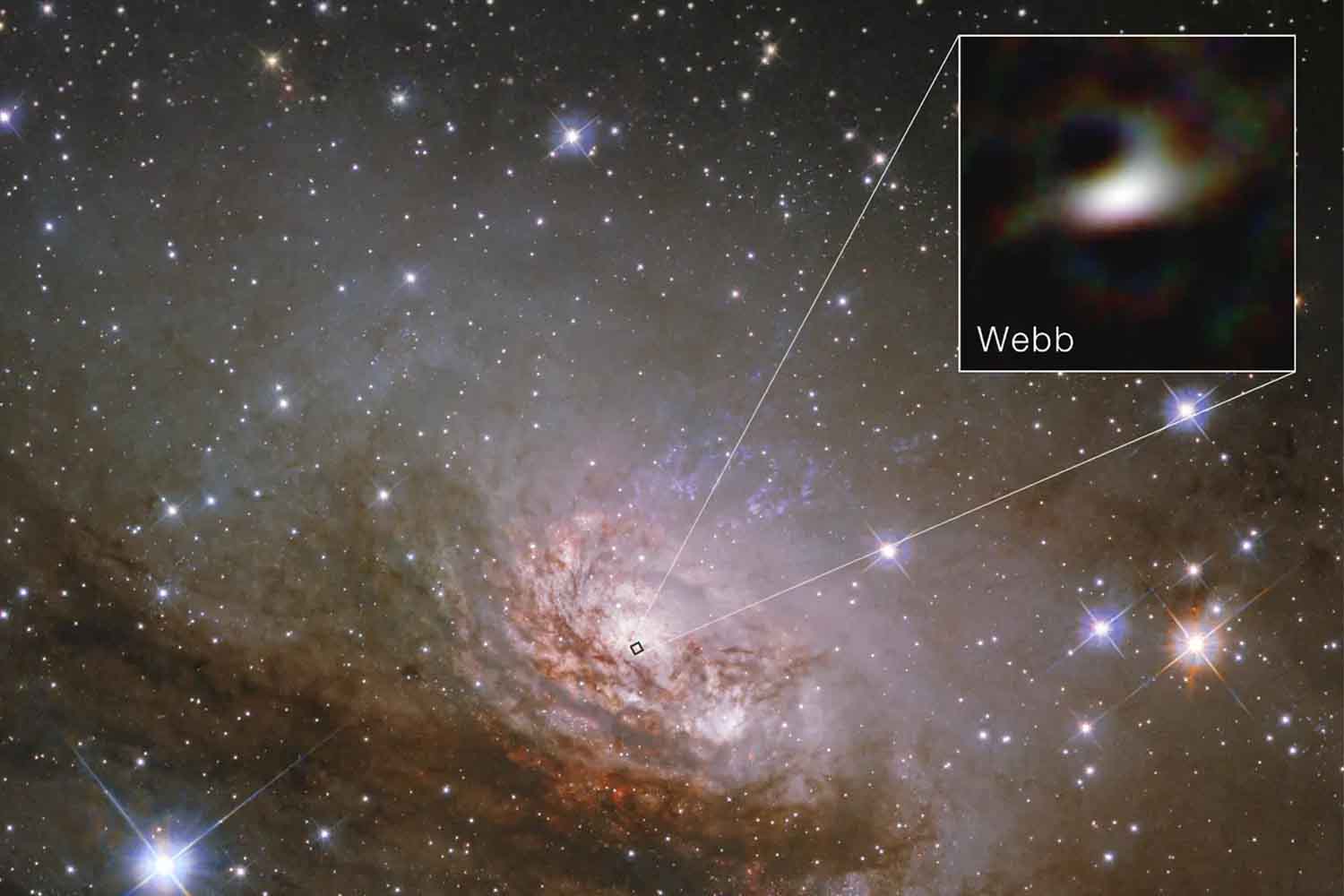
It’s not an explosion, it’s not a violent jet shooting matter into space. What really illuminates the heart of some galaxies is much more silent and continuous. The black hole at the center of the Circinus galaxy was observed with a precision never achieved before and, for the first time, we know clearly where that intense infrared light that has intrigued astronomers for years comes from.
In the heart of the Circinus galaxy the black hole reveals itself for what it really is
The new observations of James Webb Space Telescope they allowed us to look inside the nucleus of Circinus galaxya relatively nearby spiral galaxy, about 14 million light-years from Earth. An enormity, certainly, but “little” enough to allow the space telescope to distinguish details that until yesterday were only hypotheses.
The discovery, announced by NASAchanges the way we interpret how supermassive black holes work. For decades it was thought that the infrared emission of active galaxies was mainly due to winds of matter violently expelled from the center. In reality, the James Webb tells another story: most of that light is born in a dense, flattened disk of gas and dustwhich rotates around the black hole and feeds it slowly, like a cosmic funnel.
It is an extreme environment, hidden from view due to dust, but fundamental to understanding how these invisible giants grow. The team led by astrophysicist Enrique Lopez-Rodriguez used a special observation mode, never before applied to a galaxy outside the Milky Way, managing to separate structures that until now appeared merged into a single bright spot.
An image twice as sharp that overturns old theories about black holes
Thanks to a technique that combines light collected from multiple apertures, the James Webb obtained images with a resolution equivalent to that of a space telescope twice its size. In practice, it is as if the heart of the Circinus galaxy had been observed with a 13 meter instrument instead of the actual 6.5 meters.
This leap in quality made it possible to precisely measure the origin of the infrared emission. About 87% comes from the area closest to the black hole, concentrated in the disk that feeds it. Only a tiny fraction is linked to an arched structure of dust dragged outwards, a sign that outflows exist, but have a secondary role. The rest comes from more distant dust, heated by radiation and a small radio jet.
It’s not just a technical question. Understanding how a black hole grows also means understanding how a galaxy evolves. When it accumulates matter, the black hole can return energy to its surroundings, influencing the birth of stars and the very shape of the galaxy. Distinguishing what falls towards the center from what is expelled is a key step in reading this complex relationship.
Scientists are convinced that the structure observed in Circinus is not an exception. Similar disks and dust towers may be common in the universe, and the James Webb method will now be applied to other nearby black holes to build a more complete picture.
