
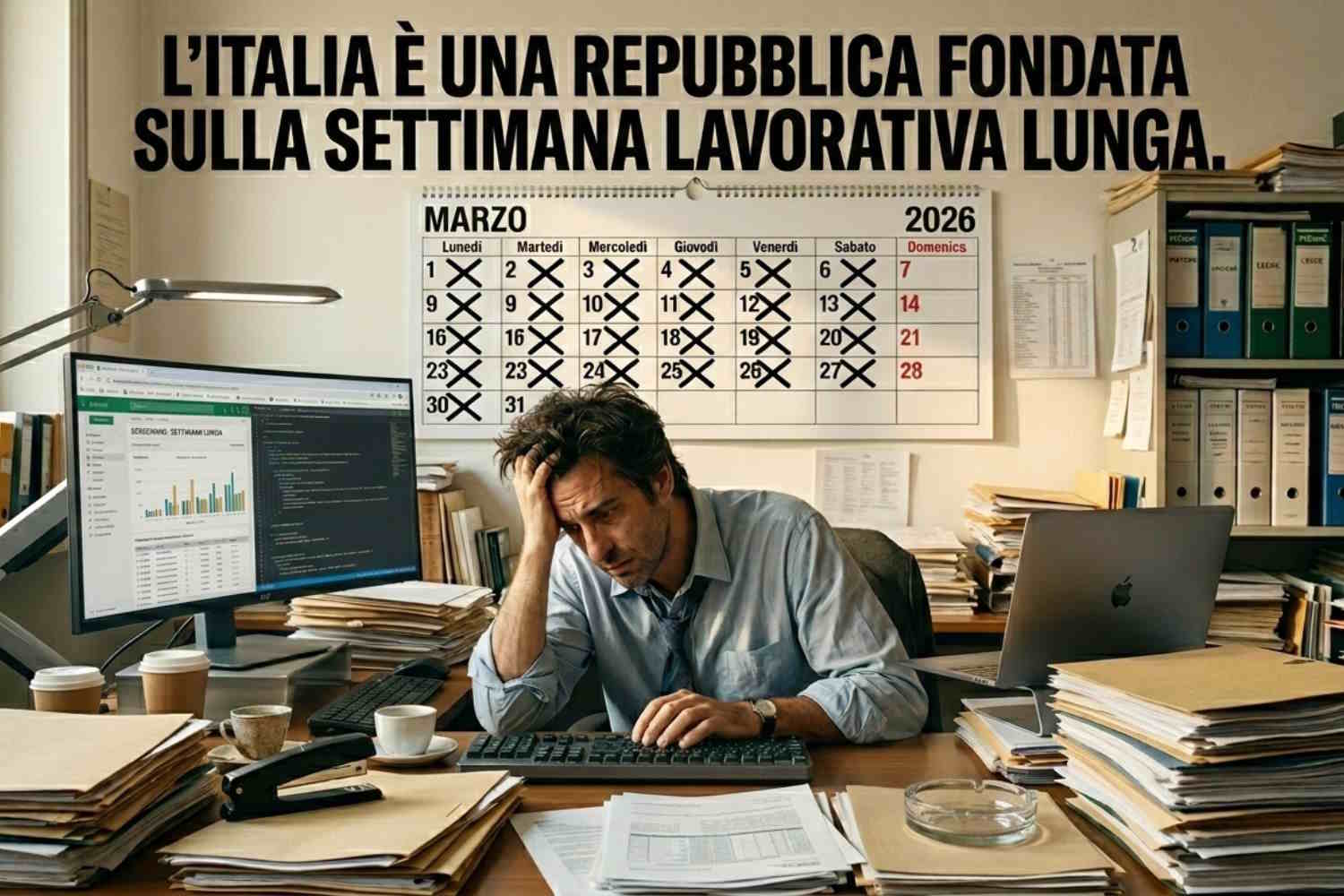
Work a few hours less, earning the same. An idea that is being tested in many European countries to improve the quality of life and reduce stress, but which in Italy – at least for now – remains distant.
In fact, the bill on the short working week, supported by the Democratic Party, the 5 Star Movement and the Green-Left Alliance, was rejected in the Chamber. The text aimed to progressively introduce reduced working hours of up to 32 hours per week, with the same salary, leaving companies the possibility of distributing them over four days or over five with shorter days.
But the provision was effectively canceled by the Montecitorio Chamber through an amendment approved by the centre-right majority: 132 votes in favour, 90 against and 9 abstentions.
What did the proposal involve?
The proposal did not foresee an immediate and mandatory change. The idea was to start a three-year experimentation phase, encouraging company agreements and collective bargaining to gradually reduce working hours. Companies that had joined would have been able to count on contribution relief, while only at a later stage would the government have been able to intervene to lower the legal weekly limit, bringing it from the current 40 hours to 36 hours.
A path similar to the one already started in various European contexts and in some private companies, where the short week has been experimented with often surprising results: more productivity, less stress and greater balance between life and work.
The political clash
The rejection immediately sparked political conflict, with the opposition pointing out that it was a question of questioning the quality of work and the productivity of the country.
The centre-right, however, justified its vote against mainly with economic reasons.
According to the president of the Chamber’s Labor commission Walter Rizzetto, of Fratelli d’Italia, the text presented several critical issues. One of the main ones concerned the possible application of the short week also to the public administration, with possible additional costs linked to the need to hire new staff.
Furthermore, the incentives provided for companies during the experimental phase, according to the estimates cited by the majority, could have increased public spending from 8.5 to around 11 billion euros, without certain financial coverage.
The vote in the Chamber closes, at least for now, the path to a reform of the working week. But the topic remains open. In many countries and companies, we continue to experiment with more flexible working models, with the aim of reducing stress, improving productivity and leaving more space for personal life.
And it is precisely here that the question that remains in the background comes into play: if work is changing everywhere, how long can Italy afford to remain still?
