

Silicone baking mats have become a rather common accessory in our kitchens. They are washed and reused many times and allow us to reduce the consumption of baking paper, which after one or two uses generally ends up in the collection of unsorted waste. A choice that is therefore advantageous for both the environment and the wallet.
But can they release unwanted substances into food during cooking? The German magazine put these accessories to the test Eco-test which analyzed 17 reusable silicone baking mats, purchased from supermarkets, furniture stores and online retailers.
The result is not particularly reassuring, only three products obtained a positive rating, while five were rejected with insufficient or poor ratings.
The test results
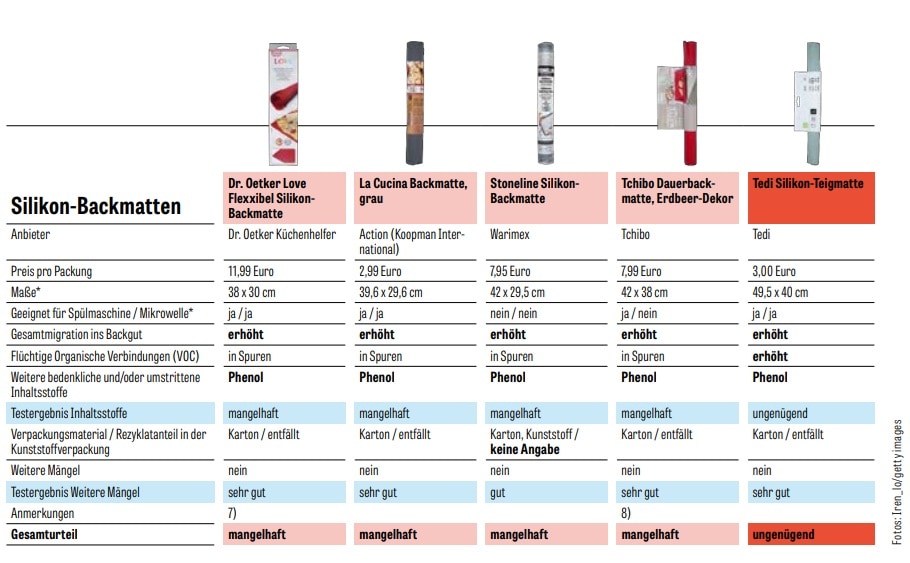
One of the results that caught the testers’ attention the most concerns phenol, detected in 11 of the 17 mats analyzed. This is a substance which, according to Öko-test, could remain as a residue from the silicone production process. Phenol is classified by the European CLP regulation as a suspected category 2 mutagen, i.e. a substance for which there are elements that suggest the ability to cause genetic alterations.
The magazine also refers to the possible neurological effects associated with exposure to this substance. The problem, according to the testers, is that phenol is volatile and could therefore transfer at least in part to foods during cooking.
This does not mean that contamination of the biscuits prepared with all 11 mats in which phenol was identified has been demonstrated, but it represents a critical element in the evaluation of the composition of the products.
Another important test concerned the so-called global migration, i.e. the overall quantity of substances that can transfer from the material in contact with food to a food simulant. To test this, the lab simulated three cooking cycles for each mat, using a temperature of 175°C. He then measured the amount of substances that migrated during the third cycle.
In 8 out of 17 products the overall migration was higher than the evaluation threshold chosen by Öko-test. The magazine considers this result worrying because it cannot be ruled out that among the substances transferred to food there are also potentially harmful compounds.
But it’s not over yet. The researchers also checked for the presence of volatile organic compounds (VOCs), substances that can release from materials and become airborne. In this case, a particularly negative result emerged for the Tedi mat, the only one of the 17 products to have a VOC content higher than the guide value indicated by the BfR, the German Federal Institute for Risk Assessment.
According to experts, these substances can potentially transfer to foods, altering their smell and taste, or disperse into the air of closed environments. The BfR indicates a guideline value of 0.5% for volatile organic compounds in silicone elastomers.
Another surprise concerns bisphenol A. Two mats had the words “BPA-free” on the packaging, but analyzes still identified traces of this substance. The quantities were very low and did not necessarily indicate an intentional addition, but per Öko-test the declaration is not correct if the product is not completely BPA-free.
The best and worst baking mats
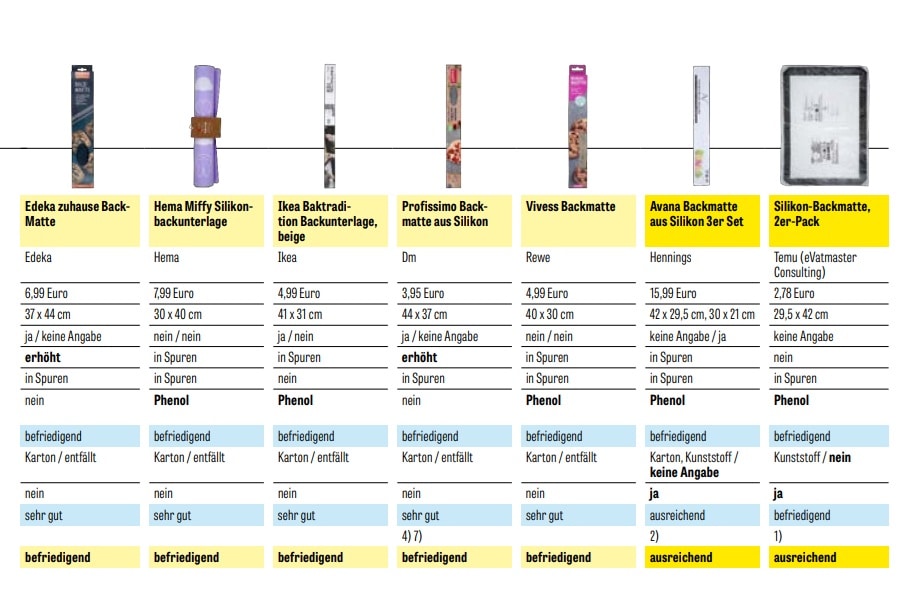
Among the 17 products examined, the best was the Tupperware mat, which obtained the rating “very good”. It is also the most expensive in the test, with a price of 36.99 euros.
In the intermediate range we find Amazon Basics and IKEA, both rated “satisfactory”. The first is a set of two rectangular mats, sold for 15.39 euros, while the IKEA model cost 4.99 euros. Temu instead obtained a “sufficient” rating, placing itself one step below these products.
@ÖKO-TEST
@ÖKO-TEST
Among the worst results we find Dr. Oetker Love Flexxibel and La Cucina Backmatte by Action, both judged “poor”. But the most negative result, as we have already announced, is that of Tedi, whose kneading mat, purchased for only 3 euros, received the rating “insufficient”. It is also the only product in which a high emission of volatile organic compounds (VOCs) has been detected.
@ÖKO-TEST
It is important to remember that the results refer to samples purchased in Germany and do not automatically demonstrate that any products with the same brand sold in Italy have identical characteristics or come from the same batches.
How the silicone mat test was conducted
To carry out the comparison, Öko-test purchased 17 reusable silicone baking mats between May and June 2026. PTFE-coated glass fiber products were excluded, focusing the investigation on silicone mats, also possibly reinforced with glass fibre.
All the samples were entrusted to specialized laboratories for a screening of the materials, which took into consideration various potentially problematic substances: phenol, phenolic compounds, phthalates and plasticizers. Specific analyzes were also carried out for organotin compounds and cyclic siloxanes, as well as controls on volatile organic compounds.
Particular attention was paid to the possibility that silicone components migrated into foods during cooking. To test this, the lab ran three simulated cycles at 175°C for each mat, using a food simulant. The evaluation focused on the overall migration detected during the third cycle.
If the “BPA-free” declaration was present on the package, the product was also subjected to a specific analysis to verify the presence of bisphenol A. However, when the manufacturer did not indicate the material used and did not respond to the request for clarification, the laboratory verified that the mat was actually made of silicone.
Even the packaging was not overlooked: it was analyzed to identify PVC, PVDC and other chlorinated compounds, while the labels were checked to verify the presence of unclear environmental declarations. Manufacturers were also asked whether they used recycled plastic in their packaging and, if so, to provide supporting documentation.
A final clarification concerns the evaluation criteria: the thresholds used by Öko-test to assign penalties do not necessarily correspond to legal limits. In particular, the 10 mg/dm² reference for global migration comes from the European Plastics Regulation, which does not apply directly to silicones. However, the magazine used it as a comparison parameter to evaluate the results.
