
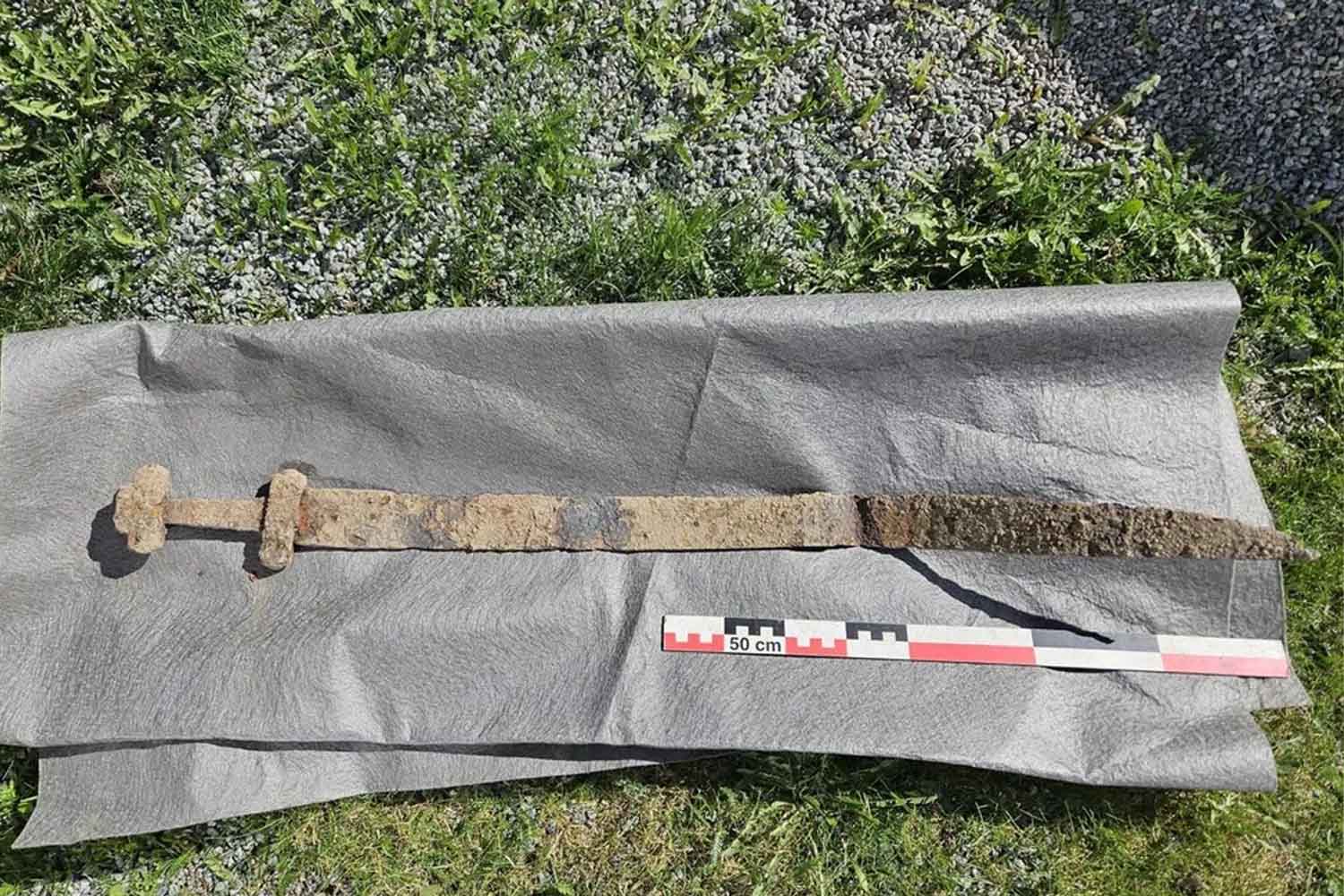
Henrik’s first concern was very practical: a tractor wheel could end up on it and get a flat. He was six years old, a class around him, a field in front of him and a piece of rusty metal sticking out of the ground like something recently forgotten. At that age an archaeological find still resembles a wreck, a crooked object, something worth collecting just to understand what it is. As Henrik Refsnes Mørtvedta first-grader at Fredheim School in Norway, took it from the ground. He was looking for rocks for a school project. He found one in his hands Viking swordor rather a blade that can be dated between the late Scandinavian Merovingian age and the beginning of the Viking age.
The discovery occurred at the end of April in a field Brandbuin the municipality of Gran, in the county of Innlandet, in south-eastern Norway. The area is Hadeland, an agricultural and historic district that is often rendered in English as “warrior land.” A somewhat cinematic translation, of course, but this time the terrain played its part without the need to add much. Henrik saw a metal part coming out of the ground, covered in rust and dirt. He thought about picking her up. Then the adults quickly understood that that elongated shape deserved more expert hands. The teachers contacted local archaeologists, doing the most important thing in such cases: stop and signal.
The blade in the field
The sword is made of iron, with a single edge, that is, sharpened on one side only. Norwegian cultural authorities have described it as an “enegget” blade, a term used to indicate a single-edged weapon. This type of object belongs to the large family of sax or scramasaxblades widespread in early medieval northern Europe, also born as hunting or combat knives and, in some cases, developed into true warrior weapons. The thing that strikes archaeologists is the state of conservation: the iron is corroded, as expected after more than a millennium in the ground, but the general shape is still legible.
Henrik, before the adults’ intervention, also tried to straighten the blade. A child’s gesture, rather than that of a small Indiana Jones: he sees something bent, tries to fix it. Then he explained that he feared she would be hit by a tractor and that perhaps she would end up in a museum. He had hit the point on this better than many greats. The sword was transferred to the Oslo Museum of Cultural Historywhere it will be cleaned, stabilized and studied with non-invasive analyses, including x-rays and tests on materials.
Dating remains the most delicate step. Initial assessments placed it between 550 and 800 ADwithin that phase which in Scandinavia is often referred to as the Merovingian age. A subsequent estimate by the archaeologist Øystein Lia instead narrows it down to between 750 and 850 ADtherefore right on the threshold of the Viking Age or in its first decades. In any case, we are in a period in which Scandinavia was changing pace: wider trade, sea voyages, raids, local leaders, unstable balances of power. In 793 the attack on the monastery of Lindisfarne, off the coast of north-east England, would become one of the symbolic episodes of the start of the Viking Age in European written sources.
A free man’s weapon
A sword, in that world, weighed much more than its iron. Materials, skills and specialized work were needed. It was an expensive object, linked to rank, war, property, the ability to stay within a network of power. Lia speculated that the weapon might have belonged to a man of high status, perhaps a free landowneran important warrior, perhaps close to a local chief as a military advisor. It is a plausible, still provisional reading. Archaeologists will need to better understand how it was produced, whether it bears traces of use, whether it was intentionally deposited or moved by agricultural work over the centuries.
The location of the discovery adds pressure to the story. The blade was found at approx 40 meters from Iron Age burial mounds already registered. This opens up a very real possibility: the sword may have originally been found in a burial, perhaps as a funerary gift. In many Nordic societies between the pre-Viking and Viking ages, placing a weapon next to a dead person meant removing richness from daily life and handing it over to someone whose role justified it. A material, expensive gesture, visible even after death.
Precisely for this reason scholars will be cautious. A plowed field always tells a disturbed story: the soil is cut, turned, moved; objects can re-emerge far from the precise point where they were placed. Henrik’s sword may have been dragged by the plows, lifted little by little towards the surface, left for years just inches from distracting eyes. Then a class of children arrived looking for rocks, and one of them took a closer look.
Norway re-emerging
The find comes in an already very rich year for Norwegian archaeology. Also in Innlandet County in April, two enthusiasts with metal detectors found 19 silver coins in a field near Rena. They stopped the search and notified the archaeologists. From there emerged the Largest Viking Age coin hoard ever discovered in Norway: the number, initially close to three thousand coins, was then updated to over 4,700 pieces recovered.
In both cases, the value of the discovery depends on the behavior of the finder. Stop, call, let the specialists work. In the Brandbu camp the teachers did it after Henrik’s surprise; in Rena the prospectors did it after the first coins. Archeology is often saved this way: with a less brilliant gesture than the discovery itself, which is much more useful. A telephone, a report, an artifact delivered before it becomes a souvenir or damage.
Henrik, when asked how old that sword might be, tried to think like a child. Maybe a hundred years. A huge amount, when you’re six years old. The ground, however, had preserved something much older: a blade of approximately 1,200-1,300 yearscoming out of the mud with rust on it and a story still to be deciphered. Now it will end up under the eyes of conservatives, who will try to read the metal without erasing its traces. The analyzes will tell the rest.
