
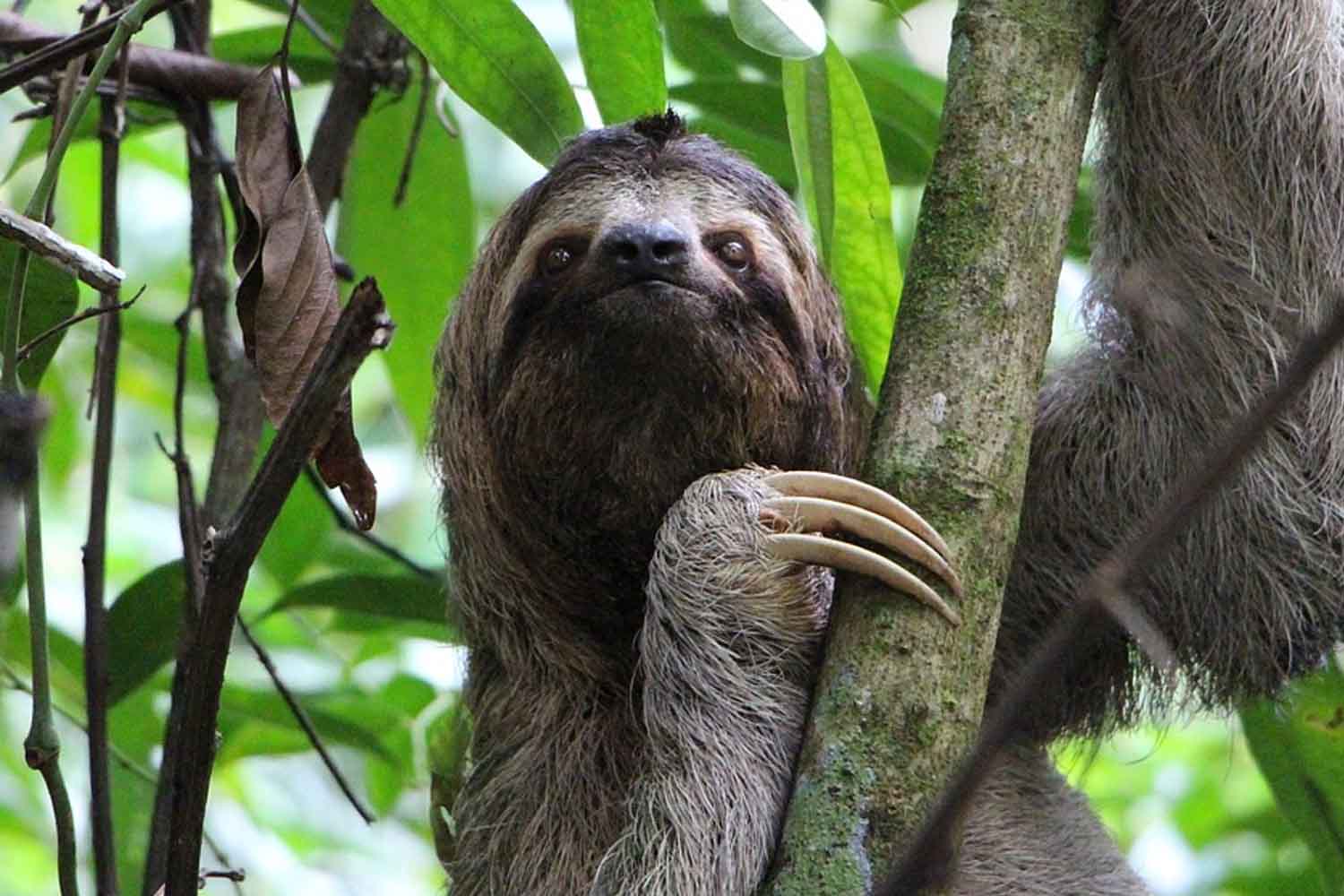
A very slow creature, apparently fragile yet extraordinarily resistant, the sloth represents one of the greatest challenges to the classic rules of natural selection. Looking at him he seems vulnerable to everything, incapable of reacting, almost out of time with the world around him. Yet it is still here, after millions of years. The question is inevitable: how does an animal like this still survive today?
When we talk about sloths we tend to imagine just one animal, but the reality is more complex. There are six species of sloth in existence today, divided into two large families: the two-toed and three-toed sloths. They all share an arboreal, suspended and inverted lifestyle, but play different roles within the forest.
Three-toed sloths, including the famous Panama pygmy dwarf sloth, are strict, smaller herbivores with a rounded snout and an expression that appears to be constantly smiling. Two-toed sloths, on the other hand, have a more robust structure, a more flexible diet and a slightly higher level of activity, although talking about “speed” is still an understatement.
The pygmy dwarf sloth itself represents the most dramatic extreme of the current situation: it is classified as critically endangered, with probably less than one hundred individuals confined to a tiny island. In contrast, other species are still considered to be at “least concern” by the IUCN. This stark contrast between apparent stability and imminent risk makes the sloth’s fate emotionally unsettling.
The slowness of the sloth is not a limit
The sloth’s most obvious trait is also the most misunderstood: its extreme slowness. His muscles are poorly developed relative to his body weight, his metabolism is incredibly low and his movements are so slow that they seem almost immobile. But it is not a defect: it is a precise biological choice.
By moving very little, the sloth consumes a minimal amount of energy and becomes almost invisible to predators, who mainly detect what moves quickly. Its fur, often covered in greenish algae, contributes to perfect camouflage in the canopy, transforming it into something similar to a tuft of living moss.
This strategy also makes the sloth unappetizing from a nutritional point of view: it has little muscle mass and very little fat, so it does not represent an interesting prey for jaguars or birds of prey. In other words, it is so “unconvenient” that it is not worth the effort of being kicked out.
If for millions of years slowness worked, today the problem is not the sloth but the context. His entire universe is the tropical forest of Central and South America. When the forest is destroyed, fragmented or crossed by roads, the sloth loses everything.
He doesn’t run, he doesn’t fly, he doesn’t have an alternative plan. When he is forced to go down to cross a road, he becomes extremely vulnerable. Cars, electrical cables, urbanization and fires are threats against which it has no defense. It is not uncommon for humans themselves to have to physically move it to avoid certain death on the asphalt.
Despite its huge claws, the sloth is completely harmless. It looks more like a large stuffed animal than a wild animal, and this perception also contributes to the problem of illegal trafficking and tourist selfies, which transform it into an object rather than a living being.
The main threats
Any interruption of forest continuity represents a direct danger for the sloth, because its life takes place almost entirely in the trees. Its slowness, which in the intact forest was a protection, today becomes a condemnation.
The destruction and fragmentation of tropical forests, collisions with vehicles while traveling on the ground, electrocutions on power lines, illegal trafficking of wild animals and climate change that alters the structure of forests add up, creating unsustainable pressure. Every tree felled is like removing a step from an already unstable ladder.
There is a surprising detail that tells better than any theory how integrated the sloth is into its environment. It comes down from the tree only once a week, always in the same place, to do its business at the base of the trunk. It is an extremely risky, but also ecologically precious moment. Its excrement fertilizes the soil and nourishes specialized insects, contributing to the life cycle of the forest. Even in the most banal gesture, the sloth supports the biodiversity that surrounds it.
Because natural selection didn’t eliminate the sloth
At first glance, the sloth seems like the opposite of an animal “fit for survival.” Yet it has been present on Earth for millions of years. Its evolutionary longevity demonstrates that natural selection does not reward strength or speed, but efficiency.
His immobility makes him invisible, his very slow metabolism allows him to live with very little food, life in the trees protects him from the dangers of the soil. Its long nails and powerful flexion muscles allow it to hang for hours, even while sleeping. He is not an evolutionary error, but an extreme specialist, a champion of “less but better”. The problem arises when this millennial balance is broken by human intervention.
Because protecting the sloth means defending the entire tropical forest
In addition to its cute appearance, the sloth is an essential cog in biodiversity. It influences vegetation, enriches the soil, hosts algae, insects and highly specialized microorganisms. Losing it would mean removing a fundamental piece from an already fragile ecosystem. In a world where over a million species are at risk of extinction, the sloth is also a symbol. It embodies a slow, silent, discreet form of life, which only asks to exist without being overwhelmed by our speed.
In several countries such as Costa Rica, Panama, Colombia and Brazil, protection laws, tree corridors above the roads and recovery centers for injured animals have been introduced. Awareness campaigns try to explain that a sloth is not a souvenir or an accessory for social media. Even serious zoos and sanctuaries contribute to research, controlled reproduction and public education, in some cases becoming a real parachute against extinction.
The hope is that the sloth will never have to reach extreme solutions like those adopted for other species now on the brink of the abyss. But to achieve this we need a radical change of outlook: to stop seeing him as a slow curiosity and start recognizing him as a being perfectly adapted to his world, a world that we are the ones destroying.
You might also be interested in:
