
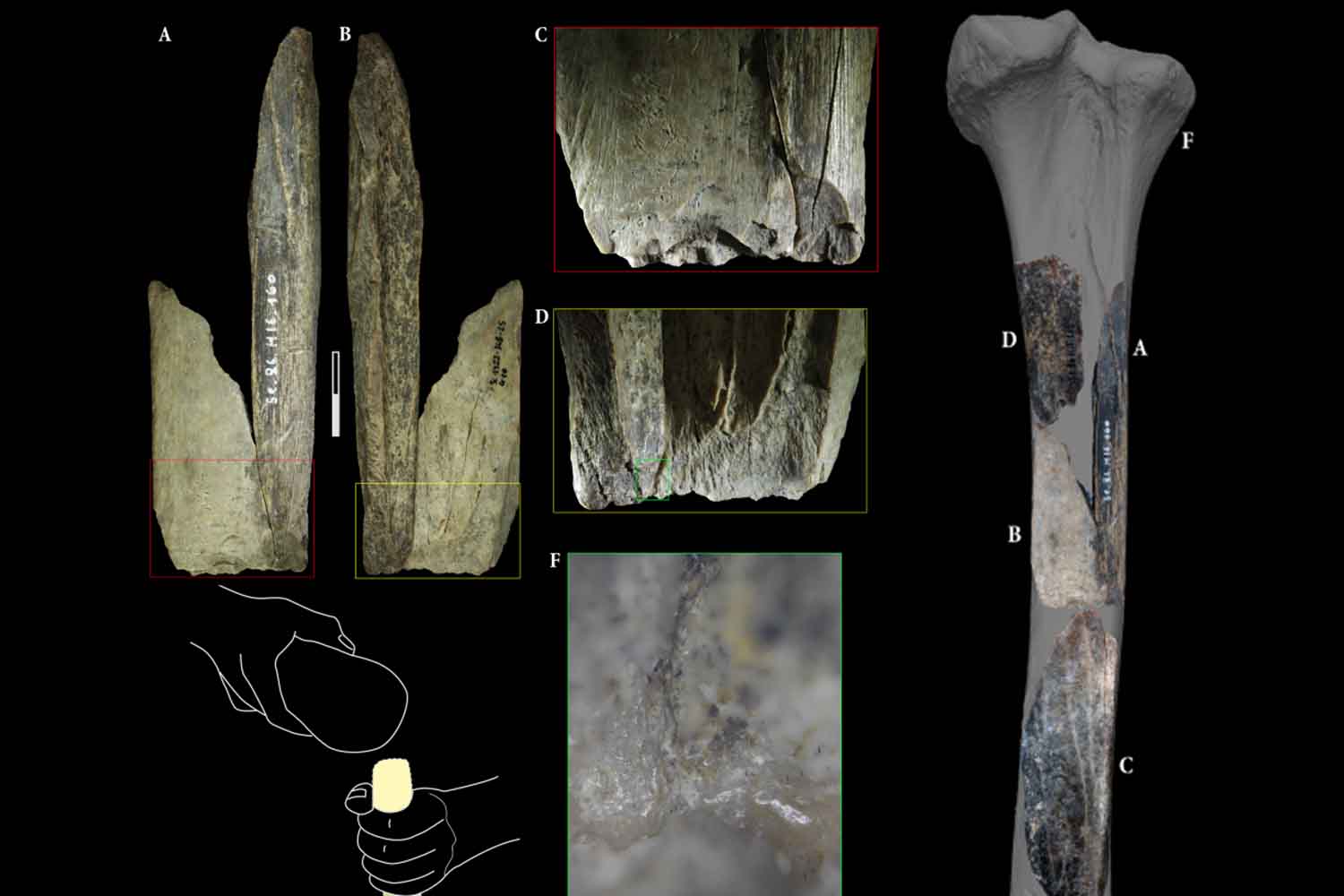
In the wet silence of the Scladina cave, in the heart of the Mosa Valley, in Belgium, a small bone fragment tells an incredible story. We are not talking about jewelry or human remains, but of a simple tibia. A bone that belonged to a lion of the caves lived beyond 130.000 years agotransformed by the Neanderthals into one multifunction tool. A discovery that revolutionizes our way of seeing these ancient human beings.
To identify this extraordinary finding was a research team of theUniversity of Gandin collaboration with international scholars. It is the oldest known multifunction tool obtained from a Leone bonea feared predator of the Pleistocene.
Not just stones
The fragments, found in the same geological layer of the cave (unit 5), were recomposed and attributed to one left tibia of an adult lion. This bone, worked on both surfaces, had been intentionally shaped, used, fractured and reused For different purposes.
Initially it was transformed into a tool similar to one chisel: one of the ends was smooth and polished To create a functional edge, as revealed by the traces of use observed under the microscope. This edge was probably needed for Wood scraping or bone.
But it doesn’t end there. After the wear, the piece came voluntarily broken and the fragments were reused as Retouchoirstools intended for finish the blades in flint. A complex process, known in archeology as chaîne opératoirewhich demonstrates a real logical chain in the production of tools. It was not a improvisation, but the result of Consolidated and transmitted knowledge.
The same technique has been observed on bear tesse tools, found on the same site. This shows that The Neanderthals had a precise strategy To take advantage of the available materials.
Why the lion? Not symbolism, but knowledge and practicality
The use of a cave lion bone – an imposing, feared animal, and rarely associated with the production of tools – is an exceptional element. But researchers invite caution :. Neanderthal, most likely, they chose the bones according to the shape, robustness and structurenot for the species they belonged to.
Bone instruments have also been found in the Scladina cave also by Bear, reindeer, horse and woolly rhinocerosbut the choice does not seem dictated by cultural reasons. On the contrary, everything suggests one Functional and conscious logic in the selection of materials.
The lion shows no signs of predation by other animals or traces of exposure to atmospheric agents, which suggests that it has been worked shortly after death. Neanderthals may have kicked it, found dead or even faced by self -defense. But it remains a fact: they were able to manage and work the remains of a great carnivoroustaking advantage of it.
A much more advanced neanderthal image than we believed
This Multifunction tool in Leone bone It is the first of its kind never discovered. Shows that neanderthals, but they also knew draw precious resources For their survival: meat, fur and bones, everything was useful.
The discovery is added to other clues that force us to radically review the image of the Neanderthals. They were not brutal and primitive, as we imagined for years. On the contrary, they were ingenious, adaptable and equipped with technical intelligence. They knew how to plan, choose the right materials and use them at best.
In the same cave they had already been found Verce tools and the remains of a neanderthal childin one of the best preserved layers of the European Paleolithic. This new find adds a fundamental piece to a narrative that enhances the cognitive and manual skills of the Neanderthals.
As the authors of the study explain, published on Scientific Reports:
This artifact testifies to a technological behavior based on early planning, knowledge of materials and functional adaptation.
