
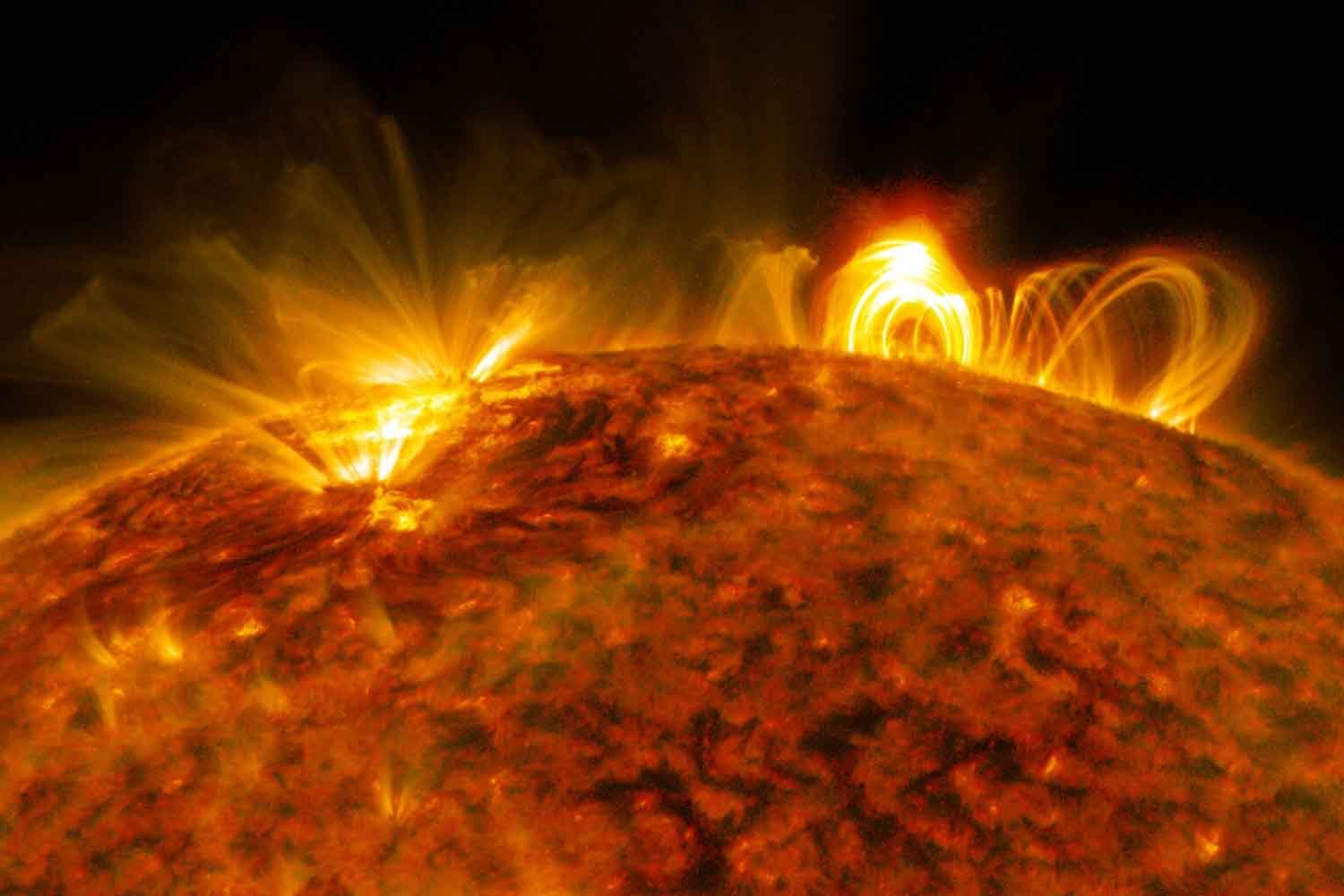
For years we have observed them without being able to really explain them. Very powerful flashes, extreme signals that arrive from space every time the Sun is at its worst. Today, however, i solar gamma rays they finally have a clear origin, and the discovery tells much more than a simple technical detail: it tells us about how much our star is still capable of surprising us.
It all starts from a study published on Nature Astronomysigned by a group of solar physicists from New Jersey Institute of Technology. By analyzing one of the most violent flares ever recorded, scientists have managed to identify an energy source that remained hidden for decades, right above the surface of the Sun.
The flare that changed everything
On September 10, 2017, the Sun produced a flare of class X8.2one of the most intense events ever observed. On that occasion, something anomalous attracted the attention of researchers: an emission of solar gamma rays too powerful to be explained with traditional models.
The answer was not on the solar surface, but higher up, in the corona, that rarefied and incandescent region that surrounds the Sun. Right there an extremely localized area was identified in which trillions of particles accelerated to impressive energies, equal to millions of electron volts, were concentrated. To give an idea, these are values hundreds or thousands of times higher than those typical of “normal” flares.
These particles move almost at the speed of light and represent a completely different population than that observed so far. This is where the gamma signals arise which, for years, have left scientists without a convincing explanation.
When the Sun accelerates extreme particles and produces light never seen before
The mechanism is as fascinating as it is violent. The very high energy particles, colliding with the plasma of the solar atmosphere, produce gamma rays through a physical process called bremsstrahlung. Simply put, it is a kind of “sudden braking” which transforms the energy of the particles into extremely energetic light.
The real surprise, however, lies in the distribution of these particles. Unlike what usually happens, here it is not the less energetic particles that are more numerous. On the contrary, most of them are located precisely in the highest energy band. An anomalous behavior that perfectly explains the spectrum of solar gamma rays observed during the 2017 flare.
Two instruments, a discovery and a step forward in understanding space weather
To reach this conclusion, the researchers cross-referenced data from very different instruments. On the one hand the Fermi Gamma-ray Space Telescopewhich precisely measured gamma emissions, on the other the Expanded Owens Valley Solar Array, a system of radio telescopes capable of “seeing” where particles are accelerated in the solar corona.
The superposition of the signals made it possible to identify a key region, until now ignored, in which radio and gamma emissions coincide perfectly. It is there that the Sun releases the accumulated magnetic energy, transforming it into natural accelerators of extreme particles.
Understanding how and where solar gamma rays arise is not just a scientific curiosity. It means improving the models that describe solar activity and, consequently, making space weather forecasts more reliable, which is essential for protecting satellites, electricity grids and the technologies we depend on every day.
However, not everything has been clarified. It still remains to be understood whether these particles are electrons or positrons, a subtle but crucial distinction to fully understand the physical processes at play. The answers could come soon thanks to the upgrade of radio telescopes, which will allow the polarization of emissions to be measured more precisely.
