
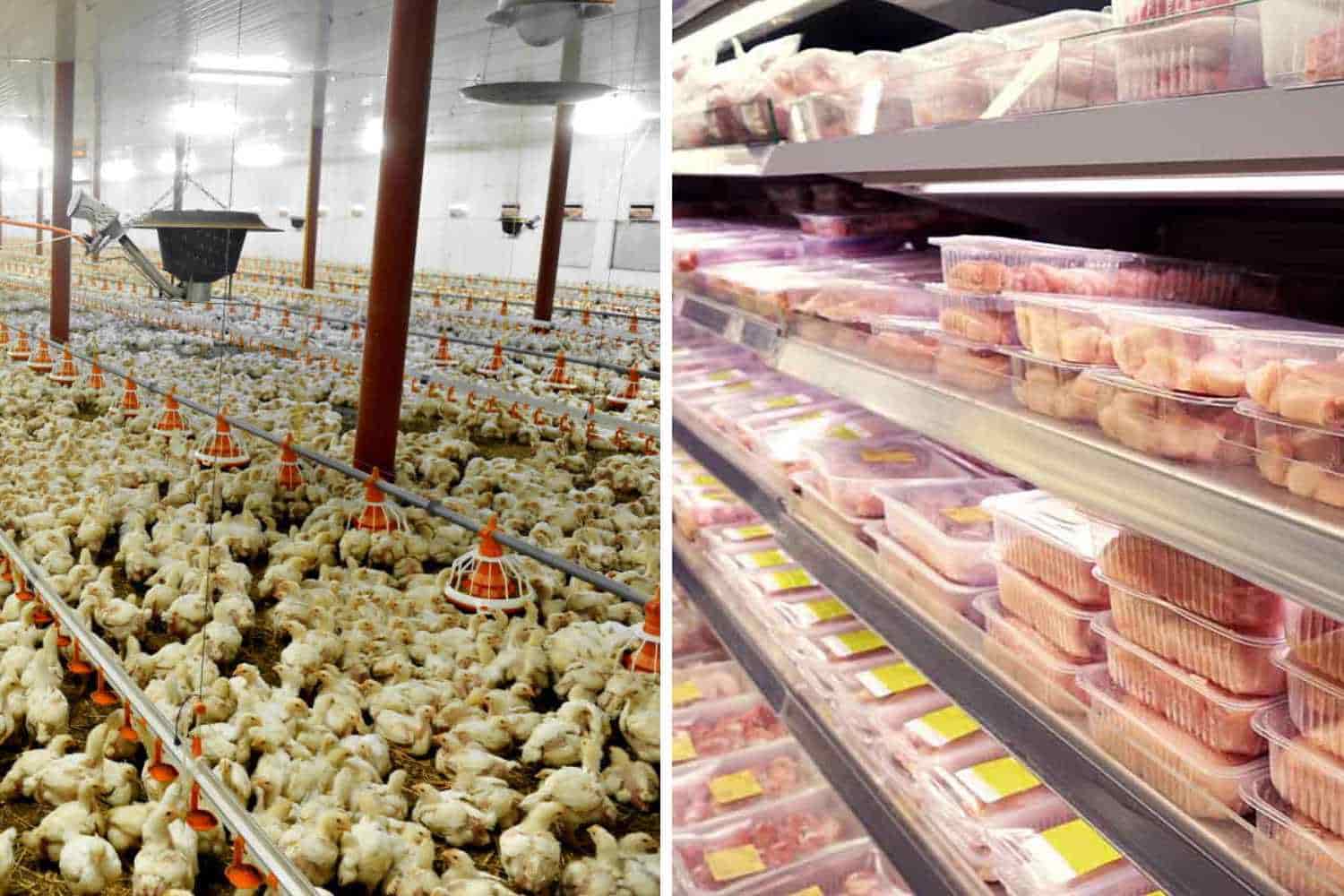
When we buy chicken at the supermarket, we hardly stop to think about how the animal lived before arriving on our tables. Yet, behind a package of chicken breast or thighs there can be very different farming conditions, with important consequences on animal welfare.
A new analysis by Compassion in World Farming (CIWF) Italy has tried to clarify, examining seven large Italian retail chains and evaluating both their animal welfare policies and the products actually available on the shelves.
The picture that emerges is not particularly encouraging: over 90% of the chicken supply analyzed comes from farms that only comply with the minimum legal standards or still provide limited improvements. Alternatives that are more attentive to animal welfare, including organic, free-range and indoor systems with higher requirements, continue to take up less space.
Over half a billion chickens slaughtered every year in Italy
To understand the scope of the problem, just look at the numbers. In Italy, over 589 million chickens raised for meat production are slaughtered every year and 93.1% come from intensive farming systems.
In these farms the animals generally live in sheds, at densities that can reach up to 42 kg per square meter, equivalent to approximately 19 chickens considering an average weight of 2.2 kg each. Their life is also very short: they are slaughtered around 30 days.
What makes these conditions particularly problematic is not only the limited space. In fact, the majority of chickens bred for meat belong to breeds genetically selected to grow very quickly, quickly reach the weight required by the market and develop a greater quantity of meat in the breast.
Such accelerated growth has consequences for animal health. As CIWF explains, it can lead to movement difficulties, lameness, cardiovascular problems and other pathologies. Added to this are environments that are often lacking in stimuli, in which chickens have little opportunity to express natural behaviors such as scratching, pecking or perching.
What is the European Chicken Commitment and why it matters
To try to improve these conditions, in 2017 Compassion in World Farming worked together with a coalition of European organizations to define a common standard, the European Chicken Commitment (ECC). This is a set of requirements that companies can adopt to make farming more respectful of chicken welfare.
It’s not simply a matter of ensuring a few extra centimeters of space or introducing some elements into the shed. The commitment includes a series of interventions that must be considered as a whole: using slower-growing breeds, limiting breeding density to a maximum of 30 kg per square meter, guaranteeing natural light and environmental enrichments, such as perches and substrates on which the animals can peck.
Controlled atmosphere stunning methods at the time of slaughter are also envisaged, as well as independent verifications and public updates on the progress made by companies.
The choice of slower-growing breeds is particularly important because it intervenes on one of the problems underlying intensive farming, namely the selection of animals that gain weight too quickly, with repercussions on their health and the possibility of moving normally.
According to CIWF, over 350 food companies in Europe and around the world have already signed up to the ECC. In Italy, however, large-scale distribution still has a long way to go.
@CIWF
@CIWF
CIWF analysis: which supermarkets do best?
The CIWF Observatory examined seven modern Italian retail brands: Coop, Conad, Selex, Esselunga, Carrefour, Lidl and Aldi.
The evaluation developed on two fronts. On the one hand, the public policies of the companies were analyzed to verify what commitments they have made on the welfare of chickens. On the other hand, the offer of own-brand fresh chicken was examined, including the lines attributable to individual supermarkets.
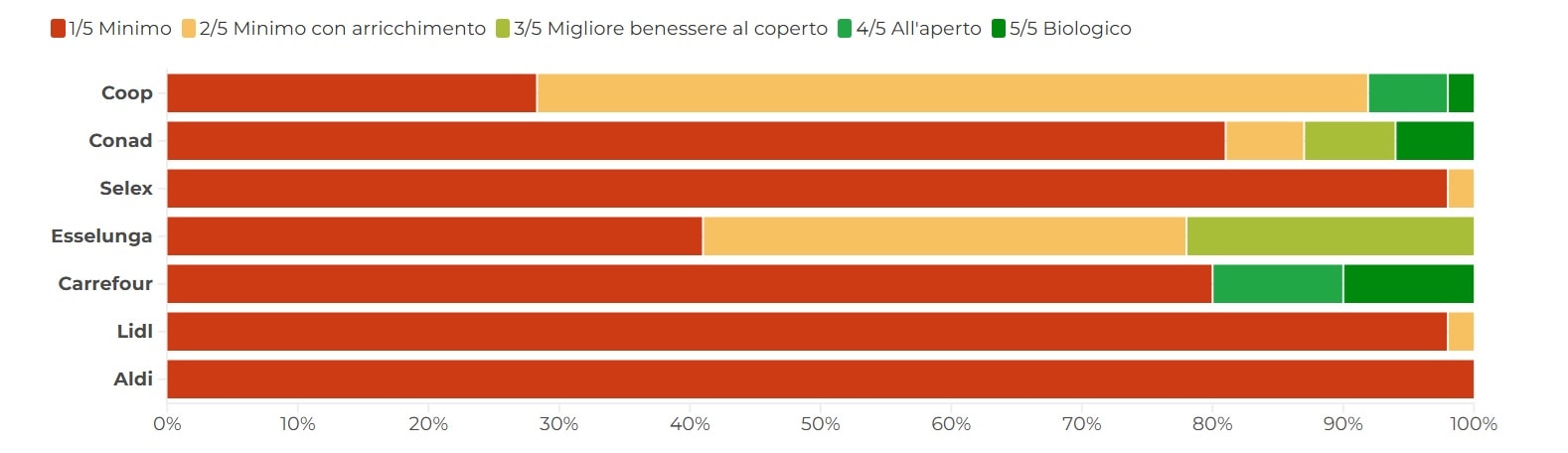
To compare the products, a five-level labeling system was simulated, which assigns an animal welfare potential to each line based on the characteristics of the farm. Level 3 corresponds to the requirements of the European Chicken Commitment for indoor farming, while organic and free-range occupy the higher bands.
It is important to clarify that this is an evaluation based on publicly available information, such as packaging, company websites and sustainability reports, and not a laboratory test on the products.
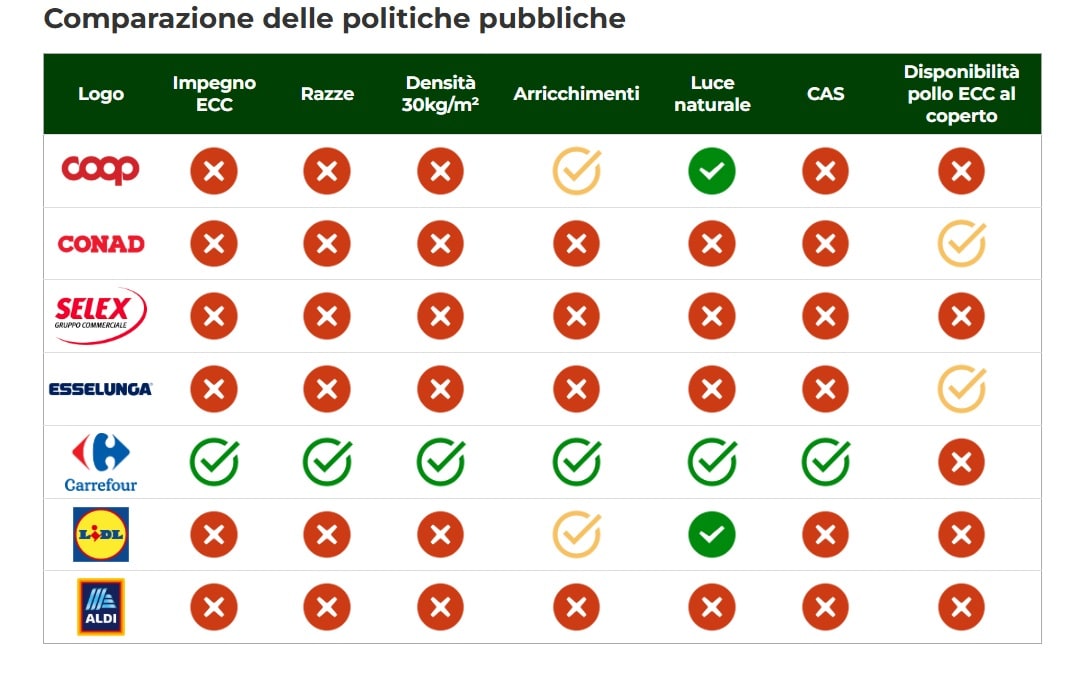
From the analysis of the policies it emerges that Carrefour, Coop and Lidl provide some requirements relating to natural light and environmental enrichments for their entire offer. However, except for Carrefour, there is a lack of commitments across all products regarding the two aspects considered most important for significant improvement: the use of slower growing breeds and the reduction of stocking density by up to 30 kg per square metre.
Carrefour, belonging to the NewPrinces-Gs group, is the only brand to have undertaken an ECC commitment across the entire offer and to also include the issue of stunning in its policy, communicating the percentage of implementation. It is also the one with the highest estimated share of products coming from organic supply chains and free-range farms.
Despite these positive elements, CIWF emphasizes that progress is still limited. The commitment expires in 2026, but a roadmap has not been published clarifying how and when it will be completed.
Looking at the products actually available, the Observatory also identifies some situations that could represent a starting point for improvement.
This is the case of Coop, where 63% of the offer analyzed combines densities of less than 33 kg per square meter, natural light and environmental enrichments. These are features that do not yet meet all ECC requirements, but could facilitate a subsequent move to higher standards.
A somewhat similar situation concerns Esselunga. The Naturama line, which represents an estimated 37% of the offer, has environmental characteristics comparable to those identified for Coop. Then there is Top Chicken, which constitutes approximately 22% of the assortment analyzed and follows requirements generally in line with those of the European Chicken Commitment.
Conad also offers an alternative to the rest of the assortment: the Come una Volta indoor chicken line, which however only represents around 7% of the offer. In fact, the majority of products remain linked to systems that comply with minimum well-being standards.
Among the discounters analyzed, Lidl and Aldi concentrate much of their offer on standard products. In the case of Lidl, however, even the basic level includes natural light and environmental enrichments. According to CIWF, for these brands the priority should above all be to improve the conditions of the entire basic offer, without necessarily focusing on the creation of numerous premium lines.
The most limited situation, among the non-discount groups examined, concerns Selex. In fact, the own-brand offer seems to focus exclusively on products with basic or minimum welfare requirements, without segmentation towards alternatives that are more attentive to animals and without transversal policies that go in this direction.
@CIWF
Because it’s not enough to have some products that are more respectful of animal welfare
The message that comes from the Observatory is quite clear: it is not enough to put some organic or free-range products on the shelves to be able to talk about real attention to the well-being of chickens.
These alternatives are important, but often represent a limited part of the assortment. To really impact the living conditions of millions of animals, it is necessary to intervene also on the products that make up the majority of sales, improving the standards of conventional farming.
This is precisely where the European Chicken Commitment comes into play, which aims to make production with higher welfare requirements more economically accessible, through indoor systems that guarantee more space, breeds less subject to problems linked to accelerated growth and environments more suited to the needs of the animals.
For those who shop, having more information and a wider offer means being able to choose with greater awareness. But the responsibility cannot fall only on consumers, it is above all the large distribution chains and the companies in the supply chain that can contribute to a concrete change, bringing higher standards out of the few niche lines and making them a feature of the ordinary offer.
