
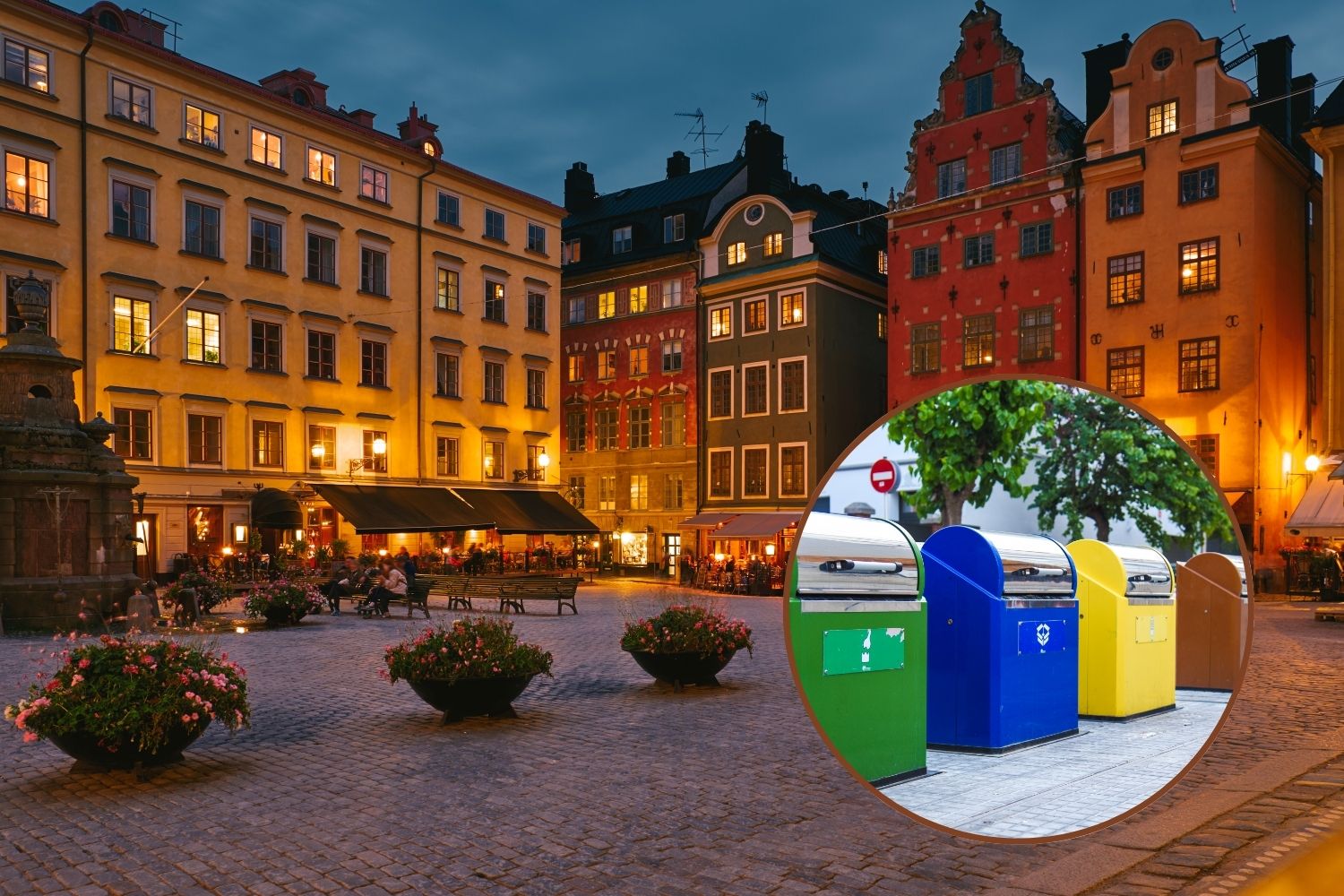
Today, more than half of waste in the world ends up in landfills, contributing to serious environmental problems. One of the most significant threats of landfills? The production of greenhouse gases like carbon And methanewhich accelerate global warming.
There Swedenone of the most sustainable countries in the world, has become a model to follow thanks to its efforts in renewable energy and reduction of emissions. With a revolutionary approach to waste management, Sweden has transformed its waste into energy, keeping the landfills empty and at the same time fueling houses and buildings.
The landfills are large sources of toxins and harmful substances for the atmosphere. In the United States, they are the third source of methane emissions of anthropic origin, a 25 -time carbon gas. Methane alone constitutes almost 15% of the country’s total emissions, contributing to air pollution and water, the loss of biodiversity and the degradation of the soil. A report by the International Solid Waste Association (ISWA) warns that, at the current rhythm, landfills will represent at least 10% of the global greenhouse gas emissions by 2025.
On a global level, about 60% of the waste end up in the landfill, but in Sweden this percentage is only 1%. How is it possible? The country has revolutionized its recycling system, drastically increasing recycling rates and implementing technologies to transform waste into energy.
Sweden recycles so well that for years it has been the trash of other countries for years
Sweden has long been a leader in the transition to zero net emissions. Here the highest share of renewable energy of the European Union is used, with 56% of its energy from sources such as hydroelectricwind and nuclear energy. In addition, Sweden has some of the lowest carbon emissions globally, thanks to a passage to electrical transport and huge investments in intelligent technologies and urban agriculture. On average, each American emits almost four times more CO2 than a Swedish, according to the World Bank.
The success story of Sweden extends beyond renewable energy to waste management. Since the 90s, the Swedish government has implemented policies to reduce the generation of wastesensitize manufacturers and citizens and reduce emissions. The introduction of the extensive responsibility of the manufacturer (EPR), which makes the producers responsible for the collection and disposal of their products, together with a tax on weight -based waste for families, encourages recycling. The national laws, which prohibit the landfill of combustible and organic waste, and the most severe standards for hazardous waste, landfills and incineration imposed by the European Union have helped Sweden to reduce emissions and waste in landfills.
Sweden has achieved a level of efficiency in waste management such as to import garbage from other countries to maintain its recycling and thermalization systems operational.
In the 70s, Sweden sent about 38% of its waste to landfill. Today, less than 1% of household waste ends up in the landfill, while the rest is recycled or transformed into energy. In particular, about 52% of waste is incinerated to produce energy, providing heating to over a million homes and electricity a 250 thousand Houses.
This efficiency has led to a lack of domestic waste, pushing Sweden to import about two million tons of waste a year from countries such as the United Kingdom, Norway, Ireland and Italy. These countries pay Sweden to dispose of their waste, which are used to feed the thermovalization systems.
Environmental and economic impacts
The Swedish system has significantly reduced greenhouse gas emissions associated with landfills, thanks to the prohibition on the transfer of organic waste and combustible in landfills introduced in 2005. Modern incineration systems are equipped with advanced technologies for emissions control, making the process more ecological than in the past.
From an economic point of view, waste management has become a source of income for Sweden. In 2020, the sector generated around 1.7 billion euros, with peaks of up to 1.98 billion euros in 2016,
But there is a but….
Despite the successes, the Swedish system is not without criticism. Some experts emphasize that the incineration of waste, although efficient, can discourage the reduction and reuse of materials, fundamental for a real circular economy. In addition, dependence on the import of waste could become problematic if other countries improved their waste management practices.
And in Italy? The challenge is in waste management and incinerators
Here with us the construction of new incinerators is the subject of contrasting opinions and often meets a strong opposition from local communities and activists, concerned about the environmental impacts of emissions and the lack of adequate infrastructure for recycling.
Thus remains the fact that the waste management system in Italy is very complicated due to regional differences in the effectiveness of the collection and recycling programs: the lack of a uniform national strategy of fact often leads to inefficiencies and an increase in waste that end up in landfills instead of being treated for energy recovery.
Despite the efforts to increase recycling, Italy still depends significantly on landfills for waste disposalwhich not only wastes precious resources, but also contributes to pollution and greenhouse gas emissions, making waste management a critical issue for the country’s sustainability objectives.
