
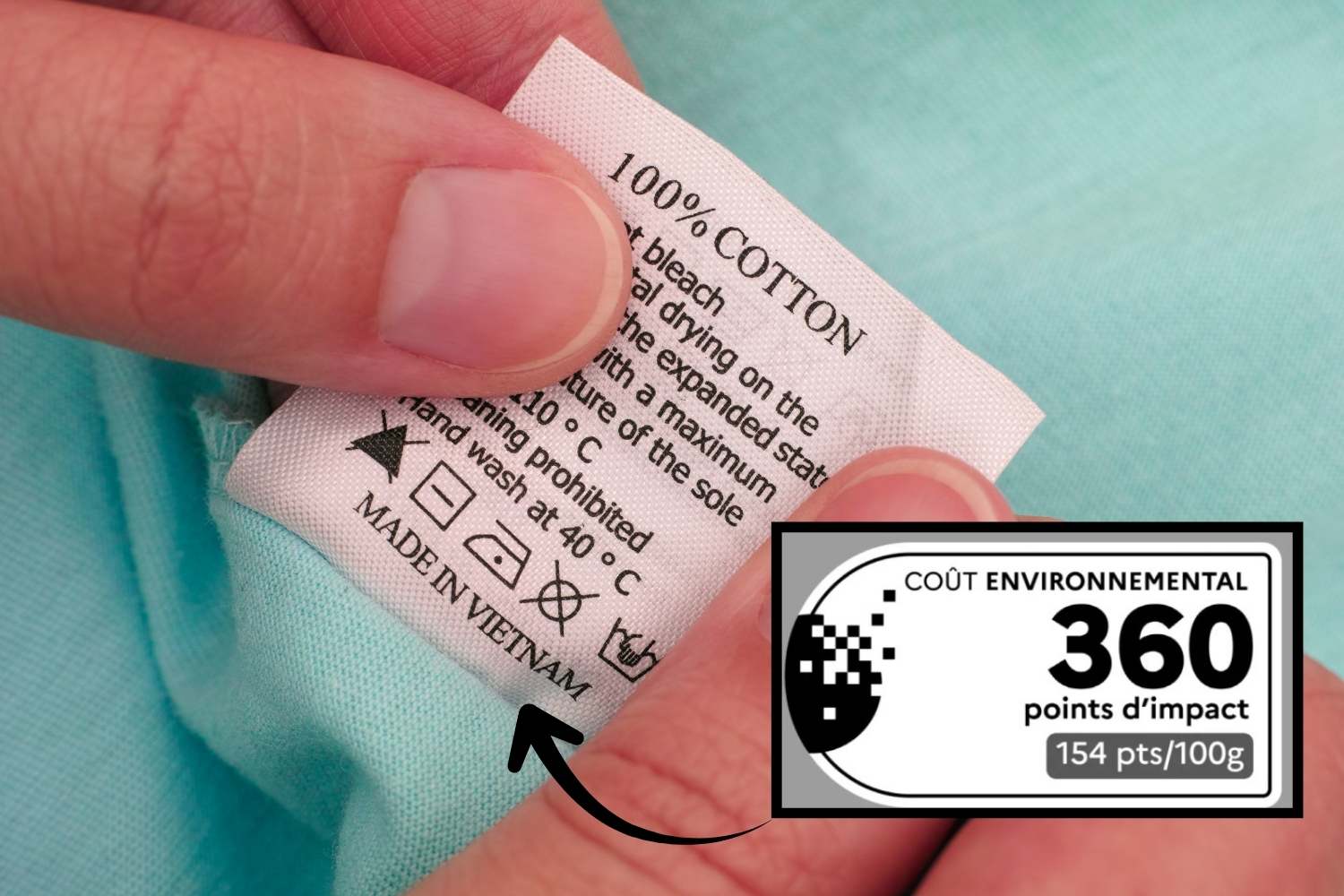
Since yesterday, October 1, 2025, French consumers can finally see on the labels of clothing a new tool designed to evaluate the environmental impact of the fabrics: the environmental score textile, or textile eco-score.
Validated last May by the European Commission, this label is the result of years of work, which began with the Climate and Resilience Act of 2021, which involved the creation of environmental display systems in the diet and textile sectors.
What is the textile eco-score and what is its purpose
The eco-score is a visualization system that allows you to know the “environmental cost” of a clothing garment, calculated on the entire life cycle: from the supply of raw materials, to production, transport, to the disposal phase as a refusal.
The goal is twofold:
However, it should be noted that the implementation of the label is based on the voluntary participation of the brands: companies are not obliged to exhibit the score, even if from 2026 the associations of consumers and third parties will still be able to publish it.
Which textile products are interested
The score concerns textile products for clothing, including:
Instead are excluded:
Where it appears and in which form
The environmental score can appear on the product itself (by marking or label), on the shelves of the stores, online and on the brands sites.
It presents itself as an expressed value in points: the higher the number, the greater the environmental cost of the product.
This evaluation takes into account various aspects:
In addition, an online tool has been made available that allows you to enter the bar code of a product to know the detailed environmental cost.
A first step, but with important limits
The system represents a useful novelty, but not without critical issues. These are the main ones, reported by the French consumer association Que choisir.
Experts of Que choisir They warn that the textile eco-score should not be seen as a panacea. The future Fast-Fashion law plans to use it to modulate the prices of the most polluting products, but the real challenge is elsewhere:
If we really want to respect the planet, you need to change consumer habits: buy less, but better. The estimates speak of no more than five new garments per year per person for a sustainable future.
Will the textile environmental score also arrive in Italy?
For now the textile score is expected only to France. But, given that it is based on a European methodology (PEF), it is likely that in the coming years other countries take it into consideration.
Italy could follow the French example, if consumers and associations ask for greater transparency. Observing how the label in France works could therefore be essential to understand if and how to introduce it and adapt it also to our country.
Sources: Ministère de l’économie et des finances / que choisir
