
2025 has not been a kind year to science. In many countries, especially in the United States, research has moved in a complicated climate, made up of cuts to public funding, political pressure on universities, increasingly difficult international mobility. A context that has put researchers and institutes in difficulty just as the environmental, health and technological crises called for rapid and solid responses.
Yet, even in this fragile scenario, science has not stopped producing knowledge. The ten stories selected each year by the magazine tell it Naturea sort of photograph of the present that goes beyond numbers and publications. Not a race, but a set of people and choices that help us understand where research is going and why it concerns us all.
A year that made clear how vulnerable science is to politics
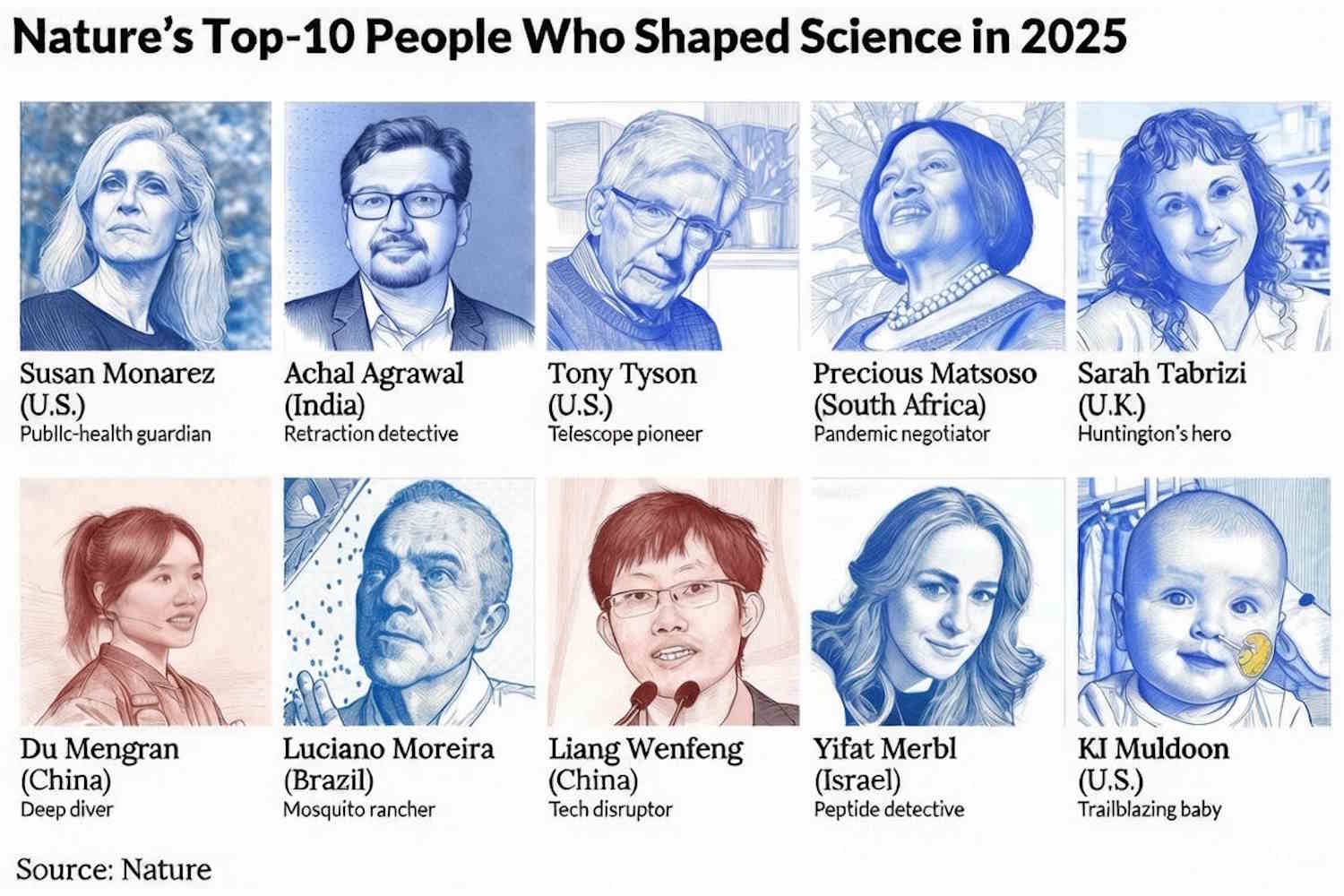
In 2025 the line between political decisions and the scientific method appeared thinner than usual. In the United States, the reduction of federal funding and interference in public agencies had immediate effects. The story of Susan Monarezremoved after a few months from the guidance of the Centers for Disease Control and Prevention, has become emblematic. His refusal to endorse vaccine recommendations without a full analysis of the data showed how easy it is to question the autonomy of science when it becomes inconvenient.
This is not an isolated case, but a broader signal. When scientific evidence is treated as one opinion among manycollective trust in research risks weakening, with consequences that extend to people’s daily lives.
International cooperation as a concrete response to global crises
In a world crossed by conflicts and geopolitical tensions, 2025 has also shown another side of science. The first was approved in April global pandemic treatisedesigned to improve prevention and response to future health emergencies. It is not a perfect agreement and not all countries have participated, but it remains an important step.
It was she who led a long and tiring process Precious Matsosoformer South African health director. His story tells that, even in a fragmented context, evidence-based cooperation can still workif supported by competence and determination.
Scientists who change the way we look at the planet
Many of the stories and above all of the scientists chosen by Nature in 2025 they talk about discoveries that push the boundaries of what we thought we knew. There geoscientist Mengran Dutogether with his team, has identified the deepest ecosystem ever observed capable of hosting forms of animal life. It is located in an ocean trench north-east of Japan, where life does not depend on sunlight, but on chemical reactions linked to methane that seeps from the seabed.
It is a discovery that has no immediate consequences, but which reminds us of an often overlooked truth: the planet we inhabit is still largely unknown and understanding it better is a necessary condition to truly protect it.
From artificial intelligence to public health
2025 was also the year that artificial intelligence continued to evolve at a rapid pace. Among the selected stories is that of Liang Wenfenglinked to the development of DeepSeek-R1, an AI model capable of competing with the most advanced systems, but with lower costs and a more open approach. A signal that the future of AI is not written only by large Western companies.
Other stories speak of a direct impact on health and the environment. In Brazil, the entomologist Luciano Moreira contributed to the spread of a strategy that uses the Wolbachia bacterium to reduce the ability of mosquitoes Aedes aegypti to transmit viruses such as dengue. In Israel, the biologist Yifat Merbl showed that the proteasome, a long-known cellular structure, also plays a key role in immune defenses, opening up new perspectives in the fight against infections.
2025 was also the year of Achal Agrawalresearcher who brought to light the high number of scientific articles withdrawn by some Indian universities. An uncomfortable job, which had a personal price, but which put an often forgotten principle back at the center: the credibility of science also depends on the ability to correct its errors.
Among the stories selected by Nature there is also that of Tony Tysonthe physicist who had a clear vision when it still seemed unachievable. He is the main creator of the new Vera Rubin Observatorya tool destined to change the way we observe the Universe.
In 2025 the telescope became reality, opening new possibilities for the study of dark matter and cosmic evolution. A silent reminder: Basic research, even when it seems distant from everyday life, builds the future piece by piece.
2025 was also a crucial year for research on Huntington’s diseasea devastating neurodegenerative disease. Neurology Sarah Tabrizi is leading some of the most advanced clinical trials to find an effective therapy.
His work does not promise immediate miracles, but it represents one of the most concrete hopes for thousands of familiesdemonstrating how perseverance in clinical research is critical, even when results take time.
In the field of biology, Yifat Merbl discovered that the proteasome, a cellular structure long considered only a “disposal” system, actually has an active role in immune defenses. A discovery that changes the way we look at the most intimate functioning of cells.
Ideally closing the list is a story that has gone around the world. KJ Muldoonat just six months old, received the first hyper-personalized CRISPR gene editing therapy. A unique treatment, tailor-made for your genetic heritage.
This child’s smile has become the symbol of a medicine that is no longer just experimental, but profoundly humancapable of adapting to the individual person. It’s not yet a solution for everyone, but it points a clear direction.
Ten stories that tell why science should be supported, not hindered
Taken together, the ten stories in the ranking of Nature they tell a very simple thing. Science works when it is free to move, collaborate and share knowledge. It works when people can study and work across borders, without politics becoming a constant obstacle.
2025 was not a year to idealize. But it has been a year that has shown, clearly, what we risk losing when research comes under pressure. And why, precisely for this reason, it is still worth defending.
