
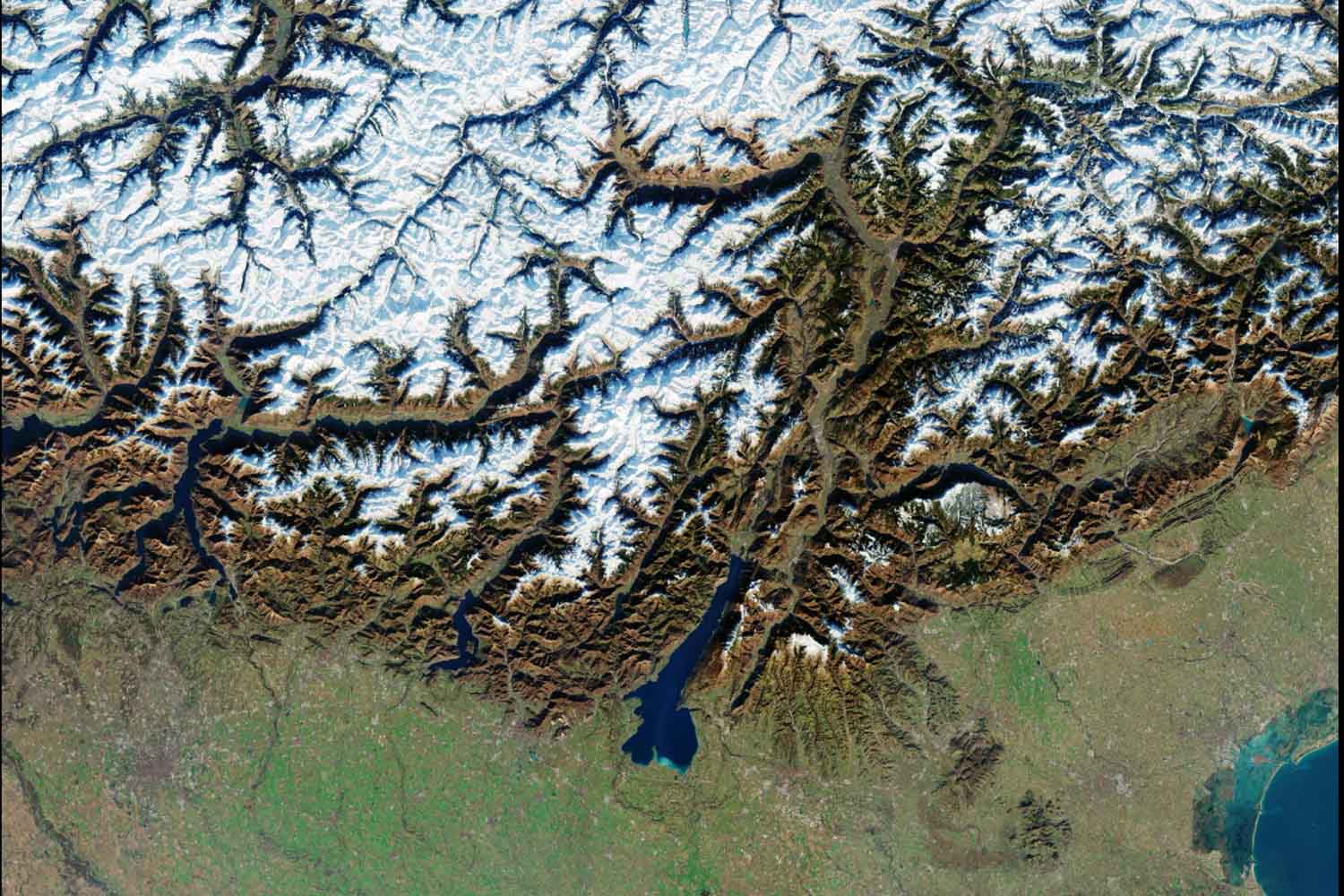
We have become accustomed to looking at the 2026 Winter Olympics with eyes focused on the slopes, on the athletes, on the medals. But you just need to look up – much higher – to realize that this edition tells something even bigger.
The images of the mission Copernicus Sentinel-2developed byEuropean Space Agencyshow Northern Italy as a living map. A territory that stretches from the snow-capped Alps to the Venetian lagoon, uniting nature and city in a single breath.
The 2026 Winter Olympics cross a vertical Italy
The upper part of the image is dominated by the Alps. White ridges, deep shadows, valleys that look like cracks in the rock. That’s where many of the races are concentrated: between Cortina d’Ampezzo, Bormio, Livigno, Anterselva, Predazzo And Tesero.
Cortina, which already hosted the Games in 1956, returns as a protagonist nestled in the Dolomites, recognized as a World Heritage Site byUNESCO. From above it appears small, almost fragile compared to the majesty of the mountains that surround it. And perhaps this is precisely the strongest sensation: the scale of things changes. Human structures seem like details, nature becomes the protagonist again.
These Olympics do not have just one center. They move. They are distributed. They follow the geography of a complex territory. It is a choice that says a lot about our country, made up of villages, valleys, medium-sized cities and metropolises that coexist just a few kilometers away.
Milan, Verona and the lagoon: sport framed by history
Going down towards the plain, the image becomes denser. The urban plot of Milan it is immediately recognisable. Just below the Alps, the stadium stands out San Siro Stadiumwhere the opening ceremony was held. A gray rectangle immersed in a pulsating city.
In the center shines the deep blue of Lake Gardathe largest Italian lake. Seen from space it is an intense, almost hypnotic stain that interrupts the geometry of the plain.
Further east there is Veronachosen for the closing ceremony. THE’Verona Arenaan ancient Roman amphitheatre, will also host the opening of the Winter Paralympics on 6 March, fifty years after the first edition. A thousand-year-old space that continues to change function without losing identity.
And finally, in the eastern corner of the image, the Venice lagoon. A turquoise crescent opening onto the Adriatic. The islands seem suspended, delicate. It is impossible to look at it without thinking of its fragility, of the complex relationship between major events, tourism and environmental protection.
The 2026 Winter Olympics seen from space teach us a simple lesson: everything is connected. The mountains, the cities, the lakes, the coast. Sport becomes a line that crosses different landscapes and communities. From orbit, no controversy or medals can be seen. You can see an entire territory. And perhaps this is the point of view we should adopt more often: the one that reminds us how small we are, and how great the responsibility is to protect what surrounds us.
