
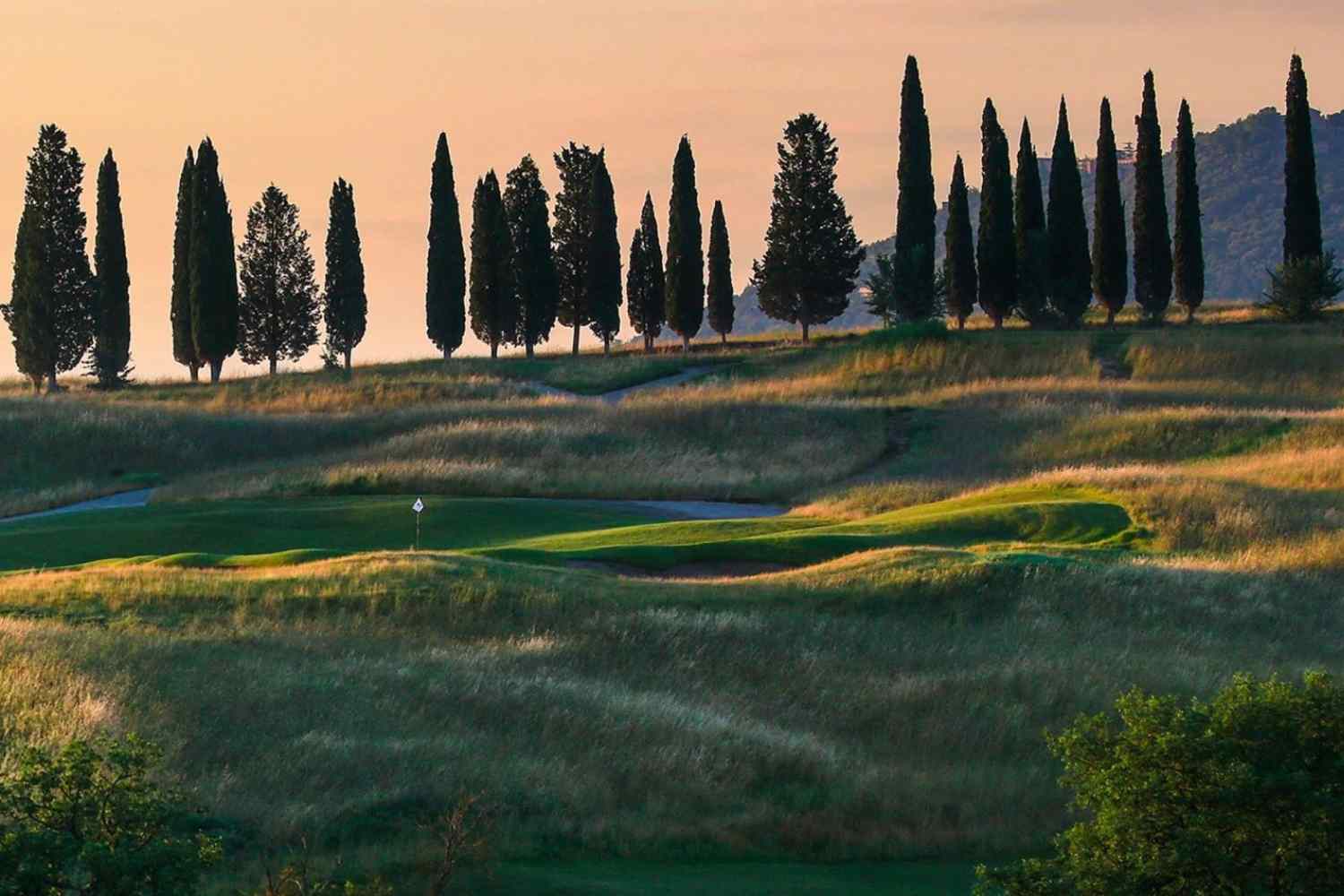
The Grandi Giardini Italiani Guide has existed since 1997 and every year updates a map of around 150 green places distributed in twelve regions. The 2026 edition adds five, all different in geography, vocation and history. Not just simple walking parks: places where nature, art and memory intertwine in surprising ways.
Ca’ del Bosco — Erbusco, Franciacorta
In a winery in Franciacorta you expect well-kept vineyards and technological cellars. There is also this at Ca’ del Bosco, but the property founded by Maurizio Zanella in the Seventies has developed a second, equally serious identity over time: that of a permanent art space en plein air. Works by Arnaldo Pomodoro, Igor Mitoraj and Cracking Art coexist among the rows, in a dialogue between sculpture and agricultural landscape that is rarely found elsewhere. Since 2023, the Ca’ del Bosco Sculpture Prize has added a further chapter, reserved for Italian artists under 40 who work on a large scale outdoors. In the historic vineyards, twenty-three totems created by students of the SantaGiulia Academy of Fine Arts in Brescia tell the story of the company’s relationship with the care of the soil. Wine, here, is just one of the languages.
The Limonaia del Castèl — Limone sul Garda
Limone sul Garda owes its name to this cultivation, and La Limonaia del Castèl is one of the very rare remaining examples of an original structure still functioning. Built in the eighteenth century at the foot of the Mughéra mountain, it develops on terraces held together by dry stone walls and hosts over one hundred plants including lemons, oranges, cedars and chinotti, cultivated as they did centuries ago. Restored and reopened in 2004, it is also an open-air museum: the story of the limonaï – the local growers – is told through objects, videos and panels, while the water channels and stone shelves for the winter coverings remain in place like architectural documents. There is something specific about this place: the feeling of agriculture kept alive not out of nostalgia, but out of conviction.
View this post on Instagram
Castiglion del Bosco — Montalcino, Val d’Orcia
Two thousand hectares in the heart of the Val d’Orcia, a UNESCO heritage site, with sixty-two hectares of organic vineyards, a winery that produces Brunello and Rosso di Montalcino, a five-star Rosewood resort with forty-two suites, eleven private villas and a two-Michelin-star restaurant.
Castiglion del Bosco is not a garden in the conventional sense: it is an estate that has transformed landscape management into both a cultural and productive project, where every element – from the vineyard to the forest, from the restaurant to the spa – is thought of as part of a single vision. Ancient and contemporary do not contradict each other here.
Villa La Quiete — Treia, Marche
Also known as Villa Spada, this residence in the Marche tells the story of Lavinio de’ Medici Spada, a figure of the Risorgimento with a passion for botany who left traces still legible in the park. The restoration followed a precise criterion: bringing the gardens and collections back to the form documented in the 1854 Catalogue, with orchards, a historic rose garden with over four hundred varieties and a forest of centuries-old holm oaks. The elliptical parterre with central fountain and the Neo-Gothic greenhouse reopened to visitors make up a landscape that is rarely encountered in the Marche hinterland. Villa La Quiete is municipal property – which means accessible – and is one of those places that you discover almost by chance and then remember for a long time.
View this post on Instagram
Trevelyan Park — Taormina, Sicily
The public garden of Taormina bears the name of its creator: Lady Florence Trevelyan, a Scottish noblewoman who arrived in Sicily in the second half of the nineteenth century with an obsession for botany and an uncommon aesthetic sensitivity. The result is a place that is difficult to classify: palm trees and tropical plants coexist with eclectic structures that Lady Florence called “beehives” – beehives – built on top of ancient farmhouses, with arches, turrets and openwork parapets of oriental inspiration, where the guest took tea with a view of Etna. Having become public after his death, the park has retained that original strangeness that makes it unique: it is not the garden of a Sicilian city, it is the garden of a woman who looked at the world from Taormina with a look all her own.
View this post on Instagram
