
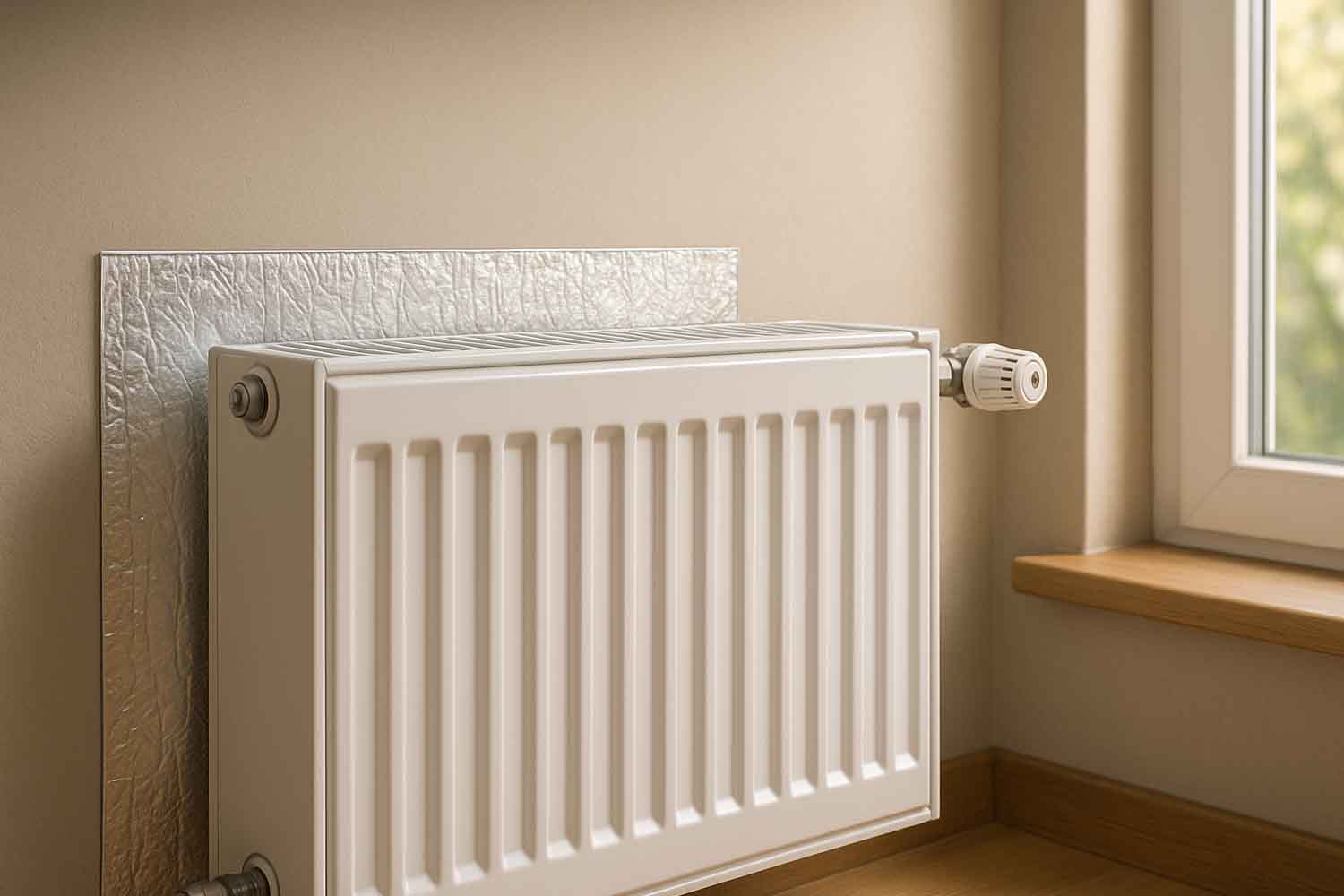
The famous trick of the aluminum foil behind the radiator spans generations as one of those solutions handed down in condominiums together with the number of the best plumber in the neighborhood. But does it really work? Or are we faced with one of the many domestic myths that survive only thanks to the strength of tradition?
The answers come from technical studies, real measurements and analyzes which, finally, allow us to escape from superstition and bring order between what really warms and what, instead, only warms the imagination.
Why the aluminum foil trick can work
The idea is simple: place a reflective material behind the radiator to prevent the heat from being absorbed by the wall, especially when it is an external wall. It’s not magic, but elementary physics: aluminum does not “create heat”, if anything it prevents the wall from capturing part of the heat emitted by the radiator.
Studies tell us that this trick was not born as an urban legend at all. Some research – such as that published in IEEE Xplore – has shown that, in conditions of poorly insulated walls, a reflective panel can significantly reduce dispersion towards the outside. In the worst cases, energy savings are even close to 9%.
Another older analysis, but fundamental for understanding the thermal dynamics, finds a reduction in heat loss through the wall of approximately 30% after the insertion of a metal foil behind the radiator. A notable variation, which however only concerns the portion of heat directed towards the wall, not the entire heating system of the room.
The crucial point is precisely this: radiators heat mainly through convection, that is, through rising hot air, not through radiation. The reflective sheet only acts on the radiation, so its contribution cannot revolutionize the efficiency of the system. A little help, often useful, especially in old houses or with cold external walls. But without miraculous effects.
The problem arises when improvised solutions are used. Simple kitchen foil does not have the characteristics of professional heat-reflecting panels and tends to wrinkle, oxidize, peel off and quickly lose effectiveness. Not to mention that, if the wall is already insulated or the radiator is installed on an internal wall, the benefit is almost imperceptible.
What to expect
Experts agree: the aluminum foil trick is useful when the house has unresolved leaks. In buildings built before the most stringent energy standards, where the external walls function more as sinks than as protections, a reflective panel can bring some of the heat that would be lost back into the room. In practical terms, we often talk about an overall improvement of close to 5–10%, a modest but concrete value if we consider the minimum expenditure required.
The trick loses its effectiveness in modern contexts: well-insulated homes, internal walls or already optimized heating systems. In these cases the reflective panel becomes little more than an invisible ornament.
The psychological aspect must also be considered: many people place great expectations in such a simple intervention, imagining a clear cut in their bill. Studies instead bring us back to a less romantic but more reliable truth: it is an accessory aid, not a structural solution.
The real leap in quality comes with interventions such as thermal insulation, high efficiency fixtures and correct balancing of the system. But while waiting to face important expenses, a heat-reflecting panel can become a small intelligent gesture, especially when the budget is limited and winter knocks loudly on the windows.
Bonna Reflective Film for Radiators, 5 m x 0.6 m x 3 mm, Insulation, Rear Insulation
You might also be interested in:
