
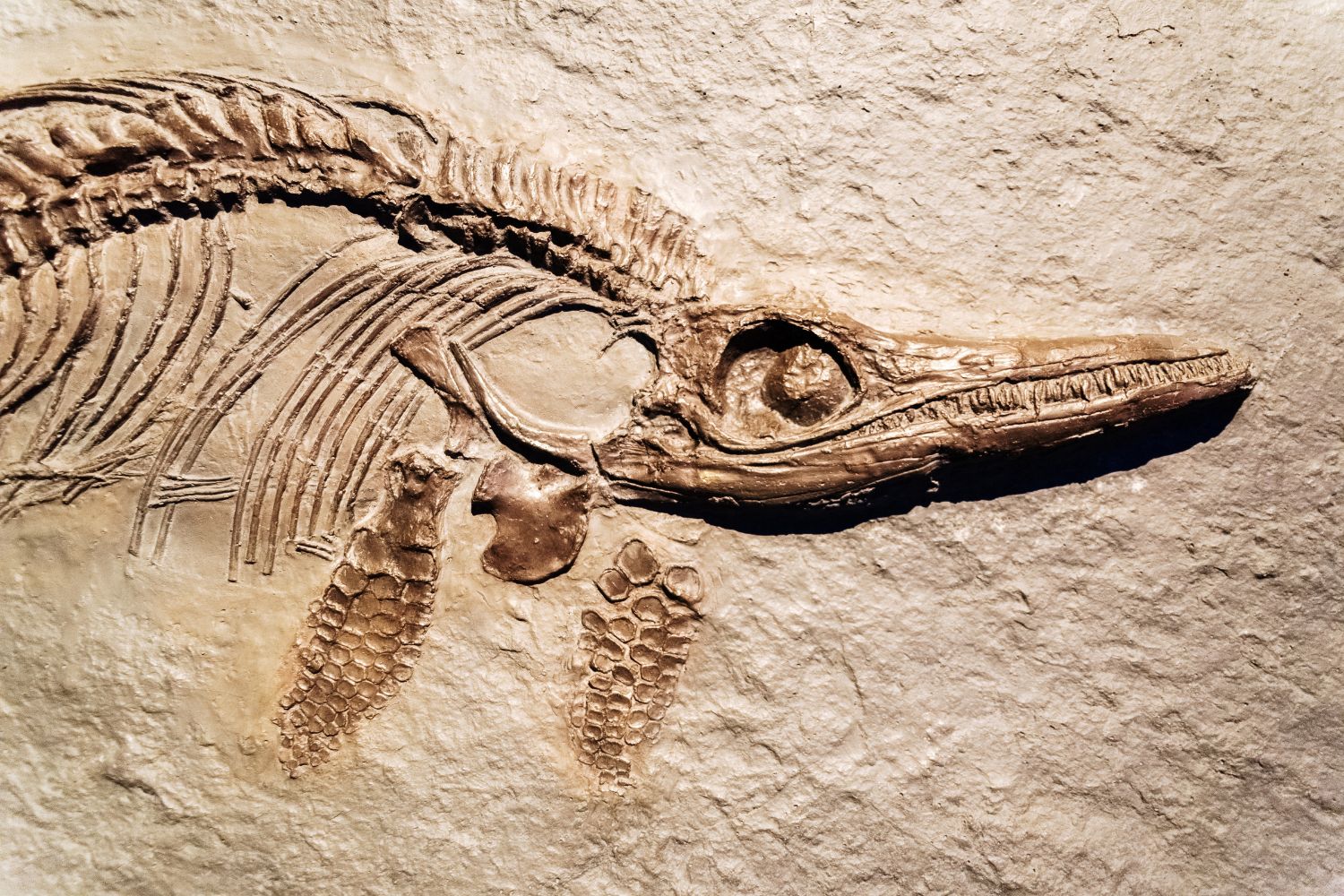
An ichthyosaur vertebra, more than 100 million years old, ended up in a Roman grave in Colchester along with a toilet spoon and some animal bones. It was the 2nd century AD and someone had already found it, collected it and taken it with them. Paleontology did not yet exist. Collecting strange things, evidently, yes.
The find was described in the magazine Britannia by Patrick S. Spencer, Adam N. Wightman and Laura EA Pooley, archaeologists of the Colchester Archaeological Trust. According to the authors, it is the first ichthyosaur fossil found in a Roman deposit and the oldest known case of intentional acquisition of a remains belonging to these marine reptiles. Primacy, as often happens, needs all the words in the sentence.
A vertebra definitely out of place
©Spencer et al. 2026
The grave was discovered on the site of the former Essex County Hospital, along Lexden Road, in Colchester, a town which in Roman times was known as Camulodunum. The deposit dates back to the third quarter of the 2nd century AD and also contained a ligulaa thin teaspoon used to scoop cosmetics, medicines, or other substances from small containers, as well as a diverse group of animal bones.
The presence of such different objects could indicate a organized depositionperhaps linked to some ritual practice. Could be. Archaeologists keep open a much less solemn explanation: the vertebra was simply a curiosity, preserved because it was unusual and then thrown away with the rest. Two thousand years ago you could pick up something because it was beautiful, strange or incomprehensible without having to fill out a museum form.
The fossil does not appear to come from around Colchester. The greenish matrix remaining attached to the bone refers to the east coast of Kent, probably the stretch between Folkestone and Hythe. It may have been found on the beach, at the foot of an eroded cliff, or during the extraction of the so-called Greensanda sandstone also traded in Roman Britain. He would then travel to Colchester. No one carries just any stone that distance, especially when the stone has the obvious shape of a vertebra.
The ichthyosaur was not a dinosaur
In the story of the discovery, the word “dinosaur” has already appeared, useful to attract the eye and wrong to describe the find. Ichthyosaurs were marine reptilesbelonging to an evolutionary lineage distinct from terrestrial dinosaurs. Their ancestors returned to the water more than 250 million years ago and over time developed streamlined bodies, fins and a profile similar to that of dolphins. A resemblance produced by adaptation to life at sea, without any close relationship with cetaceans.
From the vertebra alone it is not possible to precisely establish the species or reconstruct the dimensions of the animal. Scholars have identified it as a vertebral center probably caudal, therefore belonging to the posterior part of the column. Whoever picked it up couldn’t have known any of this. In front of him was a bone turned to stone, belonging to a creature much larger than the animals he knew. To fill in the rest, imagination was enough.
The authors speculate that the fossil may have been linked to Greco-Roman stories of giants, heroes and monstrous creatures. The large bones emerging from the ground were sometimes interpreted through mythology, the only catalog available for animals that disappeared millions of years before the appearance of humans. The other possibility remains more domestic: someone found that object interesting, took it home and kept it. The earliest paleontological ornament from Roman Britain, with many question marks and no surviving shelves.
The primacy must be kept on a leash
The discovery does not prove that “ancient Romans” were the world’s first fossil collectors, nor that there was a fashion for sea monster bones in the Empire. It documents the behavior of at least one person who lived in Roman Britain: that vertebra was deliberately acquired and retained for a period impossible to establish.
There is much older evidence of humans being interested in fossils. At the site of Mycenae, Greece, researchers have identified a fossilized bone of a large mammal, probably a rhinoceros, transported to the citadel during the Bronze Age. The find dates back to the 13th century BC, over a millennium before the Colchester pit. The Roman fossil therefore holds a more precise record: it is the oldest known ichthyosaur collected intentionally. Less universal, much more correct.
Another possible comparison comes from Cambridge, where in 2023 a Roman-era pit yielded a fossilized vertebra attributed to a plesiosaur. The case is cited by the same authors of the Colchester study, but the context and intentionality of the collection must be assessed separately. Two vertebrae do not turn Britain into a club of paleontologists seventeen centuries early. However, they show that these objects could be recognized as special and removed from the land.
We won’t know if that vertebra was a relic, evidence of a monster, or just an object too strange to leave on the ground. We know that someone collected it, traveled it and preserved it. Paleontology would arrive many centuries later. The instinct to take home something inexplicable was already well underway.
